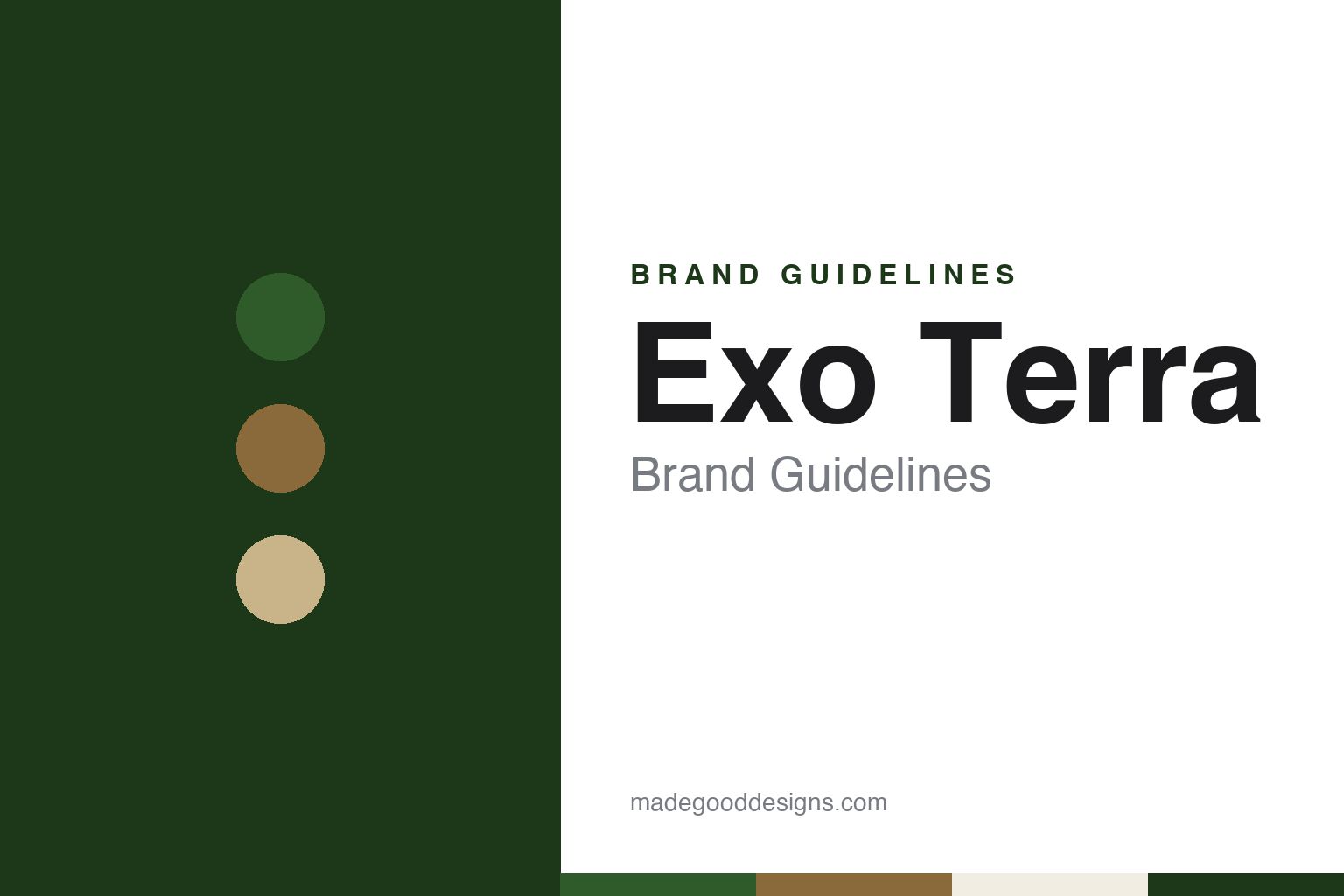
Exo Terra Brand Guidelines
The Hagen Group’s reptile brand, launched 2000.
Aa
Two constants: a rainforest green, bark and sandstone palette and a bold grotesque sans register. Abstract homage — not an Exo Terra product or mark; no terrarium, lamp, logo or label is reproduced.
A reptile brand from a family company
Montreal ownership, a launch in 2000.
Exo Terra belongs to Rolf C. Hagen Inc., the Montreal pet-products company now known as the Hagen Group. The footer of the brand’s own website describes it as “a division of Rolf C. Hagen Inc.”, and its about page calls it a division of “a family-run enterprise founded in 1955 by Rolf C. Hagen.” The Hagen Group’s timeline says the German-born founder arrived in Canada that year and registered his company soon after. The timeline says he began by sourcing bird seed on the Canadian prairies to export to Germany, and that his brothers joined him in Montreal, Dieter in 1959 as head of sales and Horst in 1963 as head of purchasing.
The same timeline gives the brand’s start. It lists 2000 as the year “Exo Terra launches,” and describes the brand as committed to “providing innovative, nature-inspired habitat solutions” for reptiles and amphibians. The cat brand Catit appears one year earlier, in 1999, on the same page. An archived copy of exo-terra.com held by the Internet Archive shows the site online by August 2002, when its home page linked to a product catalogue in PDF form.
Exo Terra arrived in a company that already had decades in the hobby. The Hagen timeline records the aquarium brand Fluval in 1975 and offices in the United Kingdom and France in the 1980s; it also records a warehouse and office opened in Malaysia in 2002, which the company describes as the base for sourcing many of its key product lines. Before that, the timeline says, Hagen Industries had begun making wire cages and glass aquariums in 1974. The group’s brands page today sets Exo Terra beside Fluval, Catit, HARI, Laguna and Nutrience.
Colour
A Base Camp in Mechelen.
Much of the brand’s development has taken place in Belgium. The trade magazine PET worldwide, in its February 2013 issue, reported that “the heart of the ‘Exo Terra’ reptile brand beats in Mechelen,” at what the company calls the Exo Terra Base Camp. The magazine described Emmanuel van Heygen as the originator of the brand and reported that he had moved from Canada to Belgium three years earlier, which led to the Mechelen base. It named the rest of the team as Guy van Heygen, Thomas Merckx and Rik van Tiggel, and described their interests: Emmanuel van Heygen in chameleons and geckos, Rik van Tiggel also in chameleons, Thomas Merckx in frogs, while Guy van Heygen ran the photo studio.
According to the same report, the whole research and development process, from first idea to final approval, took place in Mechelen, and long-term trials of products such as lamps and heat mats lasted between a year and eighteen months. The team kept living terrariums in its own offices rather than in separate laboratories, the magazine said, and the Base Camp ran a photo studio producing expedition videos and product advertising. For a design guide the most useful detail is that, as PET worldwide put it, product packaging was also designed at the Base Camp, alongside the development of the products themselves.
The Hagen Group’s brands page presents each of its names with a line of its own, and Exo Terra’s is the one its website also uses as a slogan. The site’s about page describes the brand’s staff as a team of “consummate experts” who study and keep reptiles and amphibians, and it sorts the catalogue under single words: terrariums, lighting, heating, substrates, hydration, decoration, nutrition, accessories and spare parts.
Typography
Design and documentation.
The seven brands in this group are all reptile and terrarium names: Exo Terra, Zoo Med, Arcadia, Komodo, Lucky Reptile, Fluker’s and Pangea. Reptile-care brands in general sit at many different points in the pet trade, from businesses that still carry a founder’s hobby in their story to labels that now belong to much larger pet-products groups, and a single brand can be sold everywhere from a specialist reptile shop to a general pet chain.
A reptile-care brand’s identity is usually carried less by a single product than by a name, a pack and the kind of keeper it speaks to, because the company behind the name may have changed hands, moved its production or grown far beyond the place where it started. That makes the questions behind each name worth asking plainly: who started it, who owns it now, and where its lamps, enclosures and foods are actually made.
Each guide separates what independent sources record from what the company says about itself — its founding story, its owners over time, where its products are made and how its packaging has changed — and marks plainly what rests only on the company’s own word.
Aa
A bold grotesque sans for a brand built on habitat equipment. (Specimen set in Archivo, a sans STAND-IN; NOT the Exo Terra logo.)
Exo Terra
“Make your reptiles feel at home.”
The brand speaks in one line. Both the Hagen Group’s brands page and Exo Terra’s own site carry the slogan “Make your reptiles feel at home,” and the brand’s statement of values, updated in October 2024, says it aims to enrich “the lives of reptiles and amphibians through innovative, high-quality habitat solutions” and to “educate and empower pet owners.” Among its stated values, the company says it continually strives “to push the boundaries of design and technology.”
The terrarium range shows how the brand names its products. Exo Terra’s site groups them as Natural Terrariums, which it calls “the original,” alongside Panoramic Terrariums sold on “180° unobstructed views,” Pro Terrariums and Pro Paludariums, Screen Terrariums and stackable plastic enclosures.
Exo Terra and Fluval share an owner and a family history. The Hagen Group’s timeline says the founder’s son Rolf Hagen Jr. took the lead of the company in 2004, with his brothers Tom and Mark, and that the group moved into a new head office at Baie-d’Urfé, on the western edge of the island of Montreal, in 2006. The brand’s products are sold as part of that group, and its website footer still names the parent company.
For a design guide, Exo Terra shows how a family pet-products group can give a specialist category its own name, slogan and development team. Compare Fluval, the Hagen Group’s aquarium brand, and Catit, launched a year earlier. For this guide we use a rainforest green, bark and sandstone with a sans, an unofficial interpretation; no product or logo is reproduced.
Explore & save
Keep Exo Terra’s identity on hand — save it to a board in the Made Good inspiration library.
Exo Terra identity set
Pin the Exo Terra rainforest green, bark and sandstone palette and the bold grotesque sans register to your own board.


