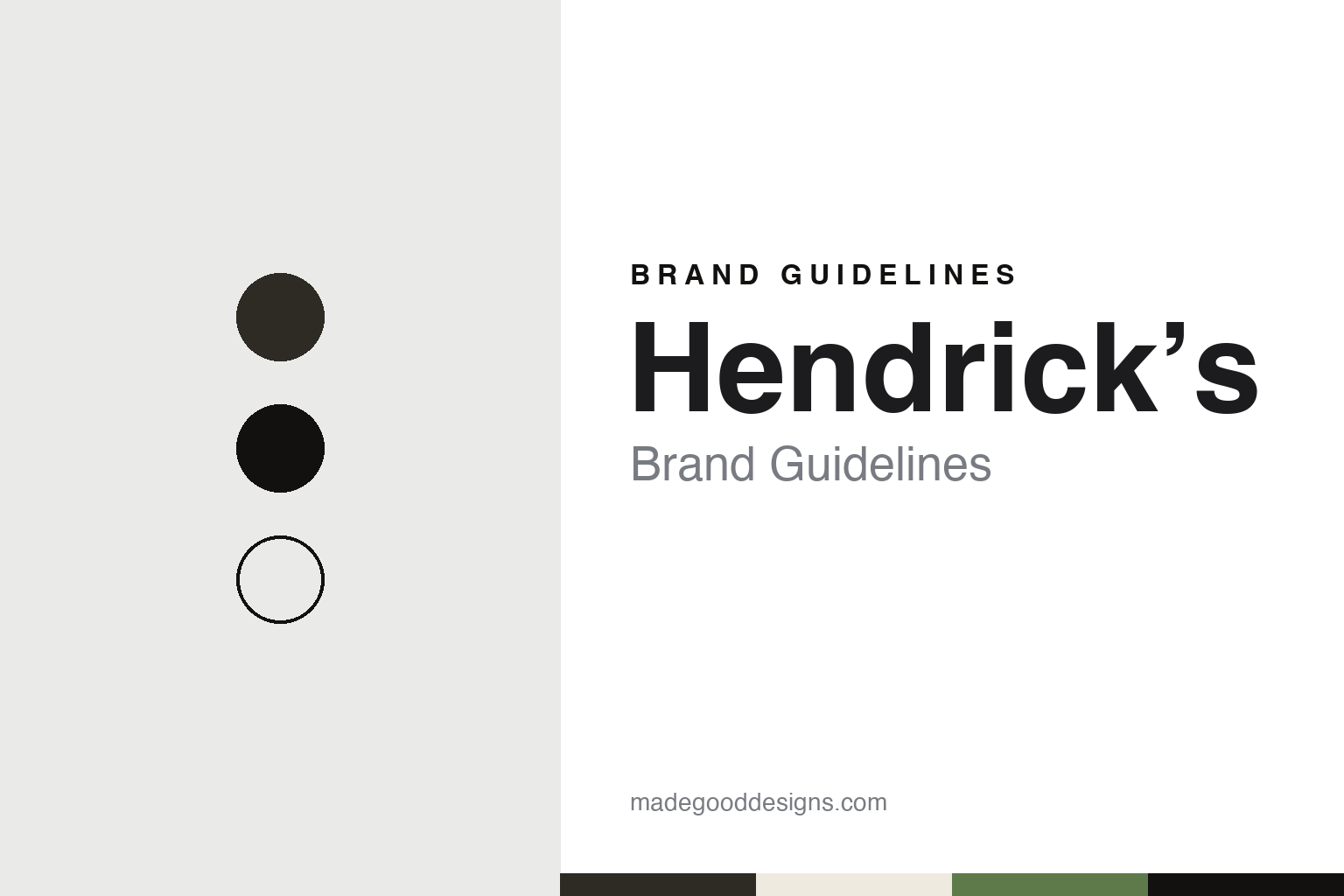
Hendrick’s Brand Guidelines
William Grant & Sons’ rose and cucumber gin from Girvan.
Aa
Two constants: a Hendrick’s apothecary brown, cucumber and rose palette and a Victorian serif register. Abstract homage — not a Hendrick’s product or mark; no bottle, label or logo is reproduced.
Two odd stills
A whisky family’s experiment in gin.
Hendrick’s is a young brand from an old company. It was launched in 1999 by William Grant & Sons, the family-owned Scotch whisky distiller behind Glenfiddich, and is made at the company’s Girvan distillery in South Ayrshire, on Scotland’s south-west coast, according to English Wikipedia and the company. Girvan itself is a grain-whisky distillery, built in 1963.
Its story starts with two stills. In 1966 Charles Gordon, a great-grandson of the founder William Grant, bought a Bennett pot still and a Carter-Head still at auction, Tom Bruce-Gardyne wrote in The Spirits Business in 2014. English Wikipedia dates the Bennett still, made by Bennett, Sons & Shears, to 1860, and the Carter-Head to 1948. The two make very different spirits: the small Bennett still boils its botanicals and gives a heavy, juniper-led spirit, while the Carter-Head passes vapour through a basket of botanicals at the top and gives a lighter, more floral one.
Gin came decades later. The Spirits Business says Hendrick’s was conceived in 1998 as an experimental brand marrying the two spirits. It was developed by Lesley Gracie, a Yorkshire-born specialist in new liquid development at William Grant & Sons, who became its master distiller, with David Stewart. The finished gin blends the spirits from both stills and adds essences of cucumber and rose petals, according to Olivia Williams’s 2014 book Gin Glorious Gin. English Wikipedia lists its other botanicals, including juniper, caraway, coriander, elderflower, chamomile, orange and lemon peel, yarrow, angelica, cubeb pepper and orris root.
Colour
New York first, then the world.
The gin was introduced abroad before it was sold at home. Hendrick’s made its world debut in New York in 2000, launched in the United Kingdom in 2003 and reached Spain a year later, The Spirits Business reported in 2014; David Piper of the company called the New York launch “an experiment that could have gone either way.” English Wikipedia says the Wall Street Journal named it the best gin in 2003.
Its growth is well documented in the trade press. The brand passed 100,000 cases in 2008 and reached 364,000 cases in 2012 across more than 70 markets, The Spirits Business reported in 2014. In June 2018 the same magazine reported that its volumes had risen from 953,000 cases in 2016 to 1.1 million in 2017, putting it in the small group of international gins selling more than a million cases a year.
The range stayed narrow for years. Orbium, in 2017, was the first new gin after the 1999 original, according to English Wikipedia; Midsummer Solstice, in 2019, was the first labelled “From our Cabinet of Curiosities,” and later editions included Neptunia in 2022 and Oasium in 2025. The brand has also made a quinine cordial, Quinetum, launched in 2013, and an absinthe, announced in 2019, The Spirits Business reported.
Its marketing leans on the cucumber. In 2017, The Spirits Business reported, the brand toured a travelling cucumber-slicing device, built a musical instrument from cucumbers and held events for World Cucumber Day; the company recommends serving the gin with tonic and a slice of cucumber instead of citrus.
Typography
Gin and its owners.
The seven brands in this group are all gin brands: Tanqueray, Gordon’s, Beefeater, Hendrick’s, Plymouth, Sipsmith and Monkey 47. Gin brands in general sit at many different points in the trade, from small distilleries that still carry a founder’s name to names that now belong to much larger drinks groups, and a single brand can be sold everywhere from a neighbourhood bar to a supermarket shelf.
A gin brand’s identity is usually carried less by a single product than by a bottle, a label and a name, because the company behind the name may have changed hands, moved its production or grown far beyond the place where it started. That makes the questions behind each name worth asking plainly: who started it, who owns it now, and where its gin is actually distilled and bottled.
Each guide separates what independent sources record from what the company says about itself — its founding story, its owners over time, where its gin is made and how its bottles and labels have changed — and marks plainly what rests only on the company’s own word.
Aa
A Victorian serif — an apothecary’s bottle. (Specimen set in IM Fell English, a serif STAND-IN; NOT the Hendrick’s logo.)
Hendrick’s
A Victorian apothecary’s bottle.
The packaging is the brand’s best-known design. Hendrick’s comes in a dark brown, apothecary-style bottle, English Wikipedia says, and The Spirits Business wrote in 2014 that it was based on an “old Victorian apothecary’s bottle.” The bottle carries the date 1886, which the magazine explained as the year William Grant & Sons was founded in Dufftown; English Wikipedia says work on the Glenfiddich distillery began in 1886 and gives 1887 as the company’s founding year. The later editions changed the glass colour, with dark blue for Orbium and deep purple for Midsummer Solstice, according to English Wikipedia.
The tone is deliberately odd. The company’s website in 2014 described a gin “infused with rose and cucumber in our remote Scottish distillery” and invited readers to join its “Society of the Unusual.” David Piper of William Grant & Sons told The Spirits Business in 2014 that the brand drew on the “eccentricity, nonsense and surrealism” of the Victorian era.
Ownership has not changed. William Grant & Sons is registered at the Glenfiddich distillery in Dufftown, has its operational headquarters at Strathclyde Business Park and its sales and marketing base in Richmond, London, and is run by descendants of William Grant, English Wikipedia says, citing Forbes in 2024. In September 2023 it also bought Silent Pool Distillers, a gin maker in Surrey, The Moodie Davitt Report reported.
For the type on the label, see our separate guide, What Font Does Hendrick’s Use? No official brand colour values are published.
For a design guide, Hendrick’s shows how a bottle and a single garnish can carry a brand: a Victorian apothecary’s shape, and a cucumber where others use lemon. Compare Gordon’s, which The Spirits Business called Britain’s market leader in 2014, and Monkey 47, a gin from Germany’s Black Forest. For this guide we use an apothecary brown, a cucumber green and a rose with a serif, an unofficial interpretation; no product or logo is reproduced.
Explore & save
Keep Hendrick’s’s identity on hand — save it to a board in the Made Good inspiration library.
Hendrick’s identity set
Pin the Hendrick’s apothecary brown, cucumber and rose palette and the Victorian serif register to your own board.