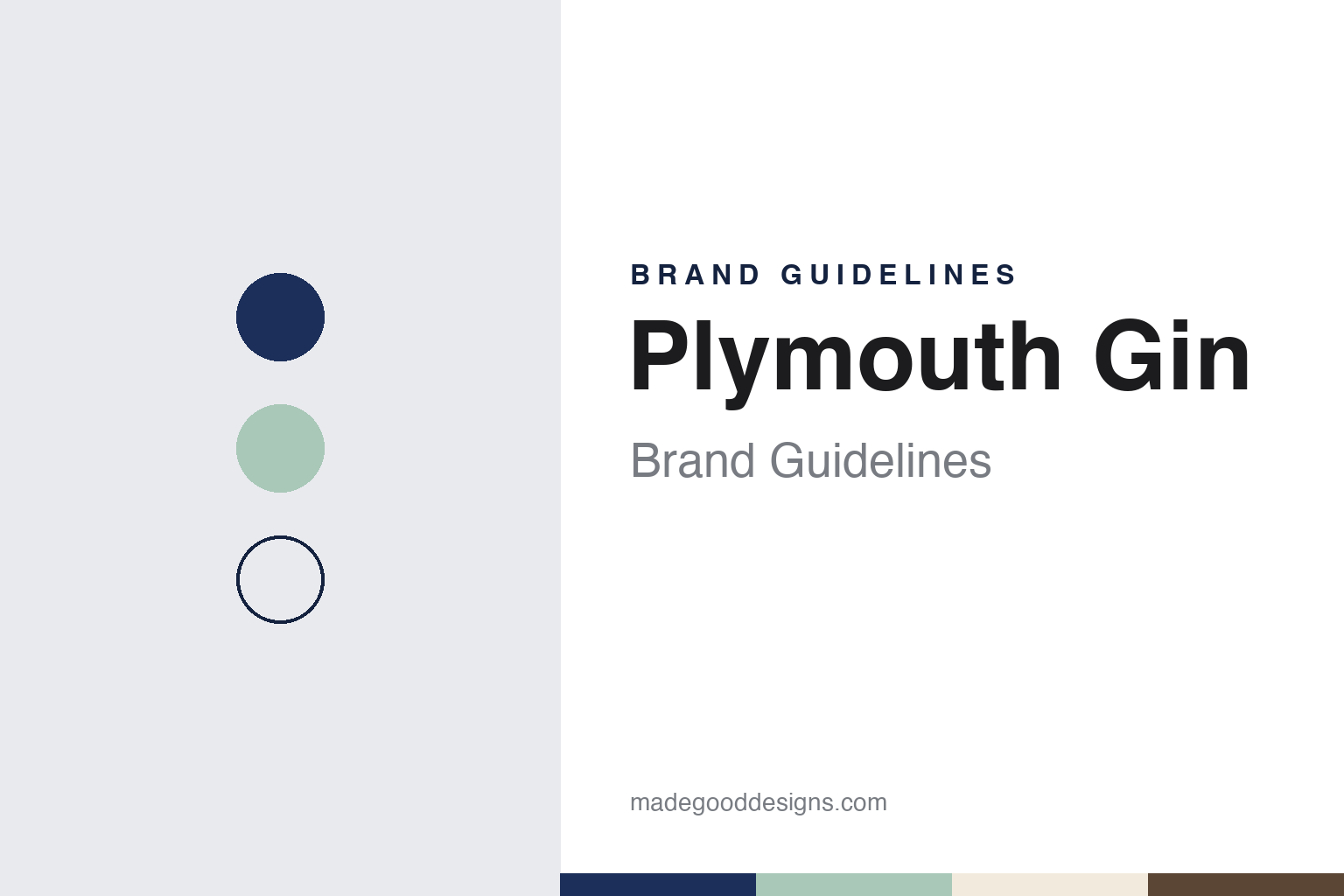
Plymouth Gin Brand Guidelines
The Black Friars Distillery gin made in Plymouth since 1793.
Aa
Two constants: a Plymouth Gin navy, sea-glass and parchment palette and an engraved serif register. Abstract homage — not a Plymouth Gin product or mark; no bottle, label or logo is reproduced.
Black Friars
A distillery on the Barbican since 1793.
Plymouth Gin has been distilled on the same premises on the Barbican in Plymouth, Devon, since 1793, English Wikipedia says. The building is far older: Wikipedia dates it to 1431 and says it is reputed to have once housed a monastery of the Dominican order, the friars known as the Black Friars. That is why the site has traditionally been called the Black Friars Distillery, a name that appears embossed on the bottles. Pernod Ricard, the current owner, describes the gin as handmade at the distillery since 1793 and distilled in a single Victorian copper pot still, with water from Dartmoor, using what it calls the original recipe of more than 200 years ago.
The founding business was the distilling firm Fox & Williamson, which began making the Plymouth brand in 1793, according to Wikipedia. It soon became known as Coates & Co., and kept that name until March 2004. The gin’s reputation travelled with the Royal Navy, which carried it on its ships, Wikipedia says, citing the historian Roderick Phillips. Pernod Ricard puts the claim more strongly: “For almost two centuries, no Royal Navy ship left port without it.” Wikipedia adds that newly commissioned Royal Navy vessels traditionally received a “Plymouth Gin Commissioning kit,” a wooden box holding two bottles of navy-strength gin and glassware, as The New York Times described in 2012.
The gin was a fixture of the cocktail age. Harry Craddock’s The Savoy Cocktail Book of 1930 names Plymouth Gin specifically in 32 of its recipes, by Wikipedia’s count. In 1933, Interbrand’s brandchannel reported in 2001, Plymouth won a trademark case against Beefeater, which had tried to sell a gin of its own under the Plymouth name.
Colour
A monk, a ship and a near miss.
By the 1990s the brand was in trouble. Gin sales had fallen across the board, and Plymouth was down to about 7,000 cases a year, according to a 2001 profile by Robin D. Rusch on Interbrand’s brandchannel; its owner, Allied Domecq, was concentrating on Beefeater, the rival London gin it also owned. Under Allied the gin’s strength had been cut to 37.5%, the profile says.
In 1996 a small management group bought the brand from Allied Domecq. With Charles Rolls as managing director, it relaunched Plymouth in March 1998 as a premium gin. “Without premium branding, our efforts would ultimately have failed,” Rolls told brandchannel. The new packaging re-created the original bottle and brought back the thirsty monk, a mock engraving placed toward the bottom of the bottle; when his feet were dry, the brand’s old motto went, it was time to buy another. The strength went back to 41.2%, and a Navy Strength version at 57% was added as a reminder of the naval connection.
Having turned the business round, the owners sold it in 2005 to the Swedish group V&S, maker of Absolut vodka. English Wikipedia says V&S changed the bottle in mid-2006 to an Art Deco style with the Mayflower on the front, a reference to the Pilgrim Fathers, whose ship put into Plymouth for shelter and repairs before crossing the Atlantic in 1620; local tradition holds that some of them stayed in the building that became the distillery. In 2008 Pernod Ricard bought V&S, and with it Plymouth Gin, which it still owns.
Typography
Gin, place and protection.
The seven brands in this group are all gin brands: Tanqueray, Gordon’s, Beefeater, Hendrick’s, Plymouth, Sipsmith and Monkey 47. Gin brands in general sit at many different points in the trade, from small distilleries that still carry a founder’s name to names that now belong to much larger drinks groups, and a single brand can be sold everywhere from a neighbourhood bar to a supermarket shelf.
A gin brand’s identity is usually carried less by a single product than by a bottle, a label and a name, because the company behind the name may have changed hands, moved its production or grown far beyond the place where it started. That makes the questions behind each name worth asking plainly: who started it, who owns it now, and where its gin is actually distilled and bottled.
Each guide separates what independent sources record from what the company says about itself — its founding story, its owners over time, where its gin is made and how its bottles and labels have changed — and marks plainly what rests only on the company’s own word.
Aa
An engraved serif — the register of an old distillery label. (Specimen set in Playfair Display, a serif STAND-IN; NOT the Plymouth Gin logo.)
Plymouth Gin
A style that became a single brand.
For years Plymouth Gin was also a legal category. Under the European Union’s rules for spirit drinks, “Plymouth Gin” carried a geographical indication; in November 2014 The Spirits Business called it the UK’s only gin with a GI and England’s only protected spirit. Each GI holder had to file a dossier with the European Commission by February 2015, and Pernod Ricard chose not to. “Plymouth is an extremely well known and respected brand of gin, solely produced by our business and its predecessors for over 100 years,” the company said, adding that a GI should represent a group of brands rather than one; the Wall Street Journal also reported the decision. That left Spain’s Gin de Mahón and Lithuania’s Vilnius gin as the EU’s two other gins with a GI, the magazine noted.
Pernod Ricard considers the protection unnecessary because it owns the Plymouth Gin trade name, Wikipedia says, which also describes Plymouth as the only remaining brand of Plymouth-style gin and Black Friars as the city’s only remaining gin distillery. The range includes the original gin at 41.2% and the 57% Navy Strength, and the distillery’s website has listed a sloe gin and a fruit cup. The brand also has a separate font article on this site, What Font Does Plymouth Use?
For a design guide, Plymouth Gin shows how packaging can carry a place: a monk, a ship and an embossed distillery name have each stood for the same building on the Barbican. Compare Beefeater, the London gin that was once its stablemate and rival under Allied Domecq, and Monkey 47, another Pernod Ricard gin. For this guide we use navy, sea-glass green and parchment with a serif, an unofficial interpretation; no product or logo is reproduced.
Explore & save
Keep Plymouth Gin’s identity on hand — save it to a board in the Made Good inspiration library.
Plymouth Gin identity set
Pin the Plymouth Gin navy, sea-glass and parchment palette and the engraved serif register to your own board.