Beefeater Brand Guidelines
James Burrough’s London dry gin, still distilled in Kennington.
Aa
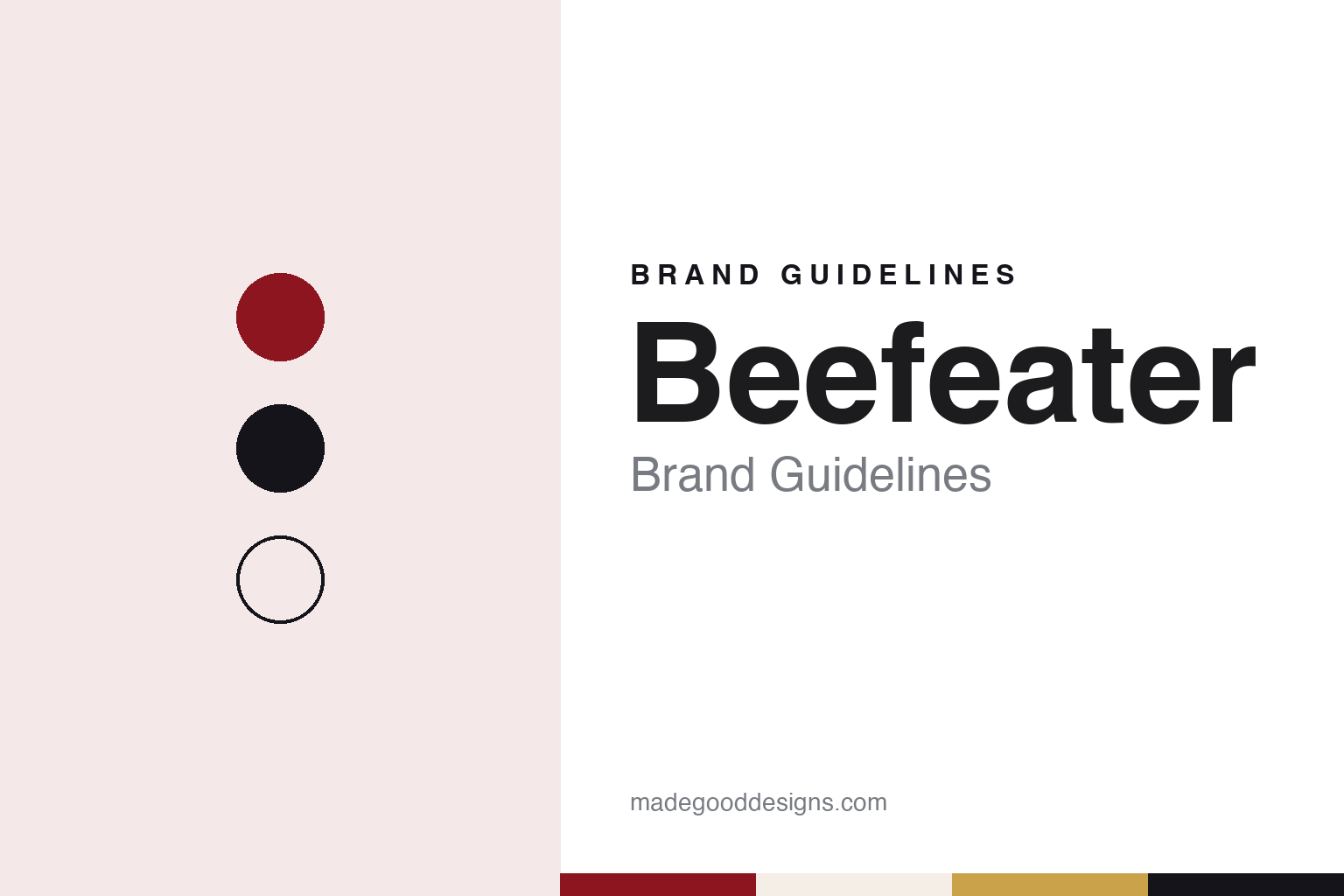
Two constants: a Beefeater red, gold and ink palette and a London serif register. Abstract homage — not a Beefeater product or mark; no bottle, label or logo is reproduced.
Cale Street
A Chelsea distillery and a London dry gin.
Beefeater is a London dry gin with a Victorian founder. James Burrough, who the company says trained as a pharmacist and whose career took him to Toronto, bought a distillery on Cale Street in Chelsea from the rectifier John Taylor. English Wikipedia, citing The Spirits Business, dates the purchase to 1862; the company’s own timeline gives 1863, and the business counts 1863 as its starting point. At first the distillery carried on making the liqueurs, fruit gins and punches of its previous owners, and the company names Fortnum & Mason among its early customers.
Gin took over. Stock lists from 1876, cited by Difford’s Guide, show a growing range of gins sold as Ye Old Chelsea, James Burrough London Dry and Old Tom, and a recipe of botanicals that Burrough named Beefeater. The name refers to the Yeomen of the Guard, the ceremonial bodyguard of the British monarch, whose nickname is “Beefeaters.” By the brand’s own account, a recipe book dated 1895 sets out the nine botanicals still listed today: juniper, angelica root, angelica seed, coriander seed, liquorice, almond, orris root, Seville orange and lemon peel.
The company moved twice as it grew. In 1908 production went to Hutton Road in Lambeth, to a distillery that, the company says, kept the Cale Street name. In 1958 it moved to Montford Place in Kennington, south London, a site the company says was once a military pickle factory. The coppersmiths John Dore & Co. were commissioned to make a larger set of pot stills copying those used at Chelsea, according to Difford’s Guide.
Colour
A gin made in London.
Kennington is still where Beefeater is distilled. The distillery, the company says, is an Edwardian building with a 1950s extension, housing Victorian pot stills and a botanical room, and its gin is made from 100% grain spirit to a recipe “virtually unchanged since the 1800s.” In February 2013 Pernod Ricard announced a visitor centre at the site, BBC News reported. In 2017 The Drinks Business counted 24 gin distilleries operating in London, with Beefeater’s among them.
The company says Desmond Payne became master distiller in 1995 and credits him with Beefeater 24, a version with Chinese green tea, Japanese sencha and grapefruit peel among its botanicals, named after a 24-hour steep before distillation. The company dates its launch to 2008; English Wikipedia gives 2009. Later came Burrough’s Reserve in 2013, made in James Burrough’s original Still No. 12, which holds 268 litres, and London Garden in 2015, inspired by the Chelsea Physic Garden, both by the company’s account. Flavoured gins followed.
In January 2024 Pernod Ricard launched Beefeater 0.0%, an alcohol-free version that first went on sale in Spain, the brand’s largest market, The Spirits Business reported, before reaching 27 markets including Canada, Italy and the United Kingdom. In July 2026 the brand promoted it with “Get More With 0.0,” a campaign by the agency Lucky Generals that recreated the shifting-floor set of Jamiroquai’s “Virtual Insanity” video for its 30th anniversary, The Spirits Business and Shots reported.
The name has a namesake to watch for. Whitbread, the company that once owned the gin, also launched a Beefeater restaurant chain in 1974, English Wikipedia says; the restaurants are a separate business from the gin.
Typography
Gin and its owners.
The seven brands in this group are all gin brands: Tanqueray, Gordon’s, Beefeater, Hendrick’s, Plymouth, Sipsmith and Monkey 47. Gin brands in general sit at many different points in the trade, from small distilleries that still carry a founder’s name to names that now belong to much larger drinks groups, and a single brand can be sold everywhere from a neighbourhood bar to a supermarket shelf.
A gin brand’s identity is usually carried less by a single product than by a bottle, a label and a name, because the company behind the name may have changed hands, moved its production or grown far beyond the place where it started. That makes the questions behind each name worth asking plainly: who started it, who owns it now, and where its gin is actually distilled and bottled.
Each guide separates what independent sources record from what the company says about itself — its founding story, its owners over time, where its gin is made and how its bottles and labels have changed — and marks plainly what rests only on the company’s own word.
Aa
A London serif — a Victorian distiller’s gin. (Specimen set in Playfair Display, a serif STAND-IN; NOT the Beefeater logo.)
Beefeater
From a family firm to Pernod Ricard.
The Burrough family kept control for more than a century. In 1987, under the direction of Norman Burrough, the firm was bought by the British brewer Whitbread, the Associated Press reported in September that year. Whitbread did not keep it long. In December 1989 it agreed to sell its liquor division to Allied-Lyons, the AP reported in The New York Times; the division was made up of James Burrough Distillers, maker of Beefeater gin and Long John Scotch whisky, and the Buckingham Wine Company, an American importer. Allied-Lyons merged with Pedro Domecq in 1994 to form Allied Domecq, and Pernod Ricard completed its takeover of Allied Domecq on 26 July 2005, according to the French group. The company describes 2005 as the start of a programme of reinvestment in the brand. Its website carries the copyright of Chivas Brothers, a Pernod Ricard company.
Its strength has also changed by market. Long sold at 47% in the United States, Beefeater was cut to 44% there in late 2020 and to 40% in 2023, VinePair reported in December 2023.
For the type behind the bottle, see our separate guide, What Font Does Beefeater Use? No official brand colour values are published.
For a design guide, Beefeater shows how a brand can borrow a national symbol and tie it to one place: a London gin named after the monarch’s guard and still distilled in the capital. Compare Plymouth Gin, which Whitbread also owned after buying the distiller Long John International in 1973, English Wikipedia says, and Sipsmith, a newer London distiller. For this guide we use a guard red, a braid gold and an ink with a serif, an unofficial interpretation; no product or logo is reproduced.
Explore & save
Keep Beefeater’s identity on hand — save it to a board in the Made Good inspiration library.
Beefeater identity set
Pin the Beefeater red, gold and ink palette and the London serif register to your own board.