Monkey 47 Brand Guidelines
The Black Forest gin in an apothecary bottle.
Aa
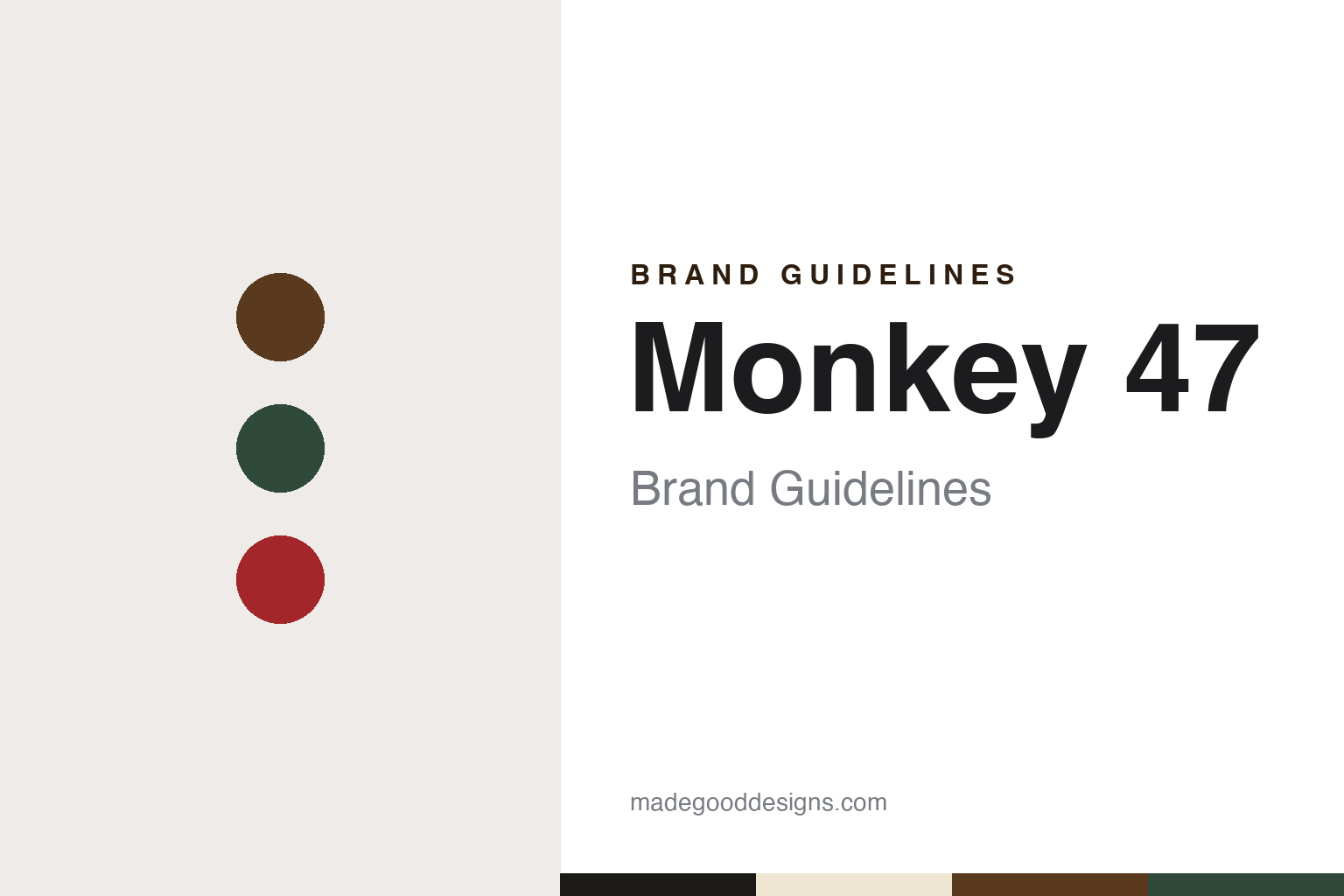
Two constants: an apothecary brown, spruce green and lingonberry red palette and a Victorian engraved serif register. Abstract homage — not a Monkey 47 product or mark; no bottle, label or logo is reproduced.
A gin and a legend
A founder, a forty-seven and a monkey called Max.
Monkey 47 is a gin from Germany’s Black Forest, sold as a Schwarzwald Dry Gin. Its owner, Pernod Ricard, dates its launch to 2010, and the trade magazine The Spirits Business reported in 2021 that Alexander Stein founded the brand in the Black Forest region that year. It is made by Black Forest Distillers in Loßburg, in the northern Black Forest, the company says. The number in the name is a double count: The Spirits Business explained in 2024 that “47” refers both to the number of botanicals in the recipe and to the gin’s strength of 47% ABV.
The company tells its own origin through a story it labels a “founding legend”, not as documented history. In that legend, Wing Commander Montgomery “Monty” Collins of the Royal Air Force was posted to the British sector of Berlin after the war and sponsored a monkey named Max at the Berlin Zoo. He then left the air force, moved to the northern Black Forest to learn watchmaking, and opened a country guesthouse called “Zum wilden Affen” (“the wild monkey”), where he set about making an English-style gin from local juniper and other botanicals. The story, the company says, trails off in the early 1960s.
The legend then jumps forward. Around the turn of the century, the company says, builders renovating the guesthouse found an old wooden box holding a letter, with notes and a description of the recipe’s botanicals, and a hand-labelled bottle with a sketch of a monkey and the words “Max the Monkey – Schwarzwald Dry Gin.” The company presents this as the tale behind the gin rather than as a record.
Colour
A pharmacy decanter, a stamp-like label and a 48th botanical.
The bottle is the brand’s most recognisable asset. The company says it is a custom-made revival of an old pharmacy decanter that Alexander Stein found while out walking with his son, and that its brown pharmaceutical glass was chosen to protect the gin from light, “purely out of concern for quality rather than appearance.” The label is hand-drawn and, in the company’s words, made “like a stamp from the Victorian era,” illustrating episodes from the Montgomery Collins legend. The bottle is closed with a natural cork stopper, the company says.
The recipe, the company says, uses exactly 47 botanicals, among them Black Forest spruce, lingonberries, sloe berries, elderflower and bramble leaves, prepared in water, distilled in batches and matured in earthenware vessels; the gin is not filtered. In its early years the company called Christoph Keller its Master Distiller. Its own blog described Keller in 2012 on his third annual search for a “species rara,” a single extra botanical for a limited Distiller’s Cut of 3,000 bottles; that year’s choice was young spruce shoots gathered in the southern Black Forest. The annual 48th botanical has continued under Pernod Ricard: capers from the Italian island of Pantelleria for the 14th edition in 2024, The Spirits Business reported, followed by salt in 2025 and mushrooms in 2026.
The company says its home is the Schaberhof, a farmstead built in 1840 that Black Forest Distillers bought in 2014, with a distillery named Zum Wilden Affen after the legend’s guesthouse. Limited bottles have widened the visual language. In April 2022 Monkey 47 worked with the Japanese streetwear label A Bathing Ape, fusing what The Spirits Business called Monkey 47’s jungle print with the label’s camouflage on a limited bottle and a capsule of clothing. In November 2024 the same magazine reported a new Sloe Gin bottle made from 95% recycled glass.
Typography
Design and documentation.
The seven brands in this group are all gin brands: Tanqueray, Gordon’s, Beefeater, Hendrick’s, Plymouth, Sipsmith and Monkey 47. Gin brands in general sit at many different points in the trade, from small distilleries that still carry a founder’s name to names that now belong to much larger drinks groups, and a single brand can be sold everywhere from a neighbourhood bar to a supermarket shelf.
A gin brand’s identity is usually carried less by a single product than by a bottle, a label and a name, because the company behind the name may have changed hands, moved its production or grown far beyond the place where it started. That makes the questions behind each name worth asking plainly: who started it, who owns it now, and where its gin is actually distilled and bottled.
Each guide separates what independent sources record from what the company says about itself — its founding story, its owners over time, where its gin is made and how its bottles and labels have changed — and marks plainly what rests only on the company’s own word.
Aa
A Victorian engraved serif for a gin with a stamp-like label. (Specimen set in IM Fell English, a serif STAND-IN; NOT the Monkey 47 logo.)
Monkey 47
From a founder’s brand to Pernod Ricard.
Monkey 47 passed to Pernod Ricard in two steps. The Spirits Business reported in 2021 that Alexander Stein sold a majority stake to the French group in 2016; French Wikipedia, citing Capital, dates the completion of that purchase to March 2016. Pernod Ricard took full ownership in 2020, the same magazine reported. Pernod Ricard says Monkey 47 has been part of the group since 2016. In 2024 The Spirits Business named Gregory Chevillat as general manager of Black Forest Distillers, the company that produces the gin.
Stein has stayed close to the brand. The Spirits Business still quoted him as Monkey 47’s founder in 2024, on that year’s Distiller’s Cut. In 2021 he launched Horse with No Name, a bourbon-based spirit drink, with Pernod Ricard, through a company he set up during lockdown the magazine reported; in 2024 it described him as the third generation to lead Jacobi Spirits, a spirits business whose heritage dates to 1880.
Christoph Keller had a parallel career in design. German Wikipedia describes him as a publisher, book designer and curator who founded the art publisher Revolver in Frankfurt in 1998, taught typography and publishing at the Hamburg art academy from 2003 to 2004, and in 2010 became the first non-Swiss winner of the Jan Tschichold Prize for book design. With his wife he also ran the Stählemühle fruit-brandy distillery in the Hegau; the Stuttgarter Zeitung, which called him “the Monkey 47 distiller,” reported his decision to close it in November 2017, and the Stählemühle website says it shut on 31 December 2018. A separate guide looks at what font Monkey 47 uses.
For a design guide, Monkey 47 shows how a brown apothecary bottle, a stamp-like label and an openly invented legend can give a young gin the look of an old one. Compare Beefeater, Pernod Ricard’s London dry gin, and Plymouth, another gin in the same group. For this guide we use an apothecary brown, a spruce green and a lingonberry red with a serif, an unofficial interpretation; no product or logo is reproduced.
Explore & save
Keep Monkey 47’s identity on hand — save it to a board in the Made Good inspiration library.
Monkey 47 identity set
Pin the Monkey 47 apothecary brown, spruce green and lingonberry red palette and the Victorian engraved serif register to your own board.