Moët & Chandon Brand Guidelines
The Épernay champagne house of Impérial, founded in 1743.
Aa
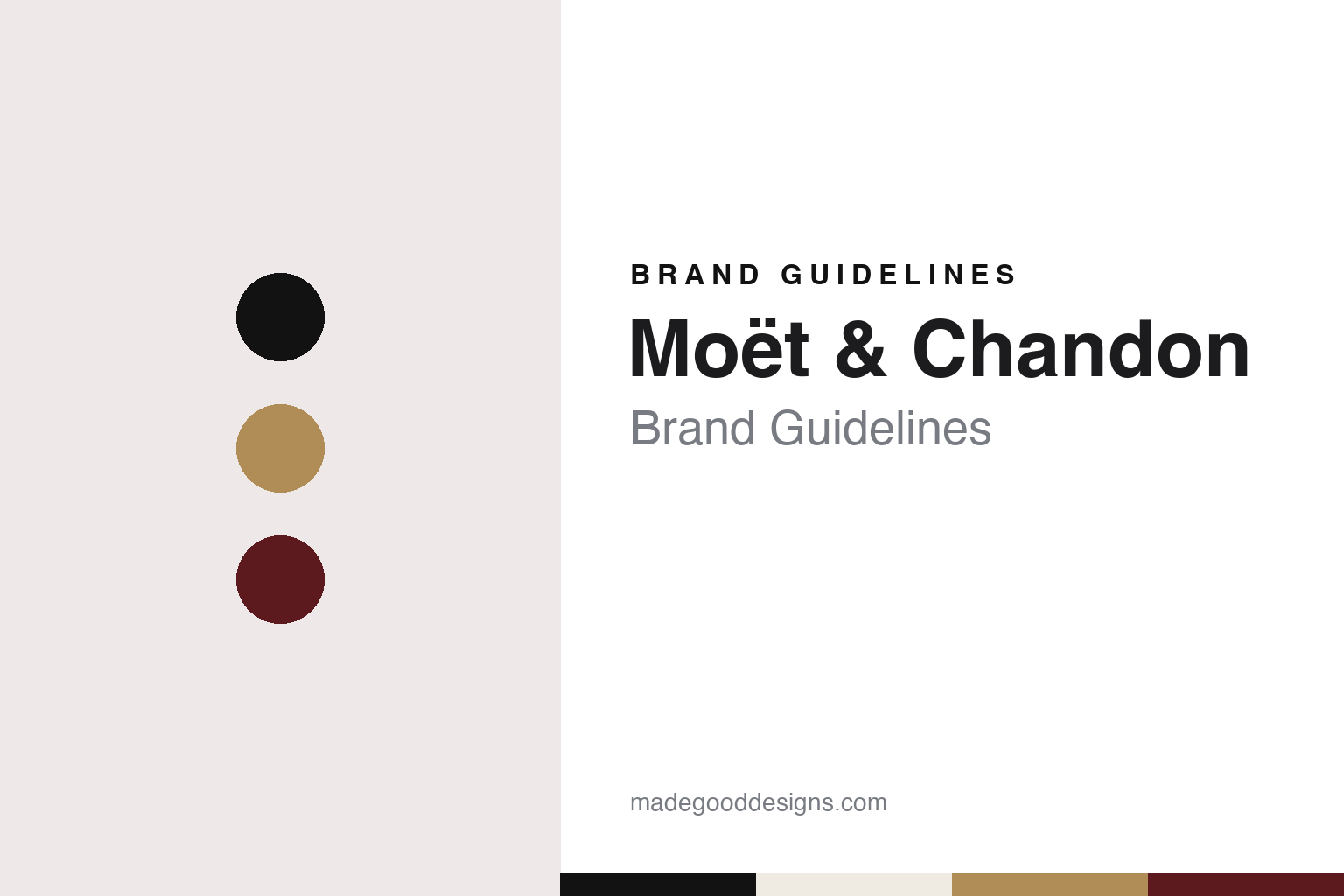
Two constants: a black, chalk, gold and claret palette and a Didone serif register. Abstract homage — not a Moët & Chandon product or mark; no bottle, label or logo is reproduced.
Moët et Cie
A wine trader, a grandson and a son-in-law.
Moët & Chandon began in Épernay in 1743, when the wine trader Claude Moët founded his own house there, English and French Wikipedia say; it traded at first as Moët et Cie. LVMH, which owns it today, says Claude Moët made his champagne among the most sought-after in Europe. The name is pronounced with a sounded “t”: The Telegraph and The Guardian have both explained that the family name is of Dutch or German origin.
The house grew under his grandson. In 1792 Jean-Rémy Moët took over the business and built a new mansion on the road then called the faubourg de la Folie, now the Avenue de Champagne, close to the firm’s cellars and warehouses, French Wikipedia says; LVMH credits him with turning the house into an international brand. Between 1805 and 1807 two pavilions, a pool in the shape of a champagne bottle and an Orangerie were added to the estate, designed by the portrait painter and miniaturist Jean-Baptiste Isabey, according to French Wikipedia.
The double name dates from 1833. That year Jean-Rémy’s son-in-law, Pierre-Gabriel Chandon de Briailles, became a partner in the management of the house, and Moët became Moët et Chandon, French Wikipedia says, citing Michel Refait’s 1998 history of the firm. English Wikipedia adds that Moët marketed its first vintage champagne in 1842 and introduced Brut Impérial in the 1860s; LVMH now calls Moët Impérial, a blend of more than 200 crus, the house’s signature cuvée.
Colour
Art Deco cellars and a monk’s name.
The house’s best-known label beyond its own name came from a neighbour. The Dom Pérignon name, owned by Champagne Mercier, was given to Moët in 1927, English Wikipedia says; the first vintage, 1921, went on sale in 1936. It was the first prestige cuvée, an idea the wine writer Tom Stevenson credited in Decanter in 2007 to an Englishman, Laurence Venn. See the Dom Pérignon guide for that story.
Moët & Chandon’s architecture has been recognised by the French state. Its Art Deco production centre in Épernay, built between 1928 and 1932 by Henri Piquart and Brunoy de Maigret at the initiative of Jean-Rémy Chandon-Moët, received the “Architecture contemporaine remarquable” label in 2015, according to the culture ministry’s heritage database. A new winemaking centre at Mont-Aigu, in Oiry, built between 2011 and 2018 to designs by Giovanni Pace, received the same label in 2023. LVMH says the house’s cellars run for more than 28 kilometres.
Its public image has long been built through sport and culture. English Wikipedia says Moët supplied the champagne for Formula One podiums from 1966 to 1999, again in 2016 and 2017, and once more from the 2025 season; the tennis player Roger Federer became a brand ambassador in November 2012, and in September 2015 the house announced a sponsorship of the McLaren team from 2016. The house’s own site now promotes collaborations with Pharrell Williams and the artist Daniel Arsham, who made a Collection Impériale creation, LVMH says. The name turns up in culture too, from Pushkin’s Eugene Onegin to Queen’s “Killer Queen,” whose heroine keeps her Moët et Chandon in a pretty cabinet. English Wikipedia says the house held a royal warrant as champagne supplier to Queen Elizabeth II.
Typography
Design and documentation.
The seven brands in this group are all cognac and champagne names: Rémy Martin, Martell, Courvoisier, Moët & Chandon, Veuve Clicquot, Dom Pérignon and Bollinger. Cognac and champagne brands in general sit at many different points in the trade, from family houses that still carry a founder’s name to names that now belong to much larger drinks groups, and a single brand can be sold everywhere from a wine merchant to an airport shop.
A cognac or champagne brand’s identity is usually carried less by a single bottle than by a label, a name and the place it comes from, because the company behind the name may have changed hands, bought vineyards or grown far beyond the town where it started. That makes the questions behind each name worth asking plainly: who started it, who owns it now, and where its wines and spirits are actually made.
Each guide separates what independent sources record from what the company says about itself — its founding story, its owners over time, where its wines and spirits are made and how its bottles and labels have changed — and marks plainly what rests only on the company’s own word.
Aa
A high-contrast Didone serif for an imperial champagne house. (Specimen set in Playfair Display, a serif STAND-IN; NOT the Moët & Chandon logo.)
Moët & Chandon
From family house to the M in LVMH.
Moët & Chandon expanded by buying rivals. Under Robert-Jean de Vogüé it acquired Ruinart in 1962 and the house of Mercier in 1970, French Wikipedia says, citing Refait. In 1971 it combined with the cognac house Hennessy to form Moët Hennessy, and in 1987 that group merged with Louis Vuitton to create LVMH. In the same year as the Hennessy deal, under Alain Chevalier, Moët also bought Parfums Christian Dior, French Wikipedia says. English Wikipedia says LVMH holds 66% of Moët Hennessy and Diageo 34%. French Wikipedia says the champagne business is today run by the company MHCS, which groups Moët & Chandon, Ruinart and Dom Pérignon.
The house also took its name abroad. In 1973 Moët-Hennessy founded Domaine Chandon in California’s Napa Valley, which English Wikipedia calls the first French-owned sparkling-wine venture in the United States; Le Figaro reported in 2021 that sparkling-wine projects followed in Brazil the same year, Australia in 1986 and India and China in 2013, alongside an earlier one in Argentina. Moët & Chandon owns about 1,190 hectares of vines, according to Tom Stevenson’s Champagne Guide and French Wikipedia; LVMH now gives 1,300 hectares and calls it the largest vineyard holding in Champagne. LVMH names Benoît Gouez as cellar master since 2005 and Sibylle Scherer as chief executive. In 2021 the house launched a programme it calls Natura Nostra, which LVMH says aims to create 100 kilometres of ecological corridors by 2027.
For a design guide, Moët & Chandon shows how a founder’s surname, an imperial cuvée name and an address on the Avenue de Champagne can work as one luxury identity. Compare Veuve Clicquot, another LVMH champagne house, and see the typeface behind the Moët & Chandon logo. For this guide we use black, chalk, gold and claret with a serif, an unofficial interpretation; no product or logo is reproduced.
Explore & save
Keep Moët & Chandon’s identity on hand — save it to a board in the Made Good inspiration library.
Moët & Chandon identity set
Pin the Moët & Chandon black, chalk, gold and claret palette and the Didone serif register to your own board.