Veuve Clicquot Brand Guidelines
The 1772 Reims house and its 1877 yellow label.
Aa
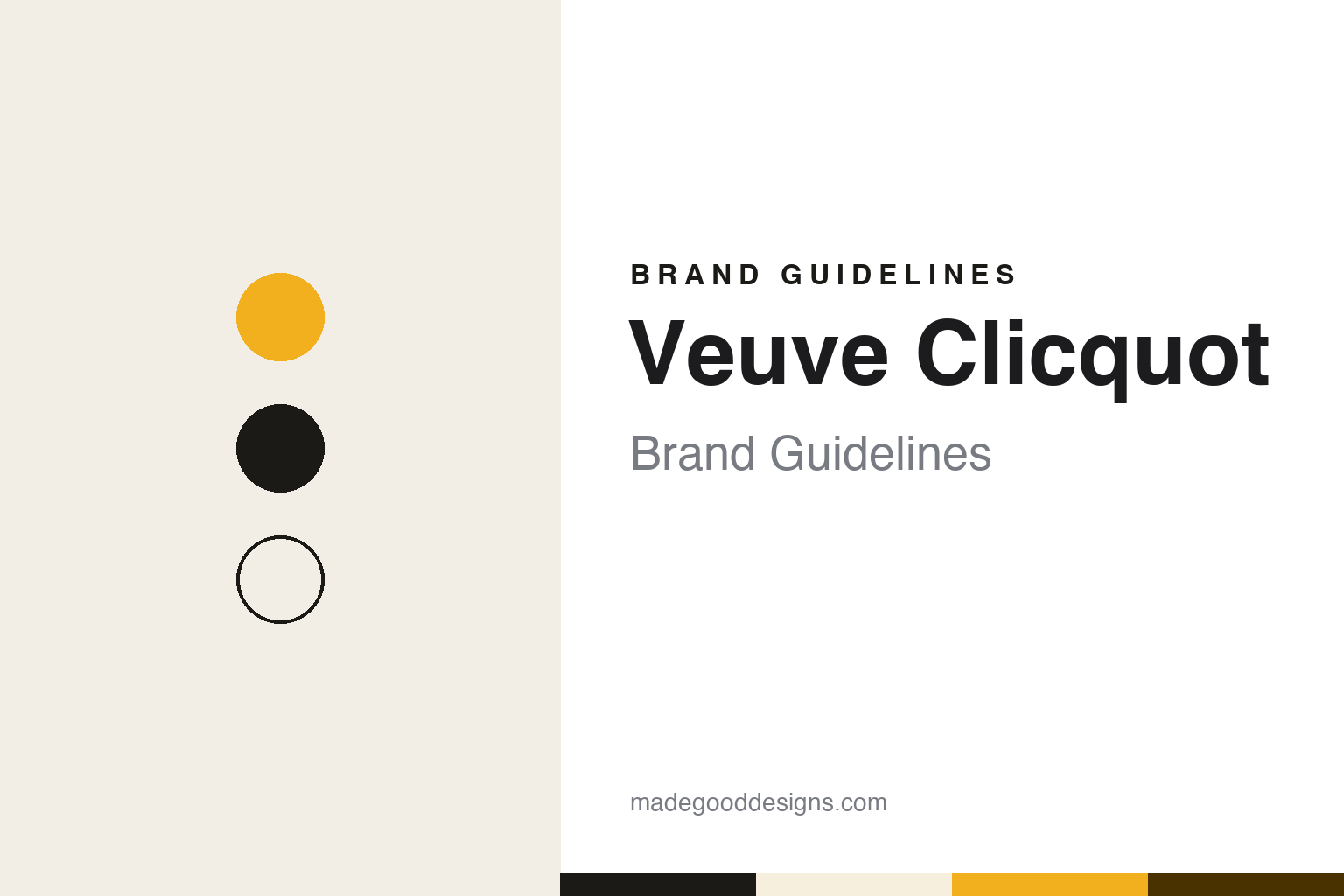
Two constants: a label yellow, cellar ochre and chalk palette and a high-contrast serif register. Abstract homage — not a Veuve Clicquot product or mark; no bottle, label or logo is reproduced.
The widow
A textile merchant’s wine business, and the widow who renamed it.
Veuve Clicquot traces itself to 1772, when Philippe Clicquot, a textile merchant in Reims, set up a wine business alongside his cloth trade. LVMH, which owns the house today, gives the same founder and year. French Wikipedia says the first destination for his bottles was Venice, and that until 1798 they carried no distinguishing mark; from then Philippe Clicquot branded the corks with an anchor, a sign of hope.
In 1798 his son François Clicquot married Barbe-Nicole Ponsardin, the daughter of Nicolas Ponsardin, a Reims textile maker who became the city’s mayor in 1810. François joined his father as a partner, and in 1801 the firm took on Louis Bohne, a travelling salesman who carried the wine to England, the German lands, Austria and Russia. The word veuve means widow: the house says she was widowed in 1805 and, aged 27, took over the business. French Wikipedia records that she first traded in partnership with the wine merchant Alexandre Fourneaux as “Veuve Clicquot, Fourneaux & Cie,” and adopted the name Veuve Clicquot Ponsardin in 1810, when that partnership ended.
Her years in charge produced most of the firsts the house still repeats. LVMH credits her with the first vintage champagne in 1810, the riddling table in 1816 and the first blended rosé in 1818; English Wikipedia names her cellar master Antoine de Müller as her assistant on the riddling table, and notes that Ruinart had sold a rosé tinted with elderberry earlier, so the claim is to the first rosé blended from red and white wine. The riddling table held bottles neck-down while cellar hands turned them a little each day, gathering the sediment in the neck so it could be removed and the wine left clear. A comet visible in 1811 gave her “vin de la comète,” and French Wikipedia says the comet later appeared on her corks, a second branded mark after the anchor. After 1814 Russia became her great market, and English Wikipedia notes that 19th-century Russian novels used a word built on “Clicquot” for high-class champagne.
Colour
From Werlé to the yellow label.
The business passed through a succession of partners rather than heirs. French Wikipedia says Édouard Werlé, who joined in 1820, became Madame Clicquot’s partner after Bohne; English Wikipedia says he became head of the company in 1841, and that in August 1866 a new firm, “Werlé & Cie, successors to Veuve Clicquot-Ponsardin,” was formed. The widow’s name stayed on the bottle.
The colour that now identifies the house dates from the Werlé years. English Wikipedia says Édouard and his son Alfred Werlé began using a yellow label in 1877, an unusual colour for champagne at the time, and registered it as the “Veuve Clicquot Ponsardin” Yellow Label trademark, with its use then extended to all bottles. The house’s oldest bottle bearing that label, an 1893 found in 2008 in a sideboard at Torosay Castle on the Isle of Mull, is kept in its Reims collection, English Wikipedia reports. The label has since become a cue in its own right: the non-vintage brut is sold as Yellow Label.
The cellars are part of the identity too. French Wikipedia says Bertrand de Mun, Alfred Werlé’s son-in-law, became a partner in 1902 and in 1909 bought crayères, old chalk pits under the Saint-Nicaise hill on the edge of Reims. English Wikipedia says the house commissioned the artist André Navlet to carve reliefs on the cellar walls in the early 20th century, and that the chalk pits sit within the Champagne hillsides, houses and cellars listed by UNESCO as a World Heritage Site. In 1932 de Mun was joined by his son-in-law Bertrand de Vogüé; the company became a société anonyme in 1963, and Alain de Vogüé succeeded his father in the 1970s.
Typography
The champagne house as a brand.
The seven brands in this group are all cognac and champagne names: Rémy Martin, Martell, Courvoisier, Moët & Chandon, Veuve Clicquot, Dom Pérignon and Bollinger. Cognac and champagne brands in general sit at many different points in the trade, from family houses that still carry a founder’s name to names that now belong to much larger drinks groups, and a single brand can be sold everywhere from a wine merchant to an airport shop.
A cognac or champagne brand’s identity is usually carried less by a single bottle than by a label, a name and the place it comes from, because the company behind the name may have changed hands, bought vineyards or grown far beyond the town where it started. That makes the questions behind each name worth asking plainly: who started it, who owns it now, and where its wines and spirits are actually made.
Each guide separates what independent sources record from what the company says about itself — its founding story, its owners over time, where its wines and spirits are made and how its bottles and labels have changed — and marks plainly what rests only on the company’s own word.
Aa
A high-contrast serif, for a house that names itself in a widow’s title. (Specimen set in Bodoni Moda, a serif STAND-IN; NOT the Veuve Clicquot logo.)
Veuve Clicquot
A yellow label inside a luxury group.
The family era ended in the 1980s. French Wikipedia says the house joined the Louis Vuitton group in 1986, and that the group became LVMH the following year, in 1987; English Wikipedia gives both dates in different sections. Today Veuve Clicquot is part of Moët Hennessy, LVMH’s wines and spirits arm, and French Wikipedia says it is operated through MHCS, the group’s champagne company, alongside Ruinart and Krug. The house remains on the rue du Temple in Reims, where LVMH lists its headquarters, and its wines are made in Champagne. French Wikipedia says it owned 390 hectares of vines in 2023, in 13 of the region’s 17 grand cru villages, and both French Wikipedia and LVMH describe the current cellar master, Didier Mariotti, as the eleventh in the house’s history.
Its prestige cuvée, La Grande Dame, was launched in 1972, two hundred years after the founding, English Wikipedia says; its name recalls the title given to Madame Clicquot, “la grande dame de la Champagne.” The same anniversary year brought the Veuve Clicquot Business Woman Award, which French Wikipedia says was later renamed the Bold Woman Award. LVMH’s page on the house shows a 2006 portrait of Madame Clicquot by Yayoi Kusama and a campaign visual for La Grande Dame 2018 made with Simon Porte Jacquemus. The brand has an older place in popular culture as well: in Casablanca (1942), Captain Renault recommends Veuve Clicquot to Major Strasser. For the typography behind the label, see our separate guide, What Font Does Veuve Clicquot Use?
For a design guide, Veuve Clicquot shows how a single colour, registered in 1877, and a founder’s title can carry a champagne house for well over a century. Compare Moët & Chandon, its Épernay stablemate in LVMH, and Dom Pérignon, the group’s vintage-only prestige champagne. For this guide we use a label yellow, a cellar ochre and chalk with a high-contrast serif, an unofficial interpretation; no product or logo is reproduced.
Explore & save
Keep Veuve Clicquot’s identity on hand — save it to a board in the Made Good inspiration library.
Veuve Clicquot identity set
Pin the Veuve Clicquot label yellow, cellar ochre and chalk palette and the high-contrast serif register to your own board.