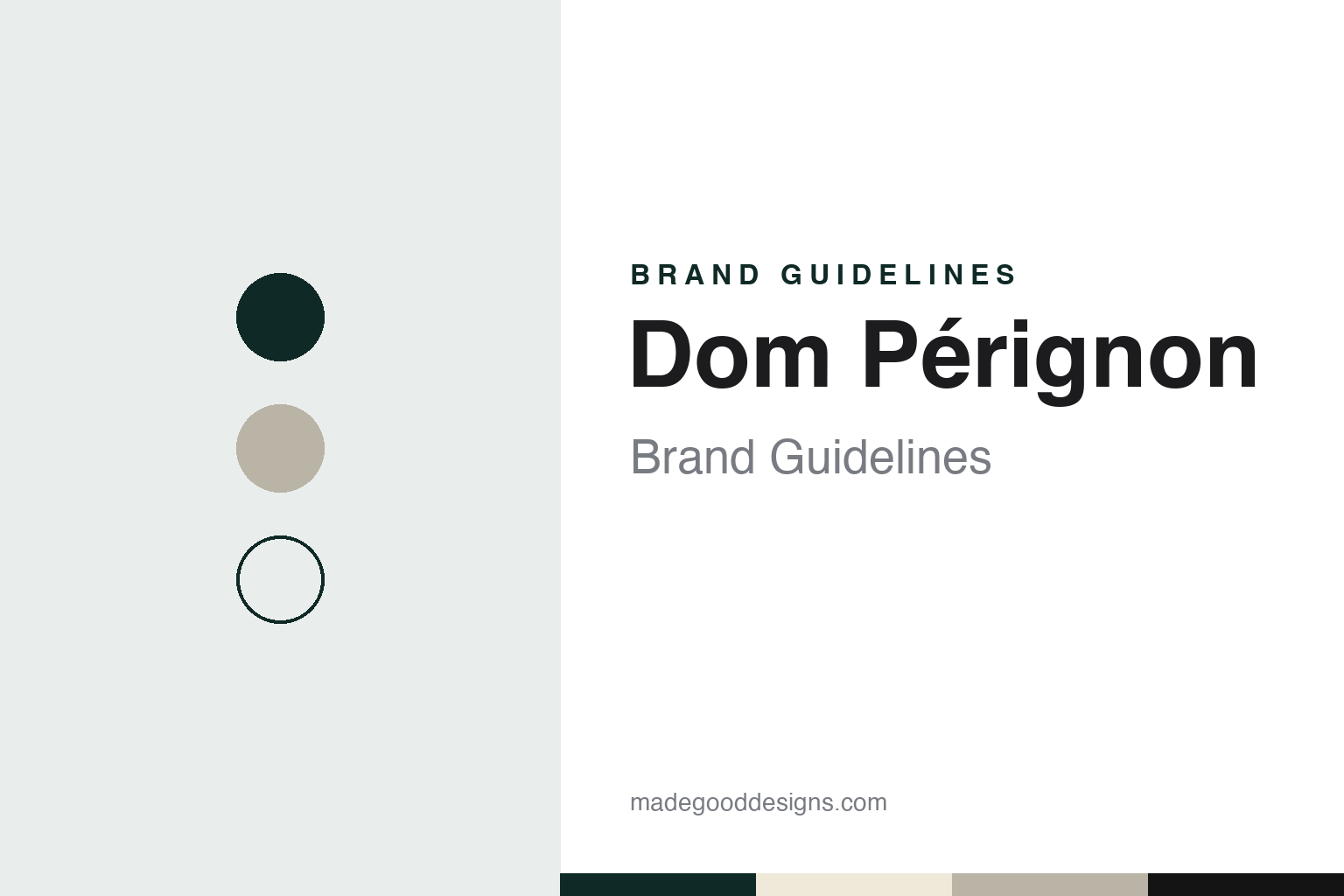
Dom Pérignon Brand Guidelines
Moët & Chandon’s vintage-only cuvée, first made in 1921.
Aa
Two constants: a bottle green, pewter and parchment palette and an old-style serif register. Abstract homage — not a Dom Pérignon product or mark; no bottle, label or logo is reproduced.
The cellarer
A Benedictine cellarer, and a name borrowed three centuries later.
Dom Pérignon is a brand of vintage champagne made by Moët & Chandon, the Épernay house founded by Claude Moët in 1743. Its name belongs to Dom Pierre Pérignon, a Benedictine monk who, LVMH says, was appointed procurator of the Abbey of Hautvillers in 1668 and worked there for 47 years to make “the best wine in the world.” English Wikipedia describes him as the abbey’s cellarer, under whom its vineyard holdings doubled, and says the remains of the monastery now belong to Moët & Chandon.
The monk is better known than his record. English Wikipedia, citing the wine historians Roderick Phillips and Hugh Johnson, says popular tales wrongly credit him with inventing sparkling champagne, which did not become the region’s dominant style until the mid-19th century; in his day refermentation in the bottle was a problem winemakers tried to avoid. The line he is supposed to have spoken on tasting it, “Come quickly, I am tasting the stars!”, first appears in a print advertisement of the late 19th century, the same article says. What the sources do credit him with is closer to craft: rules published in 1718 by Canon Godinot and attributed to Dom Pérignon call for low-pruned vines, careful picking and blending grapes from several vineyards before pressing. A statue of him stands at the entrance to Moët & Chandon’s headquarters in Épernay, and in 2022 a new bronze was unveiled in Hautvillers, with a glass champagne bottle set into the figure.
The brand name came later and from elsewhere. English Wikipedia says the name, registered but unused by Champagne Mercier, was given to Moët in 1927 on the occasion of a marriage between the two families, and English Wikipedia’s Moët & Chandon article credits an Englishman, Laurence Venn, with the idea of a prestige cuvée.
Colour
A 1921 vintage in an 18th-century bottle.
The first Dom Pérignon was the 1921 vintage. English Wikipedia says that in 1935 Moët sent 300 bottles of a 1926 wine to Simon Brothers & Co., its importer in Britain, to mark the importer’s centenary; those bottles were nearly identical to later Dom Pérignon but carried a centenary inscription rather than the name. The 1921, with the name, was then released for sale in 1936 and shipped to New York aboard the liner Normandie, the same article says; French Wikipedia dates the first sales to 1935.
The look came first and the separate wine second. According to English Wikipedia, until the 1943 vintage Dom Pérignon was Moët & Chandon vintage champagne moved, after long cellaring, into special 18th-century-style bottles; from the 1947 vintage it has been made separately from the start. A rosé followed from the 1959 vintage. In 1981 the magnums of the 1961 vintage served at the wedding of Prince Charles and Lady Diana Spencer carried an insignia made for the day, both English and French Wikipedia report, and in the film Dr. No (1962) James Bond weighs a bottle of the 1955.
The rule that defines the brand is that it is always a vintage: every grape comes from a single year’s harvest, and in years judged too weak no Dom Pérignon is made. English Wikipedia lists 48 white vintages released by 2026, from 1921 to 2017, and says runs of more than two consecutive vintages were rare until the 2000s. LVMH says each vintage spends at least eight years in the cellar before release, the Rosé at least twelve.
Typography
The cuvée as a brand.
The seven brands in this group are all cognac and champagne names: Rémy Martin, Martell, Courvoisier, Moët & Chandon, Veuve Clicquot, Dom Pérignon and Bollinger. Cognac and champagne brands in general sit at many different points in the trade, from family houses that still carry a founder’s name to names that now belong to much larger drinks groups, and a single brand can be sold everywhere from a wine merchant to an airport shop.
A cognac or champagne brand’s identity is usually carried less by a single bottle than by a label, a name and the place it comes from, because the company behind the name may have changed hands, bought vineyards or grown far beyond the town where it started. That makes the questions behind each name worth asking plainly: who started it, who owns it now, and where its wines and spirits are actually made.
Each guide separates what independent sources record from what the company says about itself — its founding story, its owners over time, where its wines and spirits are made and how its bottles and labels have changed — and marks plainly what rests only on the company’s own word.
Aa
An old-style serif, for a brand built on an 18th-century bottle shape. (Specimen set in Cormorant Garamond, a serif STAND-IN; NOT the Dom Pérignon logo.)
Dom Pérignon
Plénitudes, cellar masters and artists’ bottles.
Ownership followed Moët & Chandon. English Wikipedia says Moët merged with the cognac house Hennessy in 1971, and Moët Hennessy merged with Louis Vuitton in 1987 to form LVMH. Today LVMH presents Dom Pérignon as a maison of its own within Moët Hennessy, its wines and spirits division, and the wine is made in Champagne from Pinot Noir and Chardonnay, in proportions that change with each vintage, English Wikipedia says.
Later releases gave the brand a second vocabulary. English Wikipedia says late-disgorged wines were once sold as Œnothèque, and that around 2016 the producer began labelling them P2 and P3, for the second and third “plénitudes,” stages in the wine’s life in the cellar; LVMH says P2 spends at least fifteen years there. Richard Geoffroy was chef de cave from 1990 to 2018, English Wikipedia says, and LVMH names Vincent Chaperon as the current chef de cave.
Dom Pérignon also uses its bottle as a canvas. English Wikipedia lists limited editions and gift boxes made with artists and designers, among them Andy Warhol for the 2000 and 2002 vintages, David Lynch for 2003, Jeff Koons and Iris van Herpen for 2004, Björk with Chris Cunningham for 2006, Tokujin Yoshioka for 2009, Lady Gaga for 2010 and the estate of Jean-Michel Basquiat for 2015. For the typography behind the label, see our separate guide, What Font Does Dom Pérignon Use?
For a design guide, Dom Pérignon shows how a monk’s name, an old bottle shape and a strict vintage-only rule can be turned into a brand that sits apart from the house that makes it. Compare Moët & Chandon, the Épernay house behind it, and Veuve Clicquot, its Reims stablemate in LVMH. For this guide we use a bottle green, pewter and parchment with an old-style serif, an unofficial interpretation; no product or logo is reproduced.
Explore & save
Keep Dom Pérignon’s identity on hand — save it to a board in the Made Good inspiration library.
Dom Pérignon identity set
Pin the Dom Pérignon bottle green, pewter and parchment palette and the old-style serif register to your own board.