Penfolds Brand Guidelines
The Magill winery behind Grange, founded in 1844.
Aa
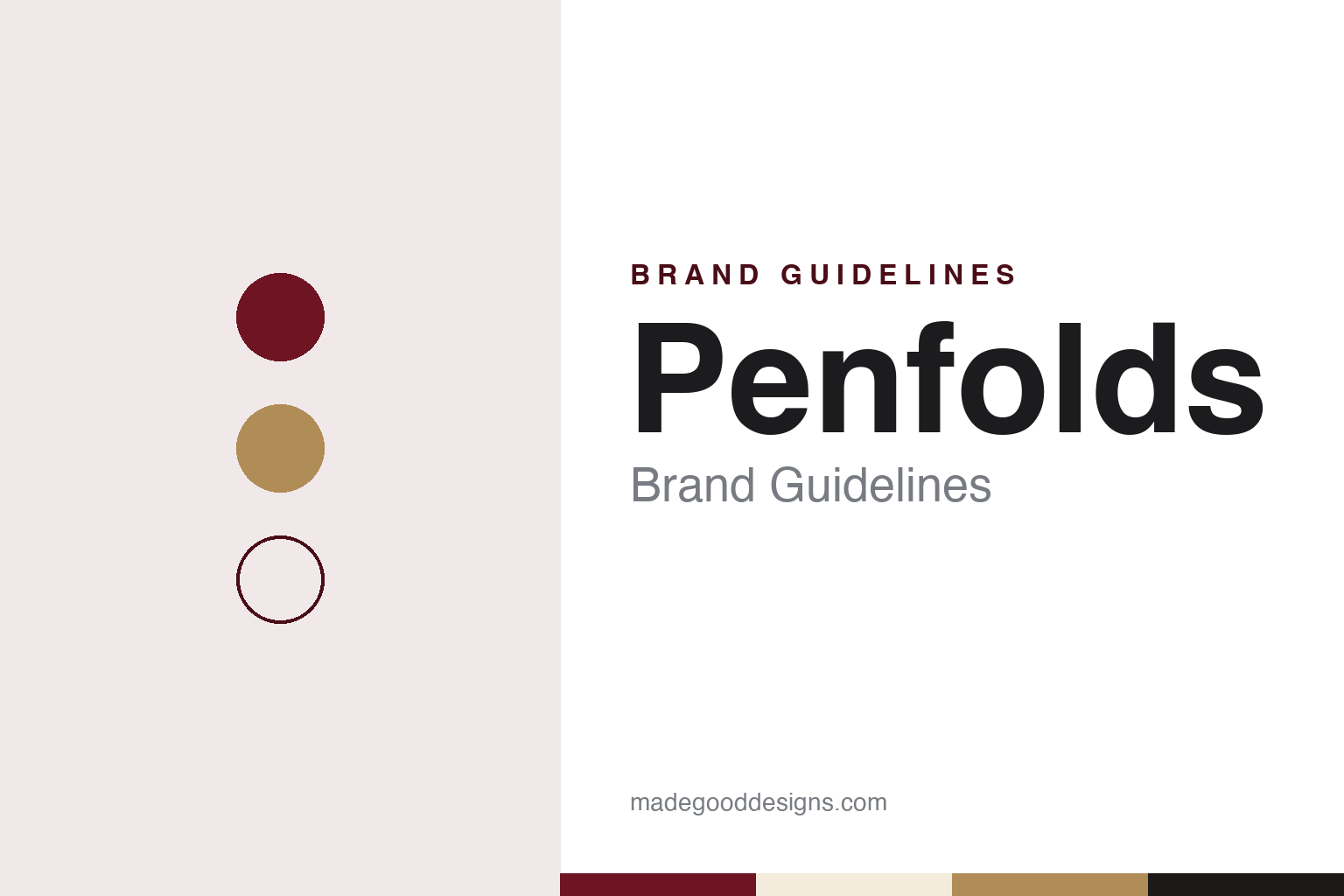
Two constants: a claret, old gold and label cream palette and a classical book serif register. Abstract homage — not a Penfolds product or mark; no label, logo or bottle is reproduced.
A doctor, his wife and The Grange
An English couple, a Magill cottage and a winery run by Mary.
Penfolds began in 1844 at Magill, at the foot of the Mount Lofty Ranges east of Adelaide. English Wikipedia, citing the Australian Dictionary of Biography, says the physician Dr Christopher Rawson Penfold, born in Steyning, Sussex, in 1811, and his wife Mary arrived in South Australia in June 1844 from Angmering, West Sussex. They bought land at Magill, then spelled “Mackgill,” built a cottage they called The Grange and planted vine cuttings brought out from England. The cottage name would later be given to the company’s most famous wine.
The first Penfolds wines were fortified sherry- and port-style wines, English Wikipedia says; clarets and rieslings followed. As Christopher’s medical practice grew, Mary took over the vines and the blending, and from 1870, the year of Christopher’s death according to the Australian Dictionary of Biography, she ran the winery herself. English Wikipedia says she hired the cellar master Joseph Gillard, kept a partnership in place with her son-in-law Thomas Francis Hyland, and retired in 1884. Her daughter Georgina and Hyland then ran the business day to day.
The company kept growing under the family. By 1903 Penfolds was the largest winery in the Adelaide region, according to James Halliday’s Australian Wine Encyclopedia, as cited by English Wikipedia, and between 1904 and 1912 it bought vineyards in McLaren Vale and New South Wales. In 1948 Gladys Penfold Hyland became chair of the board; she led the company until it listed publicly in 1962, English Wikipedia says. Penfolds still runs a winery at Magill Estate, now within Adelaide’s suburbs, alongside its main winery at Nuriootpa in the Barossa Valley.
Colour
Max Schubert, a trip to Bordeaux and a wine made in secret.
The wine that defines Penfolds came from its chief winemaker, Max Schubert. Penfolds says the story of Grange began with a side trip to Bordeaux in 1950, during a European journey to study sherry making, and that Schubert made his first experimental Grange in 1951, naming it after the founders’ cottage; the company counts 1952 as the first vintage released commercially. English Wikipedia, citing The Wine News and the Oxford Companion to Wine, says Penfolds management ordered production stopped in 1957, but Schubert carried on in secret until 1959; Penfolds says the board reinstated the wine in 1960.
For decades the label read Grange Hermitage. The word “Hermitage” was dropped from the 1990 vintage after European Union authorities objected to the use of a French place name, English Wikipedia says. Grange is the only wine heritage-listed by the South Australian National Trust, according to the Langton’s guide cited by English Wikipedia, and, English Wikipedia says, Wine Spectator named the 1955 vintage one of its twelve top wines of the twentieth century.
The 1960s added the numbered Bin wines — Bin 389, Bin 707, Bin 28 and Bin 128 among them, English Wikipedia says. Schubert stepped down as chief winemaker in 1976, and Peter Gago has held the role since 2002, English Wikipedia says. Penfolds has also reached beyond South Australia: for its 175th anniversary it released a Champagne made with the house of Thiénot from June 2019, The Drinks Business reported, and in 2021 it launched a California Collection from its first Californian vintage, 2018, a project that Shanken News Daily traced to cuttings from the Kalimna and Magill vineyards planted in California in 1998. Wine Enthusiast named Penfolds its New World Winery of the Year in 2013.
Typography
Design and documentation.
The seven brands in this group are all wine and sake names: Yellow Tail, Jacob’s Creek, Penfolds, Casillero del Diablo, Concha y Toro, Barefoot and Gekkeikan. Wine and sake brands in general sit at many different points in the trade, from family houses that still carry a founder’s name to labels that now belong to much larger drinks groups, and a single brand can be sold everywhere from a corner shop to a restaurant list.
A wine or sake brand’s identity is usually carried less by a single bottle than by a label, a name and the place it promises, because the company behind the name may have changed hands, moved its production or grown far beyond the place where it started. That makes the questions behind each name worth asking plainly: who started it, who owns it now, and where its wine or sake is actually made and bottled.
Each guide separates what independent sources record from what the company says about itself — its founding story, its owners over time, where its wine or sake is made and how its labels have changed — and marks plainly what rests only on the company’s own word.
Aa
A classical book serif for a winery founded in 1844. (Specimen set in Cormorant Garamond, a serif STAND-IN; NOT the Penfolds logo.)
Penfolds
From family firm to Treasury Wine Estates.
The Penfold family kept a controlling interest until 1976, when the New South Wales brewer Tooth & Co. took control, English Wikipedia says. In 1982 the business became part of the Adelaide Steamship Company group, and in 1990 SA Brewing bought the wineries, whose wine assets became Southcorp Wines. Southcorp joined the Foster’s Group in 2005. In 2011 Foster’s shareholders approved a demerger, and the wine business began trading on 9 May 2011 as Treasury Wine Estates, headquartered in Melbourne and listed on the Australian Securities Exchange.
The mark itself is old. English Wikipedia says the Penfolds logo was first used in 1923 and calls it one of Australia’s most recognised trademarks. Many Penfolds names are numbers or places — the Bin numbers, Kalimna, Magill Estate, Koonunga Hill. China introduced duties on Australian wine around late 2020 and removed them with effect from 29 March 2024, after which Treasury said it would reintroduce Penfolds wines there, Shanken News Daily reported. Drinks International named Penfolds its Most Admired Wine Brand in 2016.
The family name is still written into the land around the old estate. In Rosslyn Park, near Magill, streets honour the founders and their descendants, from Mary Penfold Drive and Rawson Penfold Drive to Hyland Terrace and Grange Avenue, English Wikipedia says. English Wikipedia adds that Christopher Penfold became the first chairman of the District Council of Burnside in 1856.
For a design guide, Penfolds shows how a founder’s cottage, a single winemaker’s experiment and a logo dating from 1923 can carry a brand through a long run of corporate owners. Compare Jacob’s Creek, another South Australian wine name, and [yellow tail], the Australian wine sold around the world. For this guide we use claret, old gold and label cream with a classical serif, an unofficial interpretation; no product or logo is reproduced.
Explore & save
Keep Penfolds’s identity on hand — save it to a board in the Made Good inspiration library.
Penfolds identity set
Pin the Penfolds claret, old gold and label cream palette and the classical book serif register to your own board.