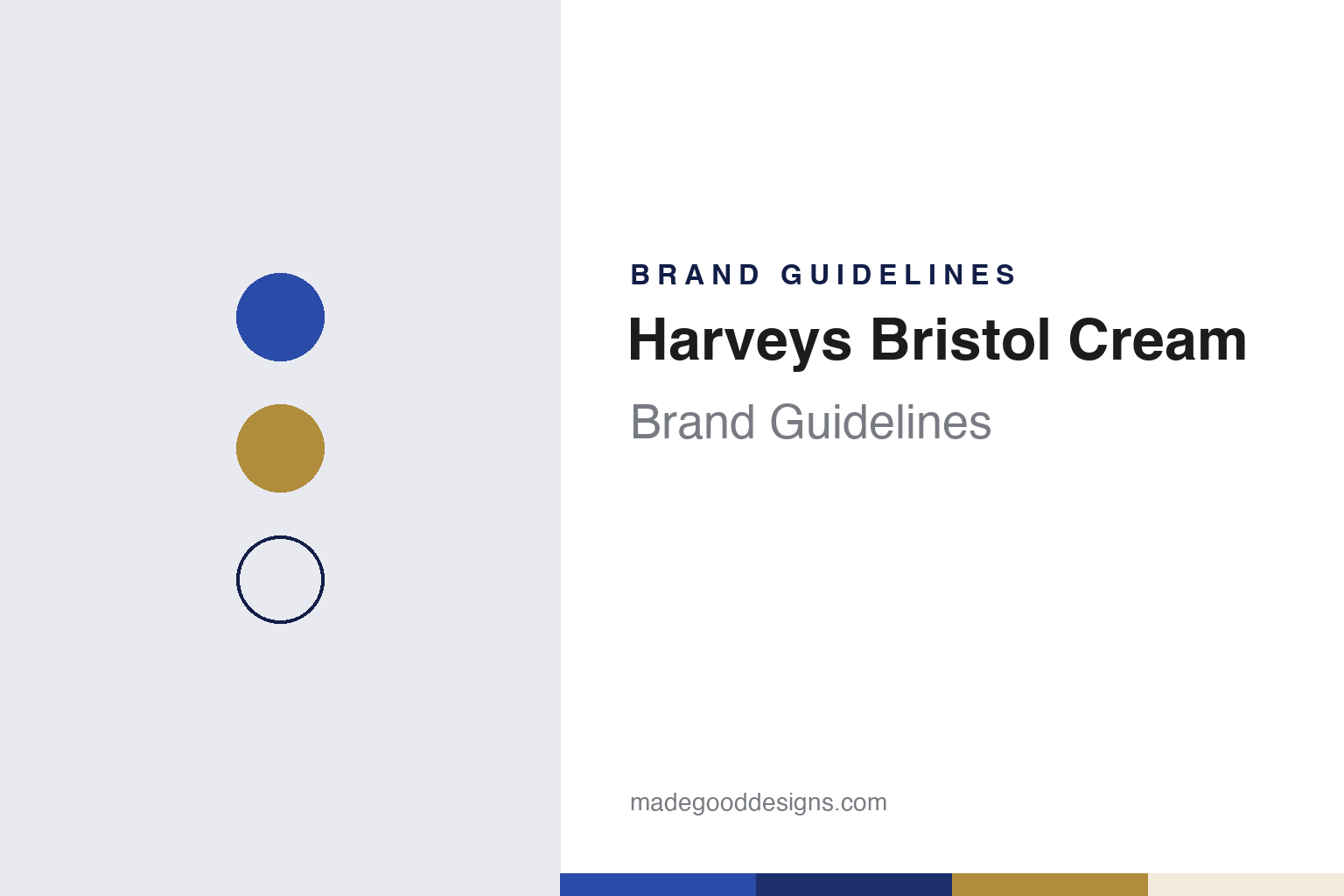
Harveys Bristol Cream Brand Guidelines
A Bristol merchant’s cream sherry, made in Jerez.
Aa
Two constants: a Bristol blue, cellar gold and cream palette and a high-contrast serif register. Abstract homage — not a Harveys product or mark; no label, logo or bottle is reproduced.
A Bristol wine merchant
From an apprentice on Denmark Street to a family name on a sherry.
Harveys began as a wine merchant in Bristol, a port that had long traded with Spain. English Wikipedia, citing the Bristol Record Office’s 2004 catalogue of the firm’s records, says the business was founded in 1796 on Denmark Street by William Perry, who went into partnership with Thomas Urch. In 1822 Urch’s nephew John Harvey joined as an apprentice; by 1839 he was the senior partner, and in 1871 the whole business took the name John Harvey & Sons. The company says that in the nineteenth century it became one of the largest importers of sherry from the Bay of Cádiz into the port of Bristol.
The brand’s signature blend came from the next generation. The company says Bristol Cream was created in 1882 by John Harvey II and his brother Edward; VinePair, in a 2022 article by Jessica Fields, dates their work on the blend to the 1860s and gives 1882 as the year the Bristol Cream name was registered as a trademark. The merchant’s older style was known as Bristol Milk, a sweetened sherry, and VinePair retells the story the house tells about the new name: a lady visiting the cellars tasted the richer blend and remarked that if the first was milk, this must be cream. VinePair also reports that Queen Victoria granted the company a Royal Warrant in 1895.
Exports followed. The Bristol Record Office catalogue, as cited by English Wikipedia, records that sales of Bristol Cream to America boomed from 1928, with Jack Harvey travelling there often. The family business became Harveys of Bristol Ltd in 1962.
Colour
A sherry blended in Jerez and a bottle made the colour of Bristol glass.
For most of its history the sherry crossed the sea before it was finished: wine was shipped from Spain and blended in Bristol. That changed in the twentieth century. The company says that since the early 1970s all of the production and blending of its sherry has been done in Jerez, and the wine writer Jancis Robinson has described Harveys buying old soleras in Jerez as it moved its sherry business there from Bristol. The Bristol premises followed a different path: the Bristol Record Office catalogue, as cited by English Wikipedia, says the firm moved from Denmark Street to Whitchurch Lane in Hartcliffe, and that the Denmark Street cellars, which had become a wine museum with a restaurant, closed in 2003 along with the Hartcliffe site.
The company describes Bristol Cream as a blend of Fino, Amontillado, Oloroso and Pedro Ximénez sherries, aged in American oak casks in the solera and criadera system, and says every sherry it makes spends at least three years in cask. It names Manuel José Valcárcel as its master blender.
The best-known part of the identity is the bottle. Marketing Week reported in March 1995 that Saatchi & Saatchi had relaunched Harveys Bristol Cream in 1994, moving away from traditional sherry imagery, giving the sherry a distinctive blue bottle and running advertisements built on the endline “Sherry with a most distinctive character.” The colour points to Bristol blue glass, the deep cobalt glass long associated with the city.
The label later took the colour further. BevNews reported in July 2019 that a new label carried thermochromic ink in the Harveys logo that turns blue when the sherry is chilled to serving temperature, together with a brighter blue label and cap; the company’s own advice is to serve it from the fridge when the label turns blue. VinePair notes a limited-edition bottle in 2013 marking the sixtieth anniversary of Queen Elizabeth II’s coronation.
Typography
Design and documentation.
The seven brands in this group are all port and sherry names: Sandeman, Graham’s, Taylor’s, Cockburn’s, Dow’s, Tío Pepe and Harveys. Port and sherry brands in general sit at many different points in the trade, from family houses that still carry a founder’s name to labels that now belong to much larger drinks groups, and a single brand can be sold everywhere from a corner shop to a restaurant list.
A port or sherry brand’s identity is usually carried less by a single bottle than by a label, a name and the place it promises, because the company behind the name may have changed hands, moved its production or grown far beyond the place where it started. That makes the questions behind each name worth asking plainly: who started it, who owns it now, and where its wine is actually made, aged and bottled.
Each guide separates what independent sources record from what the company says about itself — its founding story, its owners over time, where its wine is made and how its labels have changed — and marks plainly what rests only on the company’s own word.
Aa
A high-contrast serif for a merchant’s name with a long history. (Specimen set in Playfair Display, a serif STAND-IN; NOT the Harveys logo.)
Harveys
A Bristol name that has passed through several drinks groups.
The family firm has had a long run of corporate owners. The Bristol Record Office catalogue, as cited by English Wikipedia, says Harveys and all its subsidiaries were bought in 1966 by Showerings, Vine Products & Whiteways, the group that was itself acquired by Allied Breweries in 1968; Allied later became Allied-Lyons and then Allied Domecq. Marketing Week named Hiram Walker as the brand’s owner in 1995. When Pernod Ricard took over Allied Domecq in 2005, Jancis Robinson has written, it sold brands it did not want to Diageo and to Fortune Brands, owner of Jim Beam, and Harveys went to the Beam business.
The latest change brought the brand back under Spanish-based management. On 30 November 2015 Beam Suntory announced an agreement to sell its Jerez brandy and sherry business, including Fundador, Harveys, Terry and Tres Cepas and production operations in Jerez and Tomelloso, to Emperador Inc. of the Philippines, The Drinks Business and the Philippine Star reported; the Philippine Star report described Harveys as the United Kingdom’s best-selling sherry. BevNews dated the acquisition to 2016. Harveys now sits within Bodegas Fundador in Jerez, and English Wikipedia names Emperador’s parent as Alliance Global Group. In the United States, BevNews reported, the brand has been distributed since June 2018 by González Byass USA, the American arm of the family company behind Tío Pepe.
The name needs care. The brand writes Harveys without an apostrophe, though the press often adds one; Harvey’s Brewery in Lewes, East Sussex, is an unrelated company, and the Harveys Cellars bar on the old Denmark Street site is a bar rather than the sherry business. The brand’s own site is harveyssherry.com.
For a design guide, Harveys Bristol Cream shows how a city’s name, a blend’s nickname and a single glass colour can keep a sherry recognisable through more than two centuries and several owners, long after the blending moved from Bristol to Jerez. Compare Tío Pepe, the González Byass fino, and Sandeman, the port and sherry house. For this guide we use Bristol blue, cellar gold and cream with a high-contrast serif, an unofficial interpretation; no product or logo is reproduced.
Explore & save
Keep Harveys Bristol Cream’s identity on hand — save it to a board in the Made Good inspiration library.
Harveys Bristol Cream identity set
Pin the Harveys Bristol blue, cellar gold and cream palette and the high-contrast serif register to your own board.