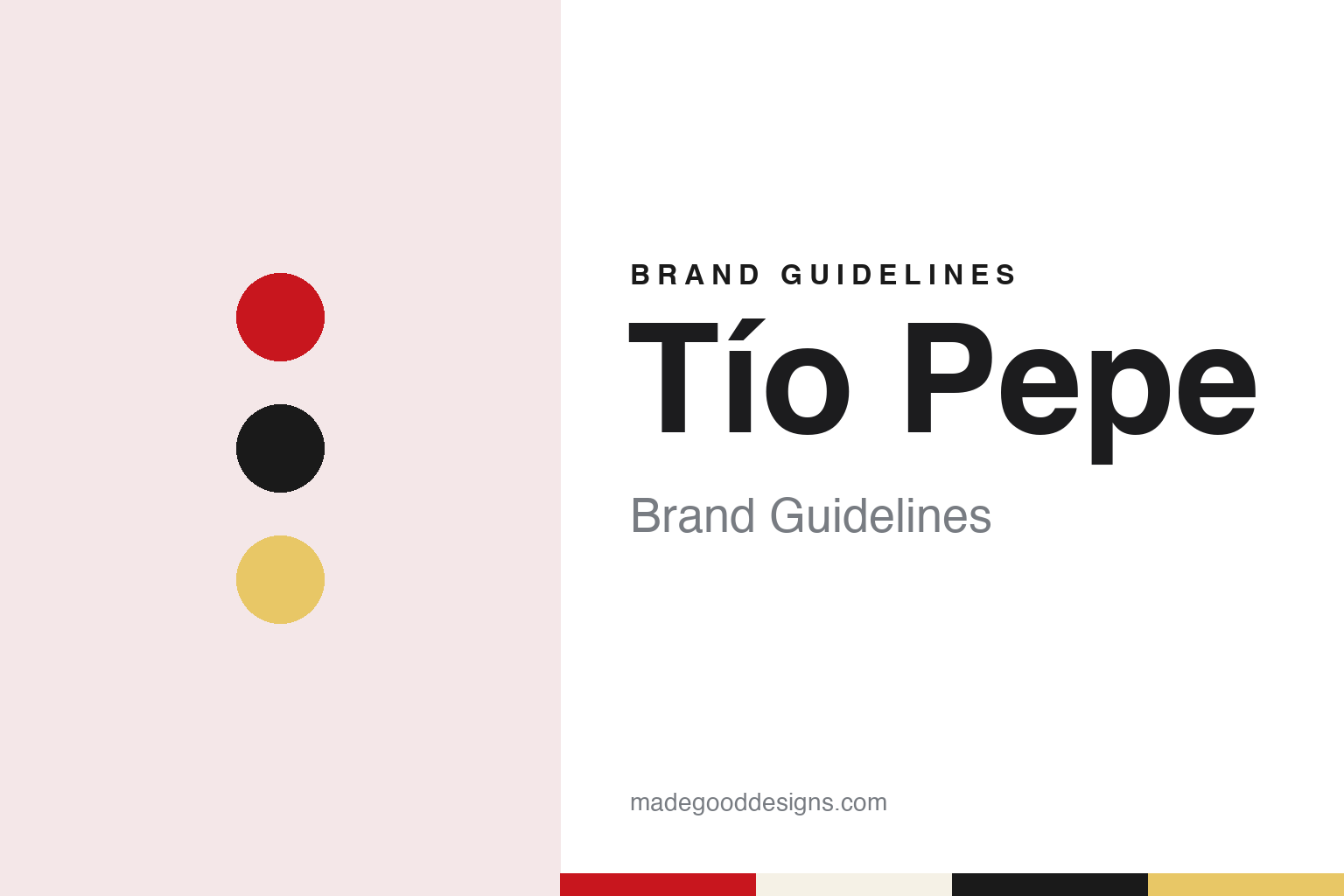
Tío Pepe Brand Guidelines
The Jerez fino named for an uncle, dressed in 1935.
Aa
Two constants: a jacket red, hat black and fino gold palette and a high-contrast display serif register. Abstract homage — not a Tío Pepe product or mark; no label, logo, figure or bottle is reproduced.
A young merchant and his uncle
Manuel María González Ángel, a fino and a family name.
Tío Pepe — “Uncle Pepe” — is a fino sherry, the pale, dry style of wine from the sherry country around Jerez de la Frontera in Andalusia. English Wikipedia describes it as best known for its fino style of dry sherry made from the Palomino grape. It belongs to González Byass, the Jerez house that dates its origins to 1835, when Manuel María González Ángel, whom the company calls a young visionary living in Jerez, went into the wine trade.
The name is a family one. English Wikipedia says the brand is named after one of the founders’ uncles, and Spanish Wikipedia says it honours an uncle of the founder for whom a dry fino was made. The company identifies him as José Ángel y Vargas, the founder’s maternal uncle, and says he guided his nephew in the trade and helped him create the house’s first fino solera; the wine that came from it carried his familiar name.
The solera is the system on which the wine depends: a sequence of casks in which younger wine is used to refresh older wine, so that a single brand can be drawn year after year with a consistent character. English Wikipedia says the Tío Pepe soleras were established in 1844 and have run uninterrupted since then. The company, for its part, says that by 1844 Tío Pepe had already travelled far beyond Spain.
The business took on its double name through its trade with Britain. Spanish Wikipedia says that in February 1838 a company called González y Dubosc was formally established in Cádiz, and English Wikipedia says the founder was later joined by his English agent, Robert Blake Byass, whose name the house still carries. English Wikipedia adds that after a visit by Queen Isabel II in 1862 a new bodega, La Concha, was commissioned from the engineer Gustave Eiffel, and that a three-storey Tío Pepe bodega holding 28,000 butts followed in 1963.
Colour
A bottle in a hat, a jacket and a guitar.
The brand’s defining image is not a label but a figure. The company says that in 1935, the house’s centenary year, Luis Pérez Solero created the Tío Pepe icon: the bottle itself, dressed in a red jacket, a traditional broad-brimmed Andalusian hat and holding a Spanish guitar. English Wikipedia likewise says that from 1935 the sombrero-wearing, guitar-playing bottle became the classic image of the brand. Spanish Wikipedia describes Pérez Solero as the bodega’s head of propaganda at the time and credits a team led by him with the label, the bottle and the slogan “Sol de Andalucía embotellado” — “Andalusian sunshine, bottled.” The business magazine Emprendedores describes how the centenary prompted a series of sketches of the house’s bottles in different costumes, of which the Tío Pepe version stood out.
The figure then moved off the shelf and onto the city. The company says that in 1958 Tío Pepe appeared above Madrid’s Puerta del Sol on an illuminated sign that became a symbol of the city; another page of the González Byass site puts the start of that presence in 1957. Spanish Wikipedia, citing the Diario de Jerez in 2019, says González Byass was already advertising in the square by 1920.
The sign has had to move once. It stood on the building at number 1 of the square until April 2011, when it was taken down as that building was being refurbished. It was away for about three years. In 2014 it returned to the Puerta del Sol on a new rooftop at number 11, on the corner of the Calle de Preciados, facing the Real Casa de Correos; the news agency EFE, in a report carried by El País on 22 April 2014, described the return of the iconic sign, and Euro Weekly News reported that up to 20 people worked on the final touches, with the help of a crane.
Jerez has its own monument to the figure. English Wikipedia says a Tío Pepe wind vane in the city is listed by Guinness World Records as the largest operational wind vane.
Typography
Design and documentation.
The seven brands in this group are all port and sherry names: Sandeman, Graham’s, Taylor’s, Cockburn’s, Dow’s, Tío Pepe and Harveys. Port and sherry brands in general sit at many different points in the trade, from family houses that still carry a founder’s name to labels that now belong to much larger drinks groups, and a single brand can be sold everywhere from a corner shop to a restaurant list.
A port or sherry brand’s identity is usually carried less by a single bottle than by a label, a name and the place it promises, because the company behind the name may have changed hands, moved its production or grown far beyond the place where it started. That makes the questions behind each name worth asking plainly: who started it, who owns it now, and where its wine is actually made, aged and bottled.
Each guide separates what independent sources record from what the company says about itself — its founding story, its owners over time, where its wine is made and how its labels have changed — and marks plainly what rests only on the company’s own word.
Aa
A high-contrast display serif for a fino with a costume. (Specimen set in Playfair Display, a serif STAND-IN; NOT the Tío Pepe logo.)
Tío Pepe
A family house, a fino and a figure in fiction.
González Byass remains a family company. English Wikipedia says it is owned and run by the fourth and fifth generations of the González family, including Mauricio González-Gordon y Díez, and lists acquisitions beyond Jerez, among them the Viñas del Vero wineries in 2008. Spanish Wikipedia records that the company bought the Port house Croft from Diageo in 2001, as El País reported at the time. The house has collected recognition along the way: English Wikipedia lists a Winemaker of the Year title in 2010, the year of its 175th anniversary, a Best Visitor Centre award in 2014 and Wine Family of the Year in 2020.
The brand has stretched its fino in both directions. The company says it introduced Tío Pepe En Rama in 2010, drawn straight from the cask and left unfiltered, and that a Tío Pepe Festival began in Jerez in 2012. A run of Tío Pepe restaurants in Madrid, opened with Grupo Vips in 2004, closed in 2011, English Wikipedia says.
The name has a life in fiction too. In Len Deighton’s 1962 novel The IPCRESS File, the narrator — later named Harry Palmer in the film and television versions — drinks Tío Pepe at a meeting with his superior, English Wikipedia notes.
The brand and the house keep separate addresses online: the sherry’s own site is tiopepe.com, while the company that makes it is at gonzalezbyass.com.
For a design guide, Tío Pepe shows how a fino named in 1844 after a family uncle was given a body in 1935 — a bottle in a red jacket, an Andalusian hat and a guitar — and how that figure became a fixture of a city square hundreds of kilometres from the bodega. Compare Harveys Bristol Cream, the sweet sherry blend sold under an English merchant’s name, and Sandeman, the Port and sherry house with its own caped figure. For this guide we use jacket red, hat black and fino gold with a display serif, an unofficial interpretation; no product or logo is reproduced.
Explore & save
Keep Tío Pepe’s identity on hand — save it to a board in the Made Good inspiration library.
Tío Pepe identity set
Pin the Tío Pepe jacket red, hat black and fino gold palette and the high-contrast display serif register to your own board.