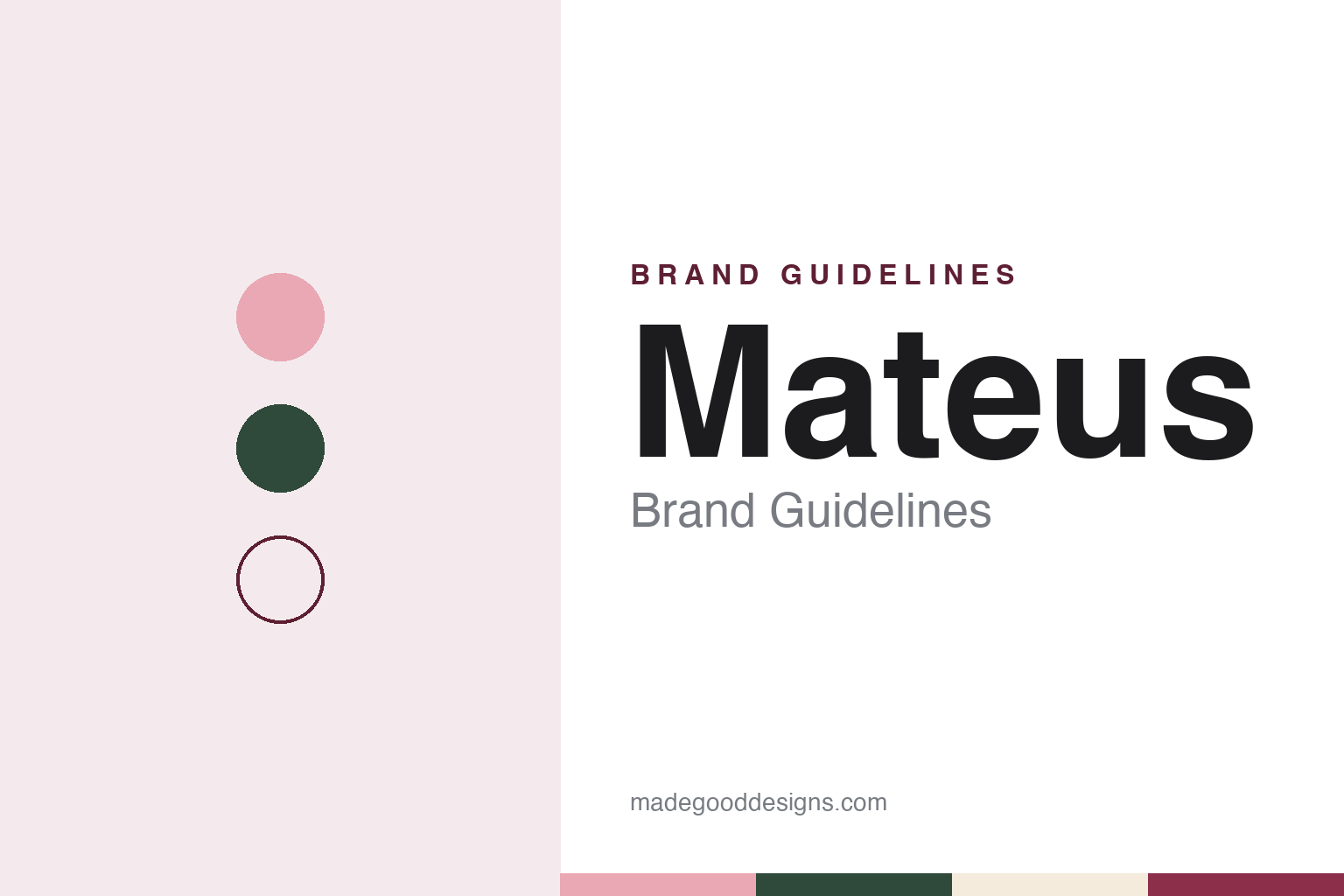
Mateus Brand Guidelines
Sogrape’s flask-bottled rosé with a palace on the label, 1942.
Aa
Two constants: a rosé pink, flask green and palace stucco palette and a baroque display serif register. Abstract homage — not a Mateus product or mark; no label, logo or bottle is reproduced.
A wartime wine for Brazil
A port trade cut off by war, and a rosé made to travel.
Mateus was born out of a problem with port. English Wikipedia, citing a 2020 profile in The Real Review and a 2020 report in Diário de Notícias, says that in 1942 Fernando van Zeller Guedes, his brothers and other partners founded the Sociedade Comercial dos Vinhos de Mesa de Portugal, the forerunner of today’s Sogrape. Before the Second World War the Douro had sold mostly port, with Britain as a major buyer; the new company’s plan was to export table wine instead, above all to Brazil, which, like Portugal, was then outside the war. Sogrape’s American arm, Evaton, gave the same founding year and founder in a release in February 2020.
The wine itself was a rosé, which English Wikipedia notes was then rare in Portugal. It says Guedes developed it with Eugène Hellis, the winemaker at Quinta da Aveleda, the estate his father owned, and that he meant it to appeal to women as well as men and to people new to wine. The wine critic Huon Hooke, writing in The Real Review in August 2020 and drawing on an obituary by Colin Parnell, a co-founder of Decanter, says the first Mateus was a slightly sweet rosé made from grapes readily available in the Douro, among them bastardo and touriga. According to English Wikipedia, the first consignment went to Brazil in 1943.
Brazil did not stay open for long. Hooke writes that Mateus sold well in Portugal and Brazil until Brazil banned imported wine during an economic crisis, which forced Guedes to look elsewhere. His method, as both Hooke and English Wikipedia tell it, was personal: he sent two bottles to every Portuguese embassy and to friends abroad, asking each recipient to drink one and pass the other to someone who might make a good agent for the wine in their country.
The approach worked. English Wikipedia, citing The Guardian in 2002, says the brand reached Britain in the early 1950s. The travel writer Sacheverell Sitwell praised it in his book Truffle Hunt (1953), describing a rosé from Trás-os-Montes the colour of orangeade and lightly pétillant, with the villa near Vila Real on its label. English Wikipedia, citing Business Standard in 2014, says that by the late 1970s Mateus, joined by then by a white version, accounted for almost 40 per cent of Portugal’s table-wine exports.
Colour
A soldier’s canteen and a baroque house.
Two pieces of design have carried Mateus since the start: the bottle and the label. English Wikipedia says Guedes chose a new bottle shape as part of his marketing, based on the flasks or canteens carried by soldiers in the First World War; Sogrape’s 2020 release repeats that the original bottle was inspired by soldiers’ flasks. Hooke quotes Guedes, via Parnell’s obituary, as saying that “the bottle was my way of doing something different,” and writes that early bottles were filled by hand through a rubber tube from the cask.
The label shows the Mateus Palace, a baroque house in the parish of Mateus, near Vila Real. English Wikipedia’s article on the palace says the architect Nicolau Nasoni was involved in its construction in the eighteenth century and that it was classified as a National Monument in 1910. According to English Wikipedia’s article on Guedes, the Count of Mangualde, who owned the estate, supplied some of the grapes, and Guedes asked his permission to put a picture of the house on the label.
That agreement became the best-known story about the brand. Hooke writes that the two men first agreed a royalty on every bottle, but that the Count changed his mind and took a one-off payment instead, along with a premium on the grapes from his estate. Guedes later remarked that the original deal would have served the Count very well once Mateus was selling some 50 million bottles a year.
The bottle has changed colour once in living memory. The Drinks Business reported in June 2015 that Mateus was moving from its green glass to a clear glass bottle while keeping the flask shape, after research by Sogrape Vinhos concluded that British drinkers preferred to see the colour of a rosé before buying it. The clear bottle had been tested for 18 months in Poland, Canada, Japan and Germany, and Sogrape reported an average sales increase of 15 per cent; the last green bottles carried neck tags explaining the change. In February 2020 Sogrape’s release for the United States introduced a Mateus Dry Rosé in a taller, gently curved bottle with a silver label showing the vintage, which it described as an update of the original design.
Typography
Design and documentation.
The seven brands in this group are all European wine names: Mateus, Lancers, Blue Nun, Black Tower, Freixenet, Codorníu and Campo Viejo. European wine brands in general sit at many different points in the trade, from family houses that still carry a founder’s name to labels that now belong to much larger drinks groups, and a single brand can be sold everywhere from a corner shop to a restaurant list.
A wine brand’s identity is usually carried less by a single bottle than by a label, a name and the place it promises, because the company behind the name may have changed hands, moved its production or grown far beyond the place where it started. That makes the questions behind each name worth asking plainly: who started it, who owns it now, and where its wine is actually made and bottled.
Each guide separates what independent sources record from what the company says about itself — its founding story, its owners over time, where its wine is made and how its labels have changed — and marks plainly what rests only on the company’s own word.
Aa
A baroque display serif for a wine named after a house. (Specimen set in Cormorant Garamond, a serif STAND-IN; NOT the Mateus logo.)
Mateus
A rosé that outlived its decade.
Mateus became a fixture of the 1960s and 1970s. English Wikipedia cites the philosopher Roger Scruton, who wrote in I Drink Therefore I Am (2009) of the brand bursting onto the English scene around 1963, and notes the line “I get juiced on Mateus” in Elton John’s 1973 song “Social Disease.” The same article says a bottle can be seen on the mantelpiece on the cover of Graham Nash’s 1973 album Wild Tales. English Wikipedia’s article on Guedes adds that Mateus sponsored a race at Ascot in 1961 and that drinkers reused the empty bottles as lamps and candle holders.
As tastes moved towards drier wine, the brand moved with them. The Guardian reported in April 2002 that Mateus was being repackaged and relaunched in Britain on a wave of 1970s nostalgia, with a less sweet and more sparkling wine, while the flask bottle, the palace label and the cork were retained; a screw-cap version was offered in northern Europe. The Independent reported in June 2005 on a Mateus Rosé Tempranillo made in Spain, and in 2014 Sogrape launched an Expressions range of three rosés and a white, according to English Wikipedia, citing The Drinks Report. The Drinks Business noted in 2015 that Mateus had added lower-alcohol wines the year before.
The owner has grown well beyond one rosé. English Wikipedia describes Sogrape as Portugal’s largest winemaker and lists among its brands Sandeman, Casa Ferreirinha and Herdade do Peso, with wineries in Spain, Argentina, Chile and New Zealand. Sogrape calls itself family-owned, and its 2020 release said Mateus was distributed in more than 120 countries and sold about 20 million bottles a year.
A few names need care. The Mateus Palace has its own website, separate from the wine company’s, and “Mateus” is also a common Portuguese given name. Our separate note on the Mateus font looks at the lettering.
For a design guide, Mateus shows how a bottle borrowed from a soldier’s kit and a picture of a baroque house can identify a wine on sight for more than eighty years, through a change of glass and a change of style. Compare Lancers, the Portuguese rosé launched two years later in a stone crock, and Blue Nun, another wine brand of the same export era. For this guide we use rosé pink, flask green and palace stucco with a serif, an unofficial interpretation; no product or logo is reproduced.
Explore & save
Keep Mateus’s identity on hand — save it to a board in the Made Good inspiration library.
Mateus identity set
Pin the Mateus rosé pink, flask green and palace stucco palette and the baroque display serif register to your own board.