Blue Nun Brand Guidelines
The Sichel wine from Mainz, launched 1923, now French-owned.
Aa
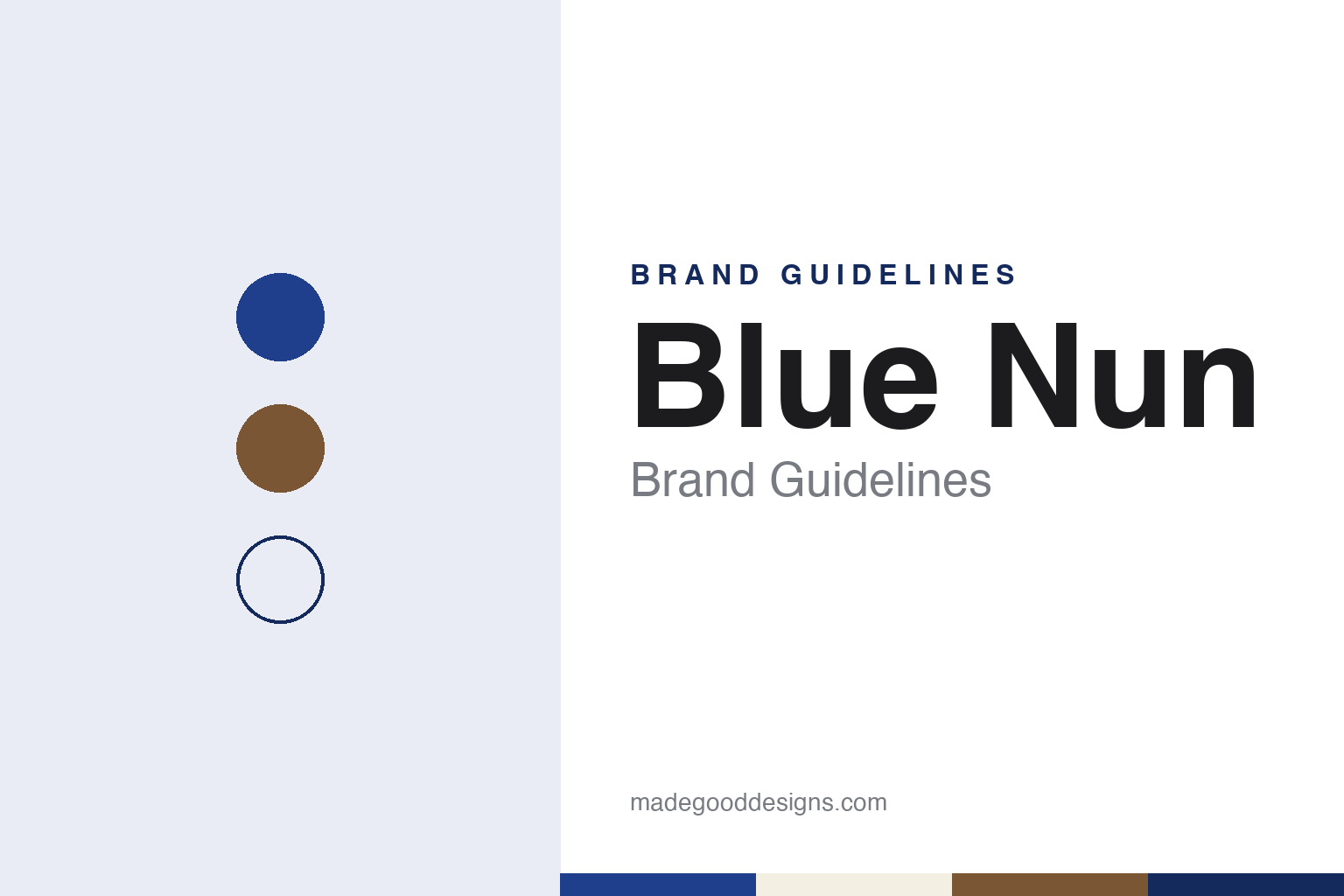
Two constants: a habit blue, robe brown and vellum palette and a classical book serif register. Abstract homage — not a Blue Nun product or mark; no label, logo or bottle is reproduced.
A Mainz merchant and an export wine
From a family wine house to the first mass-market wine brand.
Blue Nun began in Mainz, on the Rhine. English Wikipedia says the brand was launched by the Mainz company H. Sichel Söhne in 1923, using wine from the 1921 vintage. The family business was much older than the brand: The Wine Economist wrote in February 2010 that Blue Nun’s roots go back to 1857, when Hermann Sichel started a wine business in Mainz, and that the firm’s push into export began with the 1921 vintage, a year it described as said to be one of the best.
The brand was built for export from the start. English Wikipedia says Sichel opened a UK office in 1927 to target overseas buyers, and The Wine Economist reported that the wine was selling more than a thousand cases a year in England in the 1930s. The idea behind the label, English Wikipedia says, was to offer a consumer-friendly alternative to the many German wine labels set in Gothic script and carrying long, complicated vineyard and village names. One short English name and one picture did the work that a dense German label otherwise left to the buyer.
After the Second World War the brand became widely popular in the United Kingdom and the United States. From the 1950s, English Wikipedia says, Blue Nun was advertised as a wine that could be drunk throughout an entire meal, removing the question of which wine to pair with which course. The same article describes it as arguably the first wine produced and marketed with an international mass market in mind. In the United States in the 1970s the brand ran radio advertisements featuring the comedy duo Stiller and Meara, which People magazine wrote about in May 1977.
The peak came in the mid-1980s. Citing The Oxford Companion to Wine (fourth edition, 2015), English Wikipedia gives annual United States sales of 1.25 million cases in 1984–1985, with another 750,000 cases sold in other markets. In Britain, The Wine Economist reported, sales had risen to 3.5 million bottles a year in the 1970s.
Colour
A nun on the label, and a blue that became the name.
The name and the picture are the same idea: a figure of a nun and a short English name. English Wikipedia credits the brand with a label designed as a consumer-friendly alternative to German labels set in Gothic script with long, complicated names, and it describes the 1950s advertising as built on the same simplicity, presenting Blue Nun as one wine for a whole meal.
The colour has its own story. The Wine Economist wrote in 2010 that the nun on the label was originally shown in standard brown robes and that a printer’s error turned them blue, a detail that has become part of the brand’s lore. This guide takes that blue-and-brown pairing as its palette.
For most of its life Blue Nun was a single wine. English Wikipedia says it was classified as a Liebfraumilch, the semi-sweet blended German white, until the late 1990s. From the late 1980s, the Oxford Companion notes, easy-drinking semi-sweet German wines fell out of favour, and the brand came to be seen as dated. The Wine Economist reported that British sales fell back to 800,000 bottles in the 1980s. In 2007 The Scotsman noted the wine’s role as the drink of choice of Alan Partridge, Steve Coogan’s fictional broadcaster, and the Beastie Boys named a 1992 track on Check Your Head after it.
The reinvention changed the wine as well as the pack. After the 1996 change of ownership, English Wikipedia says, the brand was reclassified from Liebfraumilch to a regular Qualitätswein, the grapes moved from Müller-Thurgau to a blend with 30% Riesling, and the wine was made less sweet. From 2001, the same article says, the name was extended to other wines, including a German Riesling ice wine, a Merlot from the Languedoc and a Spanish rosé, so that Blue Nun became a range rather than one bottle.
The brand also tried new formats. The Guardian reported in May 2009 that Blue Nun had launched Blue Nun Gold, a sparkling wine containing flakes of 22-carat gold, aimed at younger women drinkers and intended to position the brand differently. The Wine Economist reported in 2010 that the brand sold 5 million bottles in Britain alone in 2005.
Typography
Design and documentation.
The seven brands in this group are all European wine names: Mateus, Lancers, Blue Nun, Black Tower, Freixenet, Codorníu and Campo Viejo. European wine brands in general sit at many different points in the trade, from family houses that still carry a founder’s name to labels that now belong to much larger drinks groups, and a single brand can be sold everywhere from a corner shop to a restaurant list.
A wine brand’s identity is usually carried less by a single bottle than by a label, a name and the place it promises, because the company behind the name may have changed hands, moved its production or grown far beyond the place where it started. That makes the questions behind each name worth asking plainly: who started it, who owns it now, and where its wine is actually made and bottled.
Each guide separates what independent sources record from what the company says about itself — its founding story, its owners over time, where its wine is made and how its labels have changed — and marks plainly what rests only on the company’s own word.
Aa
A classical book serif for a short English name on a German wine. (Specimen set in Cormorant Garamond, a serif STAND-IN; NOT the Blue Nun logo.)
Blue Nun
From Sichel to Langguth to a French wine group.
Blue Nun has had three owners. The first was the Sichel family house in Mainz. English Wikipedia says the Mosel-based family firm F.W. Langguth Erben bought Sichel, and with it Blue Nun, in 1996. Langguth was itself an old house: English Wikipedia says it was founded in 1789 by Franz Wilhelm Langguth in Traben-Trarbach on the Mosel, and lists Erben and Medinet as its main brands at home, with Blue Nun its best-known international name.
The third owner is French. BKWine reported in April 2024, under the headline “The German Blue Nun becomes French,” that Les Grands Chais de France, one of France’s largest wine companies, owned by Joseph Helfrich, was set to take over Langguth. English Wikipedia, citing Just Drinks, says the acquisition took place in the spring of 2024, and that in May 2024 the new owner announced the closure of the Traben-Trarbach site, citing a lack of profitability. The closure ended winemaking at the Langguth site that had made Blue Nun since the 1990s; the brand itself passed to the new owner.
Les Grands Chais de France has since put the brand back on British shelves. Just Drinks reported in September 2026 that the group had relaunched Blue Nun in the UK with new packaging and an initial focus on online retail, starting with two wines, an Authentic White and a Riesling. The group says Blue Nun has sold more than a billion bottles across 64 countries, and it dates the brand from the 1921 vintage on which it was launched.
For a design guide, Blue Nun shows how much a label can do with one image and two words: a picture that names the wine, a colour that became the name, and a brand that outlived the style of wine it was built on. Compare it with another German export wine with a short English name, Black Tower, and with Portugal’s Mateus, another European wine brand in this series. For this guide we use habit blue, robe brown and vellum with a classical book serif, an unofficial interpretation; no product or logo is reproduced.
Explore & save
Keep Blue Nun’s identity on hand — save it to a board in the Made Good inspiration library.
Blue Nun identity set
Pin the Blue Nun habit blue, robe brown and vellum palette and the classical book serif register to your own board.