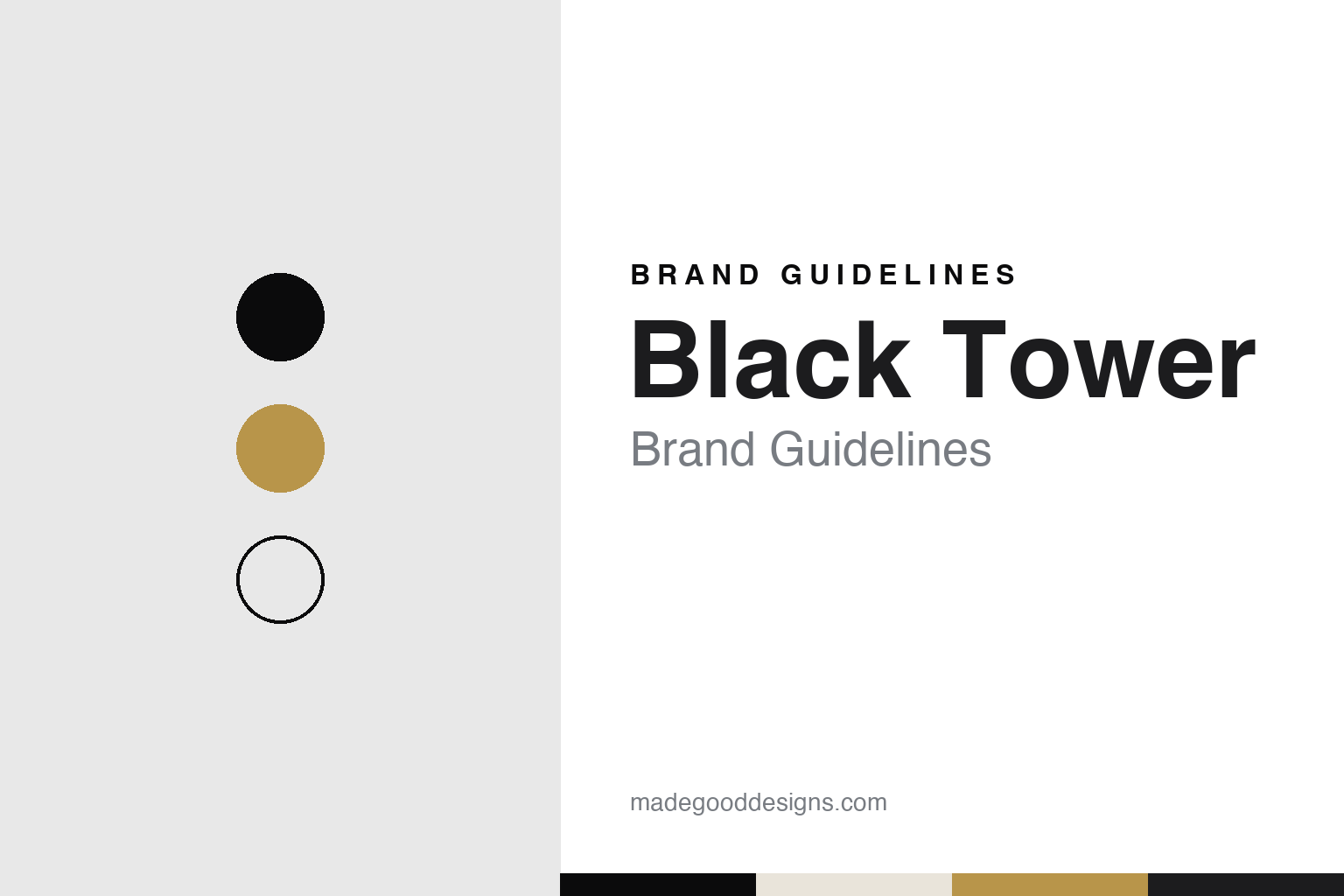
Black Tower Brand Guidelines
Reh Kendermann’s black-bottle wine from Bingen.
Aa
Two constants: a bottle black, crest gold and Rhine stone palette and an inscriptional capitals serif register. Abstract homage — not a Black Tower product or mark; no label, logo or bottle is reproduced.
Two family cellars on two rivers
From a Mosel grape trader and a Bingen cellar to one company.
Black Tower is a German wine brand made by Reh Kendermann, a family-run wine company based in Bingen am Rhein, where the Nahe meets the Rhine. The company is the product of two older businesses. German Wikipedia says Carl Reh founded a trading business for grapes, must and wine in 1920 in Leiwen on the Mosel, and set up a cellar there some seven years later. The second business was the cellar of Hermann Kendermann in Bingen, which German Wikipedia dates to 1947.
The two came together in stages. German Wikipedia says the Reh business acquired Hermann Kendermann GmbH Weinkellerei of Bingen in 1992, and that the purchase included Black Tower, which the article describes as considered the best-selling German wine brand in the world. In 1997 the two cellars were combined and the company was renamed Reh Kendermann GmbH Weinkellerei. The family line runs through the management: German Wikipedia records that Carl Reh and his son Günther Reh shared the running of the business from 1949, that Carl Reh Junior, the founder’s grandson, took over the management in 1987, and that in 1999 Andrea and Carl Reh Junior took full ownership. Alexander Rittlinger joined the management in 2015, and the company describes itself as family-run in the third generation.
The brand’s exact start date is given differently by different sources. The trade magazine Harpers reported in March 2017 that Black Tower was celebrating its 50th birthday, which points to 1967, while British supermarket listings say the wine was first launched in 1968. The company’s own brand page says only that Black Tower has been enjoyed around the world for more than fifty years, and places the first stir around its black bottle in the 1950s.
Colour
A black bottle, and a name that describes it.
The bottle is the brand. Reh Kendermann’s own account of Black Tower begins with it: the company says the story “began with a jet-black bottle” and a name that is now recognised around the world. Black Tower is a short English name for a German wine, and the company’s brand page ties the name and the bottle together from the start.
The trade press has treated that bottle as the brand’s fixed point. Wholesale Manager called it the brand’s “iconic black bottle” in March 2008, in a report on sales passing one million nine-litre cases a year worldwide, ahead of the brand’s summer 2008 target. The same report named the United Kingdom as Black Tower’s largest export market. When Harpers covered the 50th birthday in March 2017, the anniversary was marked on the bottle itself: the core range was rolled out with a gold 50th crest, alongside a campaign called #CheersToMe built around everyday personal achievements, run across press, sponsorship and sampling.
The company says the brand has stayed true to type since its early years while becoming more modern in design, and that it still keeps its unique look. The range has widened around the bottle. Reh Kendermann says Black Tower has expanded its choice of grape varieties and blends, and now comes in various bottle sizes, pouches, bag-in-box and, more recently, Tetra Pak cartons, which the company describes as light, unbreakable and sustainable. British retailers list wines such as a Fruity White, a Smooth Red, a Rosé and a Pinot Grigio under the name.
The name also travels widely. The company says Black Tower is exported to more than 35 countries and calls it Germany’s number one export wine brand. German Wikipedia, citing a 2010 Datamonitor study, gives Reh Kendermann a share of about 12% of the German wine market in 2010.
Typography
Design and documentation.
The seven brands in this group are all European wine names: Mateus, Lancers, Blue Nun, Black Tower, Freixenet, Codorníu and Campo Viejo. European wine brands in general sit at many different points in the trade, from family houses that still carry a founder’s name to labels that now belong to much larger drinks groups, and a single brand can be sold everywhere from a corner shop to a restaurant list.
A wine brand’s identity is usually carried less by a single bottle than by a label, a name and the place it promises, because the company behind the name may have changed hands, moved its production or grown far beyond the place where it started. That makes the questions behind each name worth asking plainly: who started it, who owns it now, and where its wine is actually made and bottled.
Each guide separates what independent sources record from what the company says about itself — its founding story, its owners over time, where its wine is made and how its labels have changed — and marks plainly what rests only on the company’s own word.
Aa
An inscriptional capitals serif for a dark bottle and a short English name. (Specimen set in Cinzel, a serif STAND-IN; NOT the Black Tower logo.)
Black Tower
An export brand turning to its home market.
Black Tower has long sold mainly abroad. The German drinks trade site about-drinks.com reported in January 2024 that Black Tower had been for decades the most popular German wine brand outside Germany and remained the most important pillar of Reh Kendermann’s business. The same report said the company was working on a relaunch of the brand and on sparkling versions, and that the new Club Edition wines were the first Black Tower range listed nationwide in Germany, growing among drinkers under 35 though below the company’s expectations.
That report also set out a difficult year. about-drinks.com said the brand had taken losses from weak business in Scandinavia and the United Kingdom and that Reh Kendermann had entered a strategic partnership with the Pfalz estate Weingut Vollmer in Ellerstadt from January 2024. The company exports to 39 countries, the report said, and is led by managing director Alexander Rittlinger.
Sichel’s Blue Nun, another short English name on a German export wine, followed a different path. Blue Nun passed through two takeovers and, in 2024, into French ownership; Black Tower has stayed with the family company that bought it in 1992, and is still made by Reh Kendermann, based in Bingen. For the lettering on the label, see our guide to the Black Tower font.
For a design guide, Black Tower shows how a single object can carry a wine brand for more than half a century: a black bottle, a two-word name that describes it, and a pack that has changed format while keeping its colour. Compare it with another German export wine, Blue Nun and with Portugal’s Lancers, another European wine brand in this series. For this guide we use bottle black, crest gold and Rhine stone with an inscriptional capitals serif, an unofficial interpretation; no product or logo is reproduced.
Explore & save
Keep Black Tower’s identity on hand — save it to a board in the Made Good inspiration library.
Black Tower identity set
Pin the Black Tower bottle black, crest gold and Rhine stone palette and the inscriptional capitals serif register to your own board.