Sandeman Brand Guidelines
The London port and sherry house of the caped Don, since 1790.
Aa
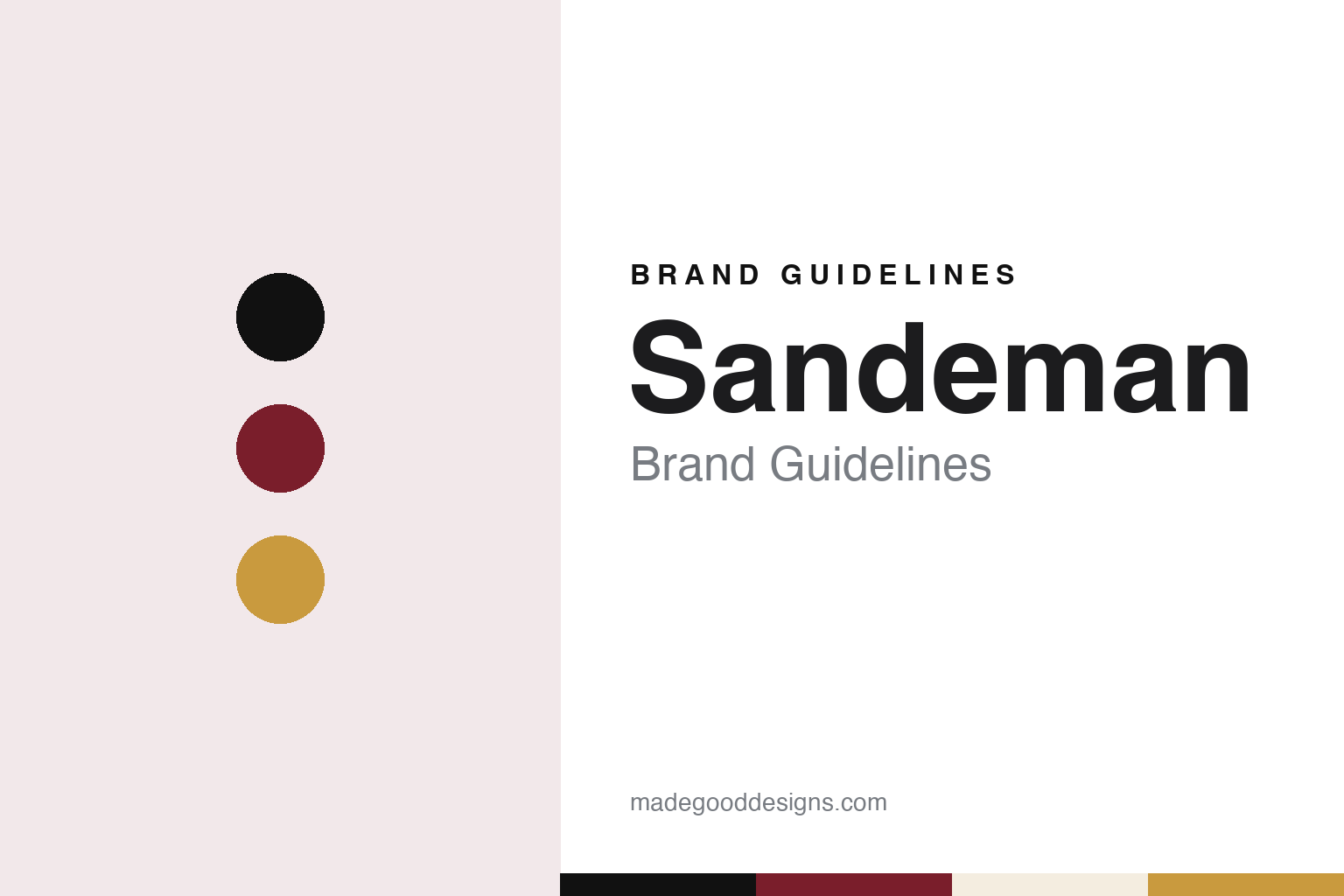
Two constants: a cape black, port red and sherry gold palette and a Didone poster serif register. Abstract homage — not a Sandeman product or mark; no label, logo or bottle is reproduced.
A coffee house in the City
A family loan, a London coffee house and a lodge across the river from Porto.
Sandeman began in London in 1790. The company says George Sandeman, a 25-year-old Scot from Perth and the son of a cabinetmaker, set up as a wine merchant with a loan from his father, and that he did his early trading not from an office but from Tom’s Coffee House on Birchin Lane in the City, where deals were agreed on a gentleman’s word. English Wikipedia, citing Julian Jeffs’s book Sherry and Charles Ludington’s The Politics of Wine in Britain (2013), names George’s brother David Sandeman as a co-founder and says David, more interested in banking than wine, left in 1798 to found the Commercial Bank of Scotland, leaving George in sole charge.
From the start the house dealt in the two fortified wines of the Iberian peninsula: port from the Douro and sherry from Jerez. The company says it began branding its wooden casks with the initials GSC, burned in with a hot iron, in 1805, and that in 1811 it bought lodges in Vila Nova de Gaia, across the Douro from Porto, to age and store port before shipment. Those cellars, the company says, still hold more than 2,000 casks.
Sherry gained a base of its own later in the century. The company says that in 1879 it acquired the assets of its Jerez partner Julian Pemartin, including vineyards, stocks and bodegas in Jerez de la Frontera. The business stayed in the family through the nineteenth century: English Wikipedia says it passed first to George’s nephew George Glas Sandeman, and that Albert George Sandeman, a later head of the firm, served as Governor of the Bank of England.
Colour
A cape, a hat and a printer’s studio in 1928.
The figure that carries the brand is the Don, a black silhouette of a man in a cape and a wide-brimmed hat. English Wikipedia, citing the company, describes the cape as that of a Portuguese student and the hat as an Andalusian type, so that one figure stands for the two countries the house bought from, Portugal for port and Spain for sherry.
The company credits the original artwork to George Massiot Brown, an artist born in Ayrshire, Scotland, who it says created it in 1928, aged 38, while working at the studio of the Lochend Printing Company in London. He signed his work without the name “Brown,” the company says, to give it a more Continental feel. The People’s Graphic Design Archive lists the Sandeman logo of 1928 under his name. According to the company, the Don entered national advertising in 1930 and appeared on labels from 1934, and it remains on Sandeman bottles today.
The house also had an early legal mark. The company says the name “GSC George Sandeman & Co.” was registered as a trademark in 1877, a year after England’s first trade mark registration act came into force.
The packaging around the Don has been rethought more than once. Design Week reported in April 2006 that the London consultancy Wren & Rowe had revamped Sandeman’s identity and packaging. In May 2016 Drinks International reported that the agency Stranger & Stranger had spent eighteen months on new packaging for Sandeman’s aged tawny ports, beginning with a review of the house archive. The design replaced dark bottles and black-and-white labels with clear glass, so the colour of the wine shows, and yellow labels that grow paler across the range. Rupert Lovie, Sogrape’s marketing manager, told the magazine: “We are shaking up the category a bit.”
Typography
Design and documentation.
The seven brands in this group are all port and sherry names: Sandeman, Graham’s, Taylor’s, Cockburn’s, Dow’s, Tío Pepe and Harveys. Port and sherry brands in general sit at many different points in the trade, from family houses that still carry a founder’s name to labels that now belong to much larger drinks groups, and a single brand can be sold everywhere from a corner shop to a restaurant list.
A port or sherry brand’s identity is usually carried less by a single bottle than by a label, a name and the place it promises, because the company behind the name may have changed hands, moved its production or grown far beyond the place where it started. That makes the questions behind each name worth asking plainly: who started it, who owns it now, and where its wine is actually made, aged and bottled.
Each guide separates what independent sources record from what the company says about itself — its founding story, its owners over time, where its wine is made and how its labels have changed — and marks plainly what rests only on the company’s own word.
Aa
A high-contrast Didone serif in the spirit of a 1920s poster. (Specimen set in Bodoni Moda, a serif STAND-IN; NOT the Sandeman logo or the Don.)
Sandeman
From a family firm to a Portuguese wine group.
The family era ended in the twentieth century. English Wikipedia, citing The Daily Telegraph, says Sandeman remained a family business until the Canadian drinks company Seagram bought it in 1979. When Seagram’s drinks business was divided, Sandeman passed to Diageo and Pernod Ricard; The Daily Telegraph reported in July 2001 that the Portuguese wine company Sogrape had lined up a purchase, and Sogrape and Sandeman both date the acquisition to 2002. A case study on Sogrape published by Lisbon’s ISEG business school describes the deal as covering the Sandeman business in both Porto and Jerez.
Under Sogrape the house is run from Vila Nova de Gaia, where its riverside cellars are open to visitors and, the company says, display a collection of old English bottles dating from 1650. In the Douro, the company says it opened a new winery in 2007 at Quinta do Seixo, near Pinhão. The range still spans port and sherry, and English Wikipedia lists brandy and Madeira among its products too. The family name has not left the business: English Wikipedia, citing the Swedish reference site Vintageport.se, says George Thomas David Sandeman, a descendant of the founder, sits on the board of Sogrape Vinhos.
The name needs a little care online. Sandeman is also a Scottish surname shared by a banker, a theologian and several sportsmen; the wine house’s own site is sandeman.com.
For a design guide, Sandeman shows how one black silhouette, drawn by a printer’s artist in 1928, can stand for two wines, two countries and more than two centuries of trading without needing the founder’s portrait or a coat of arms. Compare Tío Pepe, the fino sherry of Jerez, and Graham’s, another port house with lodges in Vila Nova de Gaia. For this guide we use cape black, port red and sherry gold with a Didone serif, an unofficial interpretation; no product or logo is reproduced.
Explore & save
Keep Sandeman’s identity on hand — save it to a board in the Made Good inspiration library.
Sandeman identity set
Pin the Sandeman cape black, port red and sherry gold palette and the Didone poster serif register to your own board.