Graham’s Brand Guidelines
The Glasgow textile traders’ port house, since 1820.
Aa
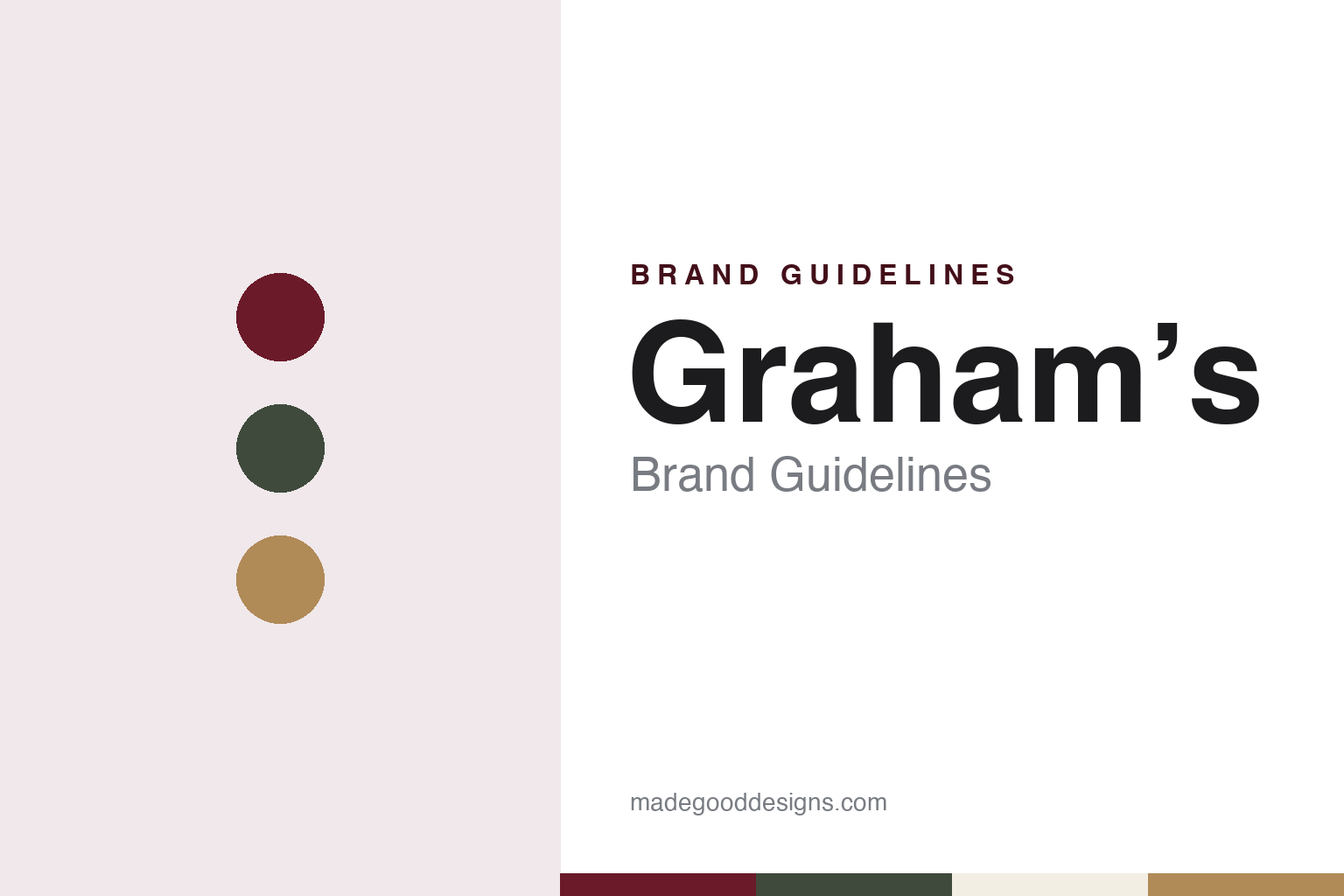
Two constants: a vintage ruby, Douro green and cask oak palette and an old-style Garalde serif register. Abstract homage — not a Graham’s product or mark; no label, logo or bottle is reproduced.
Twenty-seven pipes for a debt
A Glasgow textile firm that was paid in wine.
Graham’s did not begin as a wine business. English Wikipedia, citing the business historian Geoffrey Jones’s Merchants to Multinationals (2002), says William Graham set up a trading company in Glasgow in 1784 and over the following decade built it into an exporter of textiles and dry goods. In 1820, citing the port writer Richard Mayson’s Port and the Douro (2019), it says his son John accepted twenty-seven pipes of port, the large casks of the Douro trade, in place of a debt. The company tells the same story: William and John Graham, textile traders, took the wine as payment and decided to make port their business. English Wikipedia gives the founding place as Porto, and the house trades as W. & J. Graham’s, or simply Graham’s.
The house then put down roots on both banks of the Douro. The company says that in 1890 it acquired Quinta dos Malvedos, a vineyard estate in the Upper Douro Valley, and calls Graham’s one of the first port brands to buy land there. English Wikipedia, citing Jim Gordon’s The Wine Opus (2010), describes the purchase as securing the firm’s own supply of grapes. In the same year, the company says, it built the Graham’s Lodge in Vila Nova de Gaia, across the river from Porto, where its wines are aged.
The family that now owns the house was linked to it long before it bought it. English Wikipedia, citing Mayson, says Andrew James Symington joined the Grahams’ textile business in 1882, before leaving to become a partner in the port house Warre & Co. in 1905.
Colour
Six grape clusters burned on a cask.
The house’s best-known symbol began as a mark on wood. The Tasting Panel magazine reported in October 2014 that in the early 1900s W. & J. Graham began using a stylised symbol of six three-grape clusters, first burned and later stamped onto the casks that held wines with the potential to become vintage port. The reserve port named after that mark, Six Grapes, is the company’s reserve port, English Wikipedia says, citing Karen MacNeil’s The Wine Bible. The company says that about eighteen months after a harvest it chooses the wines to be bottled as vintage port and sets the remainder aside for Six Grapes. The Drinks Business reported in June 2021 that a new look for Six Grapes drew on the original stencils used to mark the barrels of the best wine from each harvest.
Vintage port remains the centre of the range. English Wikipedia, citing Robert Parker’s wine buyer’s guide, places Graham’s among the houses, alongside Dow’s, Fonseca and Warre’s, whose declarations count when a year is judged a vintage, and it lists the 1948, 1963 and 1985 vintages as particularly noted, citing James Suckling’s 1990 guide for Wine Spectator. Quinta dos Malvedos also gives its name to a single-quinta port made in years without a general declaration.
The lodge itself became a piece of design work. The design magazine Yatzer reported in January 2014 that the renovated visitor centre at Graham’s 1890 Lodge was the work of the architect Luis Loureiro with the Lisbon studio P-06 Atelier, under the creative direction of Nuno Gusmão, and that it was inaugurated by the president of Portugal in March 2013. The magazine noted casks in the cellars dating back to 1868.
Typography
Design and documentation.
The seven brands in this group are all port and sherry names: Sandeman, Graham’s, Taylor’s, Cockburn’s, Dow’s, Tío Pepe and Harveys. Port and sherry brands in general sit at many different points in the trade, from family houses that still carry a founder’s name to labels that now belong to much larger drinks groups, and a single brand can be sold everywhere from a corner shop to a restaurant list.
A port or sherry brand’s identity is usually carried less by a single bottle than by a label, a name and the place it promises, because the company behind the name may have changed hands, moved its production or grown far beyond the place where it started. That makes the questions behind each name worth asking plainly: who started it, who owns it now, and where its wine is actually made, aged and bottled.
Each guide separates what independent sources record from what the company says about itself — its founding story, its owners over time, where its wine is made and how its labels have changed — and marks plainly what rests only on the company’s own word.
Aa
An old-style Garalde serif for a house name in the cellar-book tradition. (Specimen set in Cormorant Garamond, a serif STAND-IN; NOT the Graham’s logo.)
Graham’s
From the Graham family to the Symingtons.
The Grahams kept the house for 150 years. English Wikipedia, citing Mayson, says that by the 1960s, like many old port names, Graham’s was in financial difficulty, and that the family sold it to the Symington family in 1970; the company says the new owners marked the change with the 1970 vintage port. The Graham name stayed in the trade: English Wikipedia says the brothers Anthony, Jonny and William Graham created Churchill Graham in 1981, the firm later known as Churchill’s. It also says the Symingtons repurchased Quinta dos Malvedos, which had left the firm, in 1982, in a poor state, and revived it.
Today Graham’s belongs to Symington Family Estates, the family company that also owns Dow’s, Warre’s and Cockburn’s. The B Corp directory lists Symington Family Estates as a certified B Corporation since July 2019. The Drinks Business reported in April 2017 that Graham’s had received a Royal Warrant to supply port to the British royal household. Decanter reported in April 2017 that the owner had bought its first vineyard outside the Douro, in Portalegre in the Alto Alentejo.
The house has also aimed at new drinkers. The Drinks Business reported in February 2019 on Blend Nº5, a white port made to be mixed with tonic water, and in July 2021 on Blend Nº12, a ruby port for the bar trade. The company marked its bicentenary in 2020 with a Bicentenary Collection of tawny and vintage ports.
For a design guide, Graham’s shows how a working mark burned onto casks to rank the best wine of a harvest can become the name and image of a product sold around the world. Compare Dow’s, its sister house under the Symingtons, and Cockburn’s, another British-founded port house in the same family group. For this guide we use vintage ruby, Douro green and cask oak with a serif, an unofficial interpretation; no product or logo is reproduced.
Explore & save
Keep Graham’s’s identity on hand — save it to a board in the Made Good inspiration library.
Graham’s identity set
Pin the Graham’s vintage ruby, Douro green and cask oak palette and the old-style Garalde serif register to your own board.