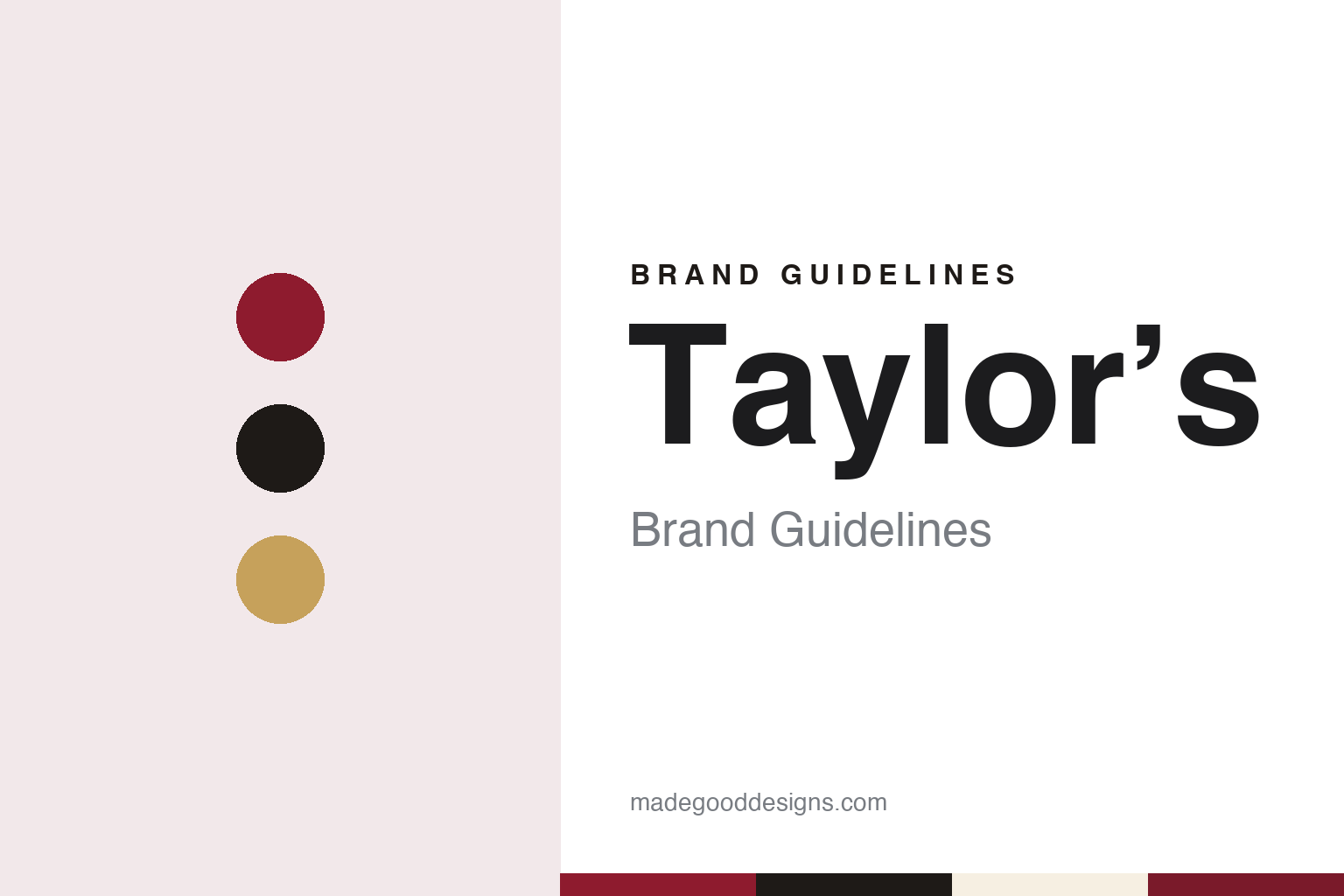
Taylor’s Brand Guidelines
The Port house Job Bearsley founded in 1692.
Aa
Two constants: a vintage ruby, lodge red and parchment palette and a classical book serif register. Abstract homage — not a Taylor’s product or mark; no label, logo or bottle is reproduced.
An English merchant in Portugal
From Job Bearsley to a partnership deed of 1838.
Taylor’s is the trading name of Taylor, Fladgate & Yeatman, one of the oldest of the Port houses. English Wikipedia describes it as one of the largest Port wine houses and gives its founding as 1692, in Vila Nova de Gaia, across the Douro river from Porto, by Job Bearsley. The company’s own history calls Bearsley an English merchant and says the firm has remained independent ever since. English Wikipedia notes that the house is often called Taylor Fladgate, the form of the name used for its wines in the United States.
The early chapters, as the company tells them, belong to the Bearsley family. It says Peter Bearsley was the first English merchant to travel up into the Douro himself, in the 1720s, and that in 1744 Bartholomew Bearsley bought the firm’s first property in the valley, at Lugar das Lages near Régua.
The three names on today’s label arrived in the 19th century. The company says Joseph Taylor became a partner in 1814 and the sole owner of the business in Portugal in 1826, and that he chose John Fladgate and Morgan Yeatman as his successors. A partnership deed of 1838 fixed the name Taylor, Fladgate & Yeatman, a date English Wikipedia also gives. Fladgate later became a Portuguese baron, the Barão da Roêda, the company says, after the Quinta da Roêda that the firm bought in 1844 and that was later sold to the house of Croft.
The 20th century belonged to the Yeatman family and, later, to their successors by marriage and invitation. The company says Alistair Robertson was invited to join the firm in 1966 and led its modernisation, and that Adrian Bridge, who married into the Robertson family, arrived in Portugal in 1994 and became managing director in 2000. The winemaker David Guimaraens joined the winemaking team in 1990, according to the same history. In 1949 Taylor’s bought the Port house Fonseca, and the combined business later traded as Taylor Fonseca.
Colour
A merchant’s mark, a Douro estate and a new style of Port.
The oldest visual element is not a logo but a merchant’s mark. The company says that for the firm’s 325th anniversary in 2017 it made a commemorative bottle modelled on one from around the time of its foundation — the earliest intact dated bottle carrying the merchant’s mark, a “4” combined with “XX”, which it still uses as its trademark. The same sign appears in a United States trademark registration of 2007 for “1692 4XX Taylor Fladgate,” and the founding year, 1692, is written into the brand’s identity in the same way.
The estate behind the name is Quinta de Vargellas, in the upper Douro. The Oxford Companion to Wine says Taylor’s acquired it in 1893, during the phylloxera crisis; the company’s history gives Lower and Middle Vargellas in 1893 and Upper Vargellas in 1896, merged into one estate. The firm added Quinta de Terra Feita in 1974, a property it had bought wine from since the previous century, the company says.
The house’s best-known innovation is a style of Port. English Wikipedia says Taylor’s invented Late Bottled Vintage Port, and the company says it launched the first LBV in 1970, using wine from the 1965 harvest. The Oxford Companion to Wine credits Taylor’s with popularising the filtered LBV style in the late 20th century. The company also says it introduced Chip Dry, which it describes as the first dry white Port, in 1934, and that in 1973, when new rules allowed an age to be stated on tawny labels, it released 10, 20, 30 and 40-year-old tawnies.
In the early 21st century the house moved into small, rare releases, which the Oxford Companion describes as a pioneering line of luxury Port. The company lists Scion in 2010 and a Single Harvest 1863 tawny in 2014, and in 2025 a release called The Globe, inspired by the shape of a mid-17th-century “shaft and globe” bottle.
The name has one complication in America. In a 2023 interview with The Drinks Business, Adrian Bridge said that a separate, unrelated Taylor brand based in New York had registered the Taylor trademark in the United States in 1922, two years before the Portuguese house tried to do the same, and that the company owns the trademark everywhere else.
Typography
Design and documentation.
The seven brands in this group are all port and sherry names: Sandeman, Graham’s, Taylor’s, Cockburn’s, Dow’s, Tío Pepe and Harveys. Port and sherry brands in general sit at many different points in the trade, from family houses that still carry a founder’s name to labels that now belong to much larger drinks groups, and a single brand can be sold everywhere from a corner shop to a restaurant list.
A port or sherry brand’s identity is usually carried less by a single bottle than by a label, a name and the place it promises, because the company behind the name may have changed hands, moved its production or grown far beyond the place where it started. That makes the questions behind each name worth asking plainly: who started it, who owns it now, and where its wine is actually made, aged and bottled.
Each guide separates what independent sources record from what the company says about itself — its founding story, its owners over time, where its wine is made and how its labels have changed — and marks plainly what rests only on the company’s own word.
Aa
A classical book serif for a house with a 17th-century founding date. (Specimen set in Cormorant Garamond, a serif STAND-IN; NOT the Taylor’s logo.)
The Fladgate Partnership
A family group built around the oldest name.
Taylor’s is now the lead brand of a wider group. The Oxford Companion to Wine says The Fladgate Partnership was formed in 2001, when Taylor Fonseca bought the houses of Croft and Delaforce from Diageo; Delaforce was later sold, and English Wikipedia lists the Krohn brand as another later sale. The partnership takes its name from Taylor’s full title and remains family owned.
The group has also built on the riverbank in Vila Nova de Gaia. It opened The Yeatman, a hotel, in 2010, The Drinks Business reported in 2011, and in July 2020 it opened World of Wine, a riverside quarter of museums and restaurants, Decanter reported. In August 2023 The Drinks Business reported that Taylor’s had bought the assets, stocks and estates in the Minho, Dão and Bairrada of the Portuguese wine company Ideal Drinks, taking the group beyond the Douro.
The Douro holdings remain the core. The Oxford Companion lists later estate purchases including Terra Feita de Cima in 1990, São Xisto in 1993 and Quinta do Junco in the late 1990s, and the company says it introduced its First Estate Port in 1988.
The name needs a little care online. Taylors of Harrogate, the Yorkshire tea and coffee company, is an unrelated business, and the American Taylor Port sold in the United States is a separate brand from Taylor’s. The Port house’s own site is taylor.pt.
For a design guide, Taylor’s shows how a merchant’s mark of the 1690s, a founding date and three partners’ surnames can carry a Port brand through more than three centuries of ownership by a handful of families. Compare Sandeman, another Port house with a long history in Vila Nova de Gaia, and Cockburn’s, the house founded in 1815. For this guide we use vintage ruby, lodge red and parchment with a serif, an unofficial interpretation; no product or logo is reproduced.
Explore & save
Keep Taylor’s’s identity on hand — save it to a board in the Made Good inspiration library.
Taylor’s identity set
Pin the Taylor’s vintage ruby, lodge red and parchment palette and the classical book serif register to your own board.