Lindeman’s Brand Guidelines
Dr Henry Lindeman’s Hunter Valley wine, founded 1843.
Aa
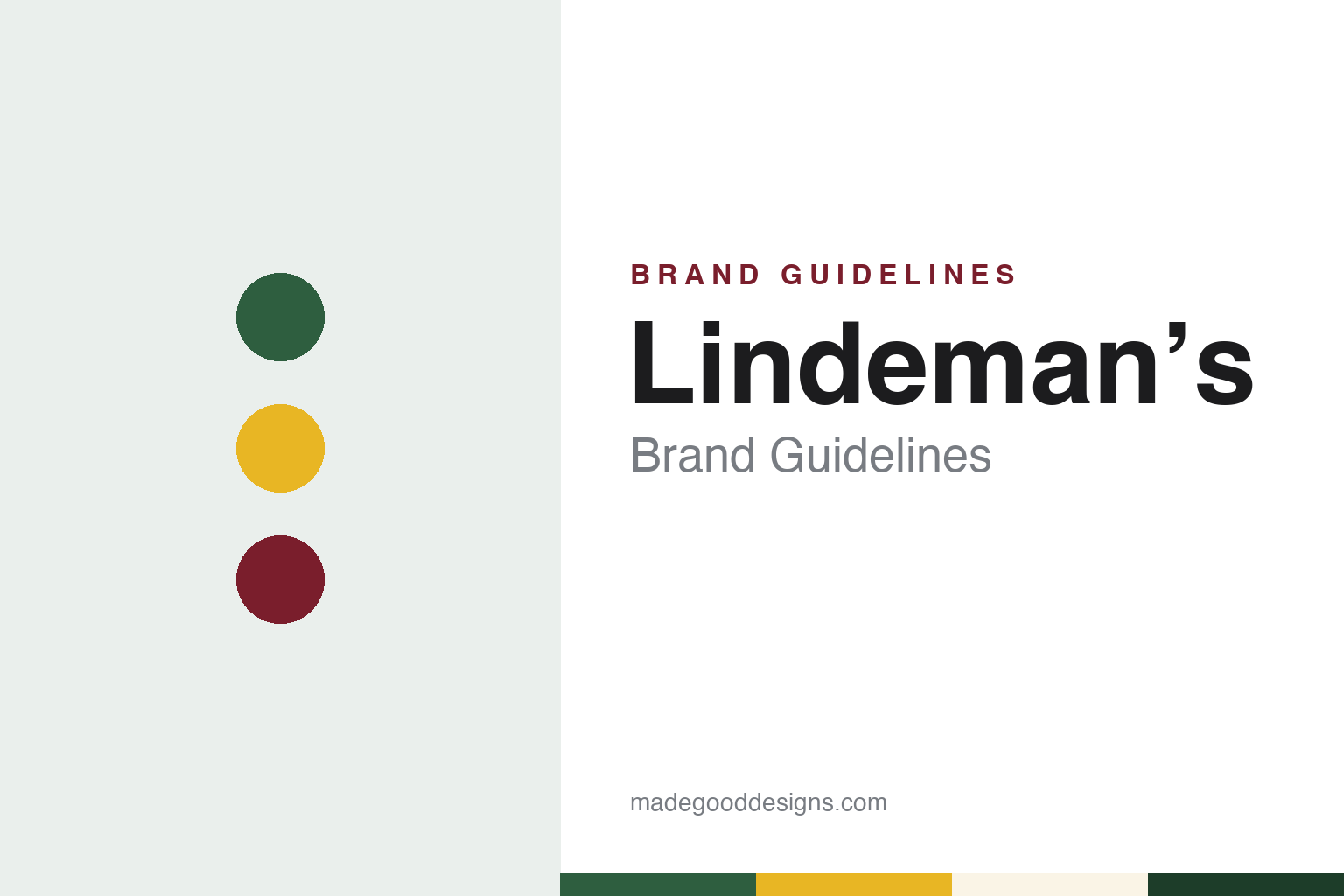
Two constants: a gum-leaf green, sunflower yellow and claret palette and a classical old-style serif register. Abstract homage — not a Lindeman’s product or mark; no label, logo or bottle is reproduced.
A doctor’s vineyard on the Paterson River
From Cawarra in the Hunter to one of Australia’s oldest wine names.
Lindeman’s is one of the oldest names in Australian wine. English Wikipedia says the company was founded in 1843 by Dr Henry John Lindeman, who planted its first vines at Cawarra, near Gresford on the upper Paterson River in the Hunter Valley of New South Wales; it cites a report in the Maitland Mercury of September 1851 for the property. The brand is written with an apostrophe: Lindeman’s.
Cawarra was small but well equipped. English Wikipedia, citing The Australasian of May 1890, says the vineyard covered only about 40 acres but had cellars and other plant for making wine from grapes grown elsewhere in the region, and that Lindeman also kept cellars in Sydney for ageing the wine. The Sydney Morning Herald reported Dr Lindeman’s death in May 1881, and the business continued under the family name.
In the twentieth century the company brought in outside talent. The Sydney Daily Telegraph reported in September 1923 that the winery had appointed Leo Buring as governing director and general manager; he left in 1931. English Wikipedia says that in the mid-1950s Lindeman’s made wines still sought by collectors, and that the original Cawarra vineyard no longer exists. Production moved well beyond the Hunter: the company now has vineyards in South Australia’s Barossa Valley, Coonawarra and Padthaway, and at Karadoc near Red Cliffs in Victoria. One name from the Paterson River survives in all of this — the homestead’s, which returned to the label in 2014.
Colour
A Hunter homestead, a wreath of gum leaves and a Latin motto.
Lindeman’s best-known wine is a number, not a place. US trade press dated the launch of Bin 65 Chardonnay to 1985, and the New York Times wine columnist Frank Prial wrote in February 1993 that it had become Australia’s top-selling white-wine export, quoting the critic Robert M. Parker Jr., who called it one of the finest chardonnay values in the world.
The brand has also been good with words. In the 1970s Lindeman’s cask wine was sold with the slogan “You make me smile, Dr Lindeman,” coined by the writer Peter Carey, according to Tony Moore’s 2012 book Dancing with Empty Pockets.
The modern identity has changed in two clear steps. Food & Drink Business reported in October 2014 that Lindeman’s was getting its first makeover in over a decade and its first logo change since a dominant “L” was introduced in 2001. The new crest, designed by the packaging firm The Collective, shows Cawarra, Dr Lindeman’s original homestead, inside a modernised wreath of Australian eucalyptus leaves and gum nuts, with the Latin phrase “Felicitas in Vitae”, which the company translates as “In Life Happiness.” The magazine said the new identity was meant to reflect the brand’s Hunter Valley heritage and to acknowledge its founder. The rollout began with the 2014 Bin Series in Australia and was to reach the US, Canada and Asia over the following months and Europe in March 2015. Sylvie Levesque, then global marketing director, said the brand would champion “heritage, home and happiness.”
Four years later the labels turned to art. For the brand’s 175th anniversary in 2018, Treasury relaunched the Bin series in the United States with labels painted by the Australian artist David Bromley, The Beverage Journal and Just Drinks reported; Bin 65 now carries his sunflowers. For the wordmark and lettering, see our guide to the Lindeman’s font.
Typography
Design and documentation.
The seven brands in this group are all Australian and New Zealand wine names: Wolf Blass, Lindeman’s, Hardys, Banrock Station, Oyster Bay, Cloudy Bay and Kim Crawford. Wine brands in general sit at many different points in the trade, from family houses that still carry a founder’s name to labels that now belong to much larger drinks groups, and a single brand can be sold everywhere from a corner shop to a restaurant list.
A wine brand’s identity is usually carried less by a single bottle than by a label, a name and the place it promises, because the company behind the name may have changed hands, moved its production or grown far beyond the place where it started. That makes the questions behind each name worth asking plainly: who started it, who owns it now, and where its wine is actually made and bottled.
Each guide separates what independent sources record from what the company says about itself — its founding story, its owners over time, where its wine is made and how its labels have changed — and marks plainly what rests only on the company’s own word.
Aa
A classical old-style serif for a nineteenth-century founder’s name and crest. (Specimen set in Cormorant Garamond, a serif STAND-IN; NOT the Lindeman’s logo.)
Lindeman’s
From Southcorp and Foster’s to Treasury Wine Estates.
Lindeman’s reached its present owner through Australia’s wine mergers. It was part of the Southcorp group, alongside Penfolds and Rosemount, when the brewer Foster’s acquired Southcorp in 2005, English Wikipedia says. Foster’s later separated its wine division as Treasury Wine Estates, which became a separately listed company in Melbourne in May 2011, Just Drinks reported, and Lindeman’s has been a Treasury brand since. English Wikipedia notes that Treasury traces its own roots to nineteenth-century wineries, naming Lindeman’s and Penfolds in Australia and Beringer in the United States.
Its strength has long been overseas. The company said in 2014 that Lindeman’s was the number-one-selling Australian wine brand in Canada, Sweden, the Netherlands and Norway, and English Wikipedia describes it as a mass producer of reasonably priced, good-quality wine. Inside Treasury it sits among the larger-volume labels rather than the luxury tier led by Penfolds. Treasury announced in August 2024 that it would look to sell its commercial brands, including Lindeman’s, Wolf Blass, Yellowglen and Blossom Hill, but kept them in February 2025, saying the offers “did not represent compelling value,” WBM reported. From July 2025 Lindeman’s has been part of the Treasury Collective division, trade reports said.
The name needs care online. Lindemans Brewery, the Belgian lambic brewer, is a separate business, and Lindemann, spelled with a double n, is an unrelated audio brand; the wine’s own site is lindemans.com.
For a design guide, Lindeman’s shows how an old brand can turn its founding story into a crest — a homestead, native leaves and a motto — while letting bin numbers and painted labels do the work on the shelf. Compare Wolf Blass, its Barossa stablemate at Treasury, and Penfolds, the Magill winery behind Grange. For this guide we use gum-leaf green, sunflower yellow and claret with a classical serif, an unofficial interpretation; no product or logo is reproduced.
Explore & save
Keep Lindeman’s’s identity on hand — save it to a board in the Made Good inspiration library.
Lindeman’s identity set
Pin the Lindeman’s gum-leaf green, sunflower yellow and claret palette and the classical old-style serif register to your own board.