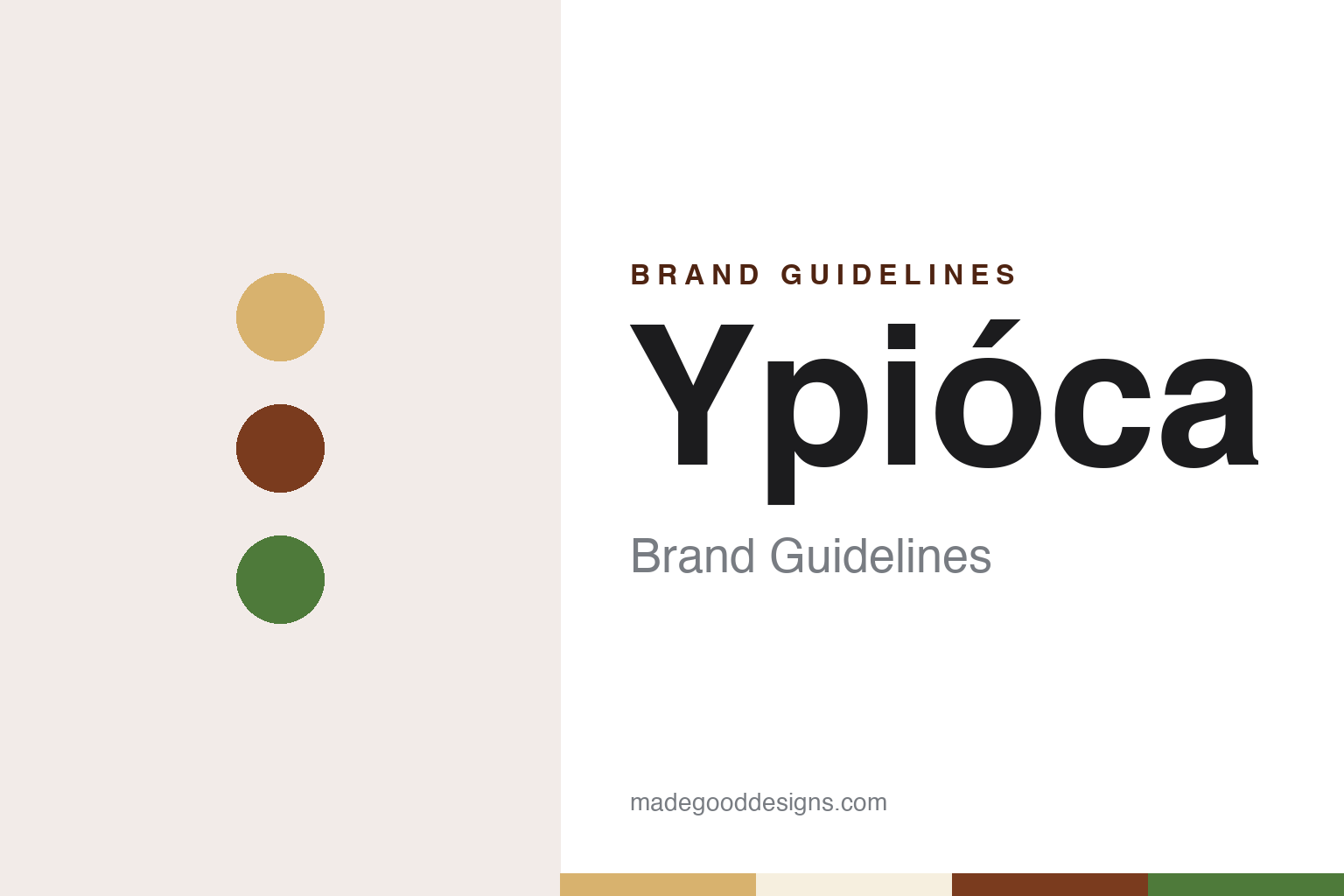
Ypióca Brand Guidelines
The Ceará cachaça of 1846 in its straw-wrapped bottle.
Aa
Two constants: a carnaúba straw, terra roxa and cane green palette and a calligraphic book serif register. Abstract homage — not a Ypióca product or mark; no label, logo or bottle is reproduced.
Red earth near Maranguape
A Portuguese settler, a sugar-cane farm and a name taken from Tupi.
Ypióca is a cachaça, the Brazilian spirit distilled from fermented sugar-cane juice, and it comes from the north-eastern state of Ceará. Portuguese Wikipedia, drawing on the company histories Ypióca 1846–1996 (2001) and Ypióca 160 anos (2006), says the founder, Dario Telles de Menezes, arrived in Ceará from Portugal in 1843 and settled on land near Maranguape, then one of the most prosperous towns in the province. The first litre of Ypióca was distilled there in 1846.
The name came with the land. The company says “Ypióca” comes from Tupi, the language of the indigenous Tupi peoples, and means “terra roxa,” the purple-red earth that suits sugar cane, a meaning repeated in Brazilian press coverage of the brand.
The business stayed in the Telles family for five generations. Portuguese Wikipedia says it passed in 1895 to the founder’s son, Dario Borges Telles, under whom the cachaça was first bottled in 600-millilitre glass bottles. From 1911 his widow, Eugênia Menescal Campos, ran the company and created its first label. Her eldest son, Paulo Campos Telles, took over next and introduced the one-litre bottle, and in 1968, the same article says, he made what it describes as Brazil’s first official export of cachaça, to Germany. In 1970 the group passed to Everardo Ferreira Telles, of the fourth generation.
The family spread the business well beyond the still. Portuguese Wikipedia lists cattle and poultry farming from the 1970s, a paper and cardboard factory using cane bagasse at Pindoretama in 1992, the Naturágua mineral-water business in 1993 and a plastic-bottle factory in 1996.
Colour
A bottle dressed in palm straw.
Ypióca’s best-known design feature is not printed at all. The brand’s classic bottle is wrapped in woven carnaúba straw, the leaf of the carnaúba palm that grows across Ceará. Portuguese Wikipedia credits Paulo Campos Telles with introducing the one-litre bottle covered in carnaúba straw, with a pouring spout. Brazilian press coverage says the wrapping began as protection for glass on rough roads and became the company’s trademark, and that the straw is woven by local women artisans; when Ypióca opened themed kiosks on Rio de Janeiro’s Copacabana beachfront, the trade site Grandes Nomes da Propaganda reported, the same artisans who weave the bottle straw made objects for their decoration.
The other half of the identity is the cask. English Wikipedia, citing the company’s own site, says Ypióca works from five production plants in the Ceará countryside with their own cane fields, uses distilling equipment imported from England and Scotland, and ages its cachaça in wooden barrels. The Museu da Cachaça at the first factory in Maranguape tells the story of the family and the spirit, and English Wikipedia, again citing the company, says it holds what the company describes as the world’s largest wooden barrel, built in 2002.
The range has long been sorted by colour and age. English Wikipedia lists Ypióca Gold and Ypióca Crystal, the aged Ypióca 150, and the second brand Sapupara, in gold and silver versions, alongside lime-flavoured mixed drinks.
Typography
Design and documentation.
The seven brands in this group are all wine and spirits names: Torres, Osborne, Fundador, Ypióca, Blandy’s, Brancott Estate and Villa Maria. Wine and spirits brands in general sit at many different points in the trade, from family houses that still carry a founder’s name to labels that now belong to much larger drinks groups, and a single brand can be sold everywhere from a corner shop to a restaurant list.
A wine or spirits brand’s identity is usually carried less by a single bottle than by a label, a name and the place it promises, because the company behind the name may have changed hands, moved its production or grown far beyond the place where it started. That makes the questions behind each name worth asking plainly: who started it, who owns it now, and where its wine or spirit is actually made and bottled.
Each guide separates what independent sources record from what the company says about itself — its founding story, its owners over time, where its wine or spirit is made and how its labels have changed — and marks plainly what rests only on the company’s own word.
Aa
A calligraphic book serif for a cachaça named in Tupi. (Specimen set in Alegreya, a serif STAND-IN; NOT the Ypióca logo.)
Ypióca
A family brand that joined a global portfolio.
The family sold the brand in 2012. On 29 May that year Family Business Magazine, citing the Financial Times, reported that Diageo, the British owner of Johnnie Walker and Smirnoff, had agreed to buy the cachaça business of the family-owned Ypióca Agroindustrial. Diageo’s annual report filed with the US Securities and Exchange Commission for the 2012 financial year says the deal was completed on 9 August 2012 and covered the Ypióca brand together with a cachaça distillery at Paraipaba, a bottling plant in Fortaleza and a warehouse at Guarulhos in São Paulo state. Diageo described Ypióca at the time as the leader in premium cachaça, with a strong sales and distribution network in the north-east of Brazil.
The Telles family kept its other businesses. Exame has reported that the family group went on to build up interests in soft drinks, packaging and biofuels after the sale.
Under Diageo, Ypióca sits in the same portfolio as the Guatemalan rum Zacapa, another bottle known for a woven band. For the typography behind the brand’s lettering, see our note on the Ypióca font.
The spelling needs care. The brand writes its name with an acute accent on the o, “Ypióca,” and online it is often spelled without it; the name also belongs to the original farm near Maranguape.
For a design guide, Ypióca shows how a material can do the work of a logo: woven palm straw, a founding date of 1846 and a Tupi name for red earth carry a regional cachaça to shelves far from Ceará. Compare Guaraná Antarctica, the Brazilian soft drink named for an Amazonian fruit, and Havana Club, the Cuban rum. For this guide we use carnaúba straw, terra roxa and cane green with a calligraphic serif, an unofficial interpretation; no product or logo is reproduced.
Explore & save
Keep Ypióca’s identity on hand — save it to a board in the Made Good inspiration library.
Ypióca identity set
Pin the Ypióca carnaúba straw, terra roxa and cane green palette and the calligraphic book serif register to your own board.


