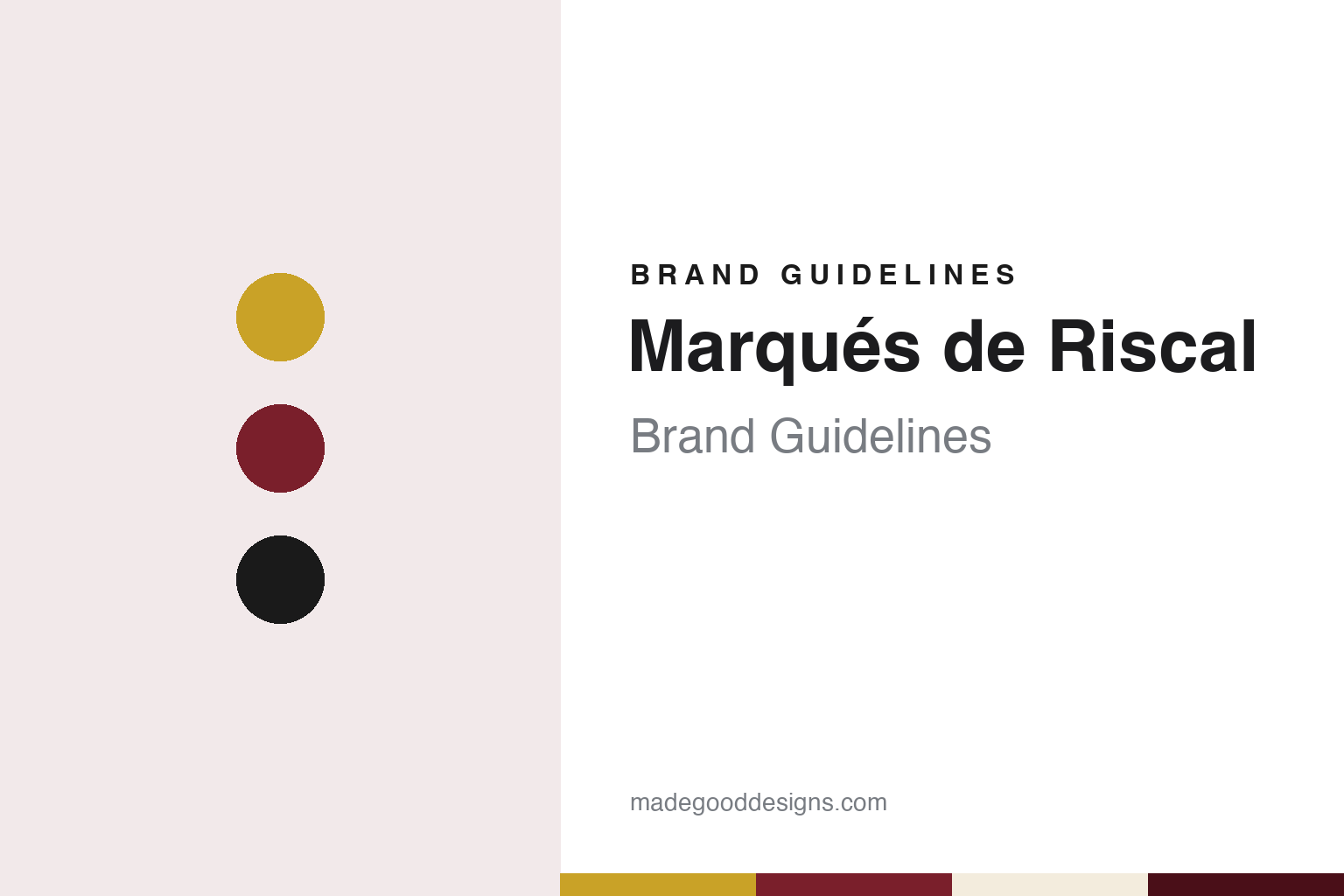
Marqués de Riscal Brand Guidelines
The Elciego Rioja house of the gold mesh, founded 1858.
Aa
Two constants: a mesh gold, Rioja red and label cream palette and a classical serif register. Abstract homage — not a Marqués de Riscal product or mark; no label, logo or bottle is reproduced.
A marquess in Bordeaux
Médoc methods brought to the Rioja Alavesa.
Marqués de Riscal is the trading name of Herederos del Marqués de Riscal — “the heirs of the Marquess of Riscal” — a wine company based in Elciego, a village in the Rioja Alavesa, the part of the Rioja wine region that lies in the Basque province of Álava. Spanish Wikipedia calls it the oldest winery in Álava. The name comes from a noble title: the marquessate of Riscal was created in 1708 by Philip V for Baltasar Hurtado de Amézaga, a lieutenant general and governor of Málaga, English and Spanish Wikipedia record.
The winery itself was the work of a later holder of the title. English and Spanish Wikipedia both name Camilo Hurtado de Amézaga, 6th Marquess of Riscal, as the founder. He was living in Bordeaux when the provincial council of Álava asked him to hire an oenologist who could teach local growers the methods of the Médoc. He chose Jean Pineau, cellar master at Château Lanessan, and signed a contract with him on the council’s behalf; he also sent nine thousand vine cuttings of Cabernet Sauvignon, Merlot, Malbec and Pinot Noir to the Rioja Alavesa, where Tempranillo and Graciano were already grown.
In 1858 Camilo, who had inherited wineries in Elciego from his father, founded his own winery there on French lines and hired Pineau once the latter had stopped working for the council, both Wikipedias say. Spanish Wikipedia credits the house with early practices that were new to the region at the time, among them wooden fermentation vats, 225-litre barrels and bottles stored on their sides. Recognition came from France: at the 1895 International Exhibition in Bordeaux, Marqués de Riscal became the first non-French winery to receive the Diploma of Honour, English and Spanish Wikipedia record.
The house later reached beyond Rioja. Spanish Wikipedia says that after two years of trials Marqués de Riscal began making white wine in Rueda, in the province of Valladolid, in 1972, and that it championed the creation of the Rueda designation of origin, which followed in 1980. Its red labels in Rioja include Barón de Chirel and Finca Torrea alongside the Marqués de Riscal Reserva and Gran Reserva, and it makes a red, Riscal 1860, under the Castilla y León regional designation, according to English Wikipedia.
Colour
A gold net, first a guard against fraud, then a signature.
The brand’s best-known device is not printed on the label at all. It is the fine gold-coloured wire mesh, the malla, that wraps the bottle. Spanish Wikipedia lists it among the house’s innovations and says it was meant to stop bottles being fraudulently refilled. Decanter, answering a reader in its “Ask Decanter” column, describes the mesh as one of the earliest forms of protection against counterfeiting and says Marqués de Riscal introduced it toward the end of the 19th century to protect its increasingly successful wines; because a mesh could not be taken off without breaking it, the cork could not be pulled and the bottle refilled unseen.
Over time the guard became a signal. Decanter notes that, given the medals the Riscal wines were winning, the gold cage came to be read as a mark of quality, and that producers of cheaper wines and wines from other regions soon copied it; the magazine adds that no regulation governs who may use the mesh. The company says the mesh had its heyday in the 1920s, when it became a familiar sight in the most fashionable hotels in Madrid. VinePair tells the same story of collectors and counterfeiters behind the gold wire on Rioja bottles.
In June 2024 the company changed its most familiar bottle. It announced that Marqués de Riscal Reserva would go on sale without the mesh from the 2020 vintage, with a renewed label, as part of its sustainability strategy, and estimated that the change would save around 14 tonnes of brass in auxiliary packaging material; the Rioja news site Nuevecuatrouno reported the decision on 30 June 2024.
Typography
Design and documentation.
The seven brands in this group are all wine names: Marqués de Riscal, Faustino, Mionetto, La Marca, Nederburg, KWV and Two Oceans. Wine brands in general sit at many different points in the trade, from family houses that still carry a founder’s name to labels that now belong to much larger drinks groups, and a single brand can be sold everywhere from a corner shop to a restaurant list.
A wine brand’s identity is usually carried less by a single bottle than by a label, a name and the place it promises, because the company behind the name may have changed hands, moved its production or grown far beyond the place where it started. That makes the questions behind each name worth asking plainly: who started it, who owns it now, and where its wine is actually made and bottled.
Each guide separates what independent sources record from what the company says about itself — its founding story, its owners over time, where its wine is made and how its labels have changed — and marks plainly what rests only on the company’s own word.
Aa
A classical serif for a house rooted in the 19th century. (Specimen set in Cormorant Garamond, a serif STAND-IN; NOT the Marqués de Riscal logo.)
The City of Wine
A titanium roof by Frank Gehry above an old winery.
The second great image of Marqués de Riscal is architectural. As part of a plan for the 2000s, the company remodelled its Elciego estate as the Ciudad del Vino, the City of Wine, with a new winery, vineyards and a leisure complex, Spanish Wikipedia says. Its centrepiece is the Hotel Marqués de Riscal, designed by Frank Gehry, the architect of the Guggenheim Museum Bilbao, in sandstone with a roof of titanium ribbons. Spanish Wikipedia records that the hotel opened on 1 September 2006 and was formally inaugurated on 10 October 2006 in the presence of King Juan Carlos I; it was built by Ferrovial and is now part of Marriott’s Luxury Collection. Gehry’s name also appears on one of the house’s Rioja reds, the Frank Gehry Selection 2001, according to English Wikipedia.
The estate has since become a visitor destination in its own right. In November 2024 the company announced that Marqués de Riscal had been voted the best vineyard in the world and the best in Europe in the World’s Best Vineyards 2024 awards, at a ceremony held at the Nyetimber estate in southern England, after placing second in the three previous editions. The same announcement named Alejandro Aznar as president of the company.
The name needs care in search. “Marqués de Riscal” is also the name of the noble title itself, which English Wikipedia lists as still held by the Hurtado de Amézaga family; the winery’s own site is marquesderiscal.com.
For a design guide, Marqués de Riscal shows how a single functional object, a wire net invented to stop fraud, can turn into the defining cue of a wine brand, and how a house can later add a building as a second emblem — and even retire the net from its best-known bottle. Compare Faustino, its Rioja Alavesa neighbour in Oyón, and Concha y Toro, the Chilean wine house founded in 1883 by a former finance minister. For this guide we use mesh gold, Rioja red and label cream with a serif, an unofficial interpretation; no product or logo is reproduced.
Explore & save
Keep Marqués de Riscal’s identity on hand — save it to a board in the Made Good inspiration library.
Marqués de Riscal identity set
Pin the Marqués de Riscal mesh gold, Rioja red and label cream palette and the classical serif register to your own board.