Faustino Brand Guidelines
The Oyón Rioja with a Rembrandt on the label, since 1861.
Aa
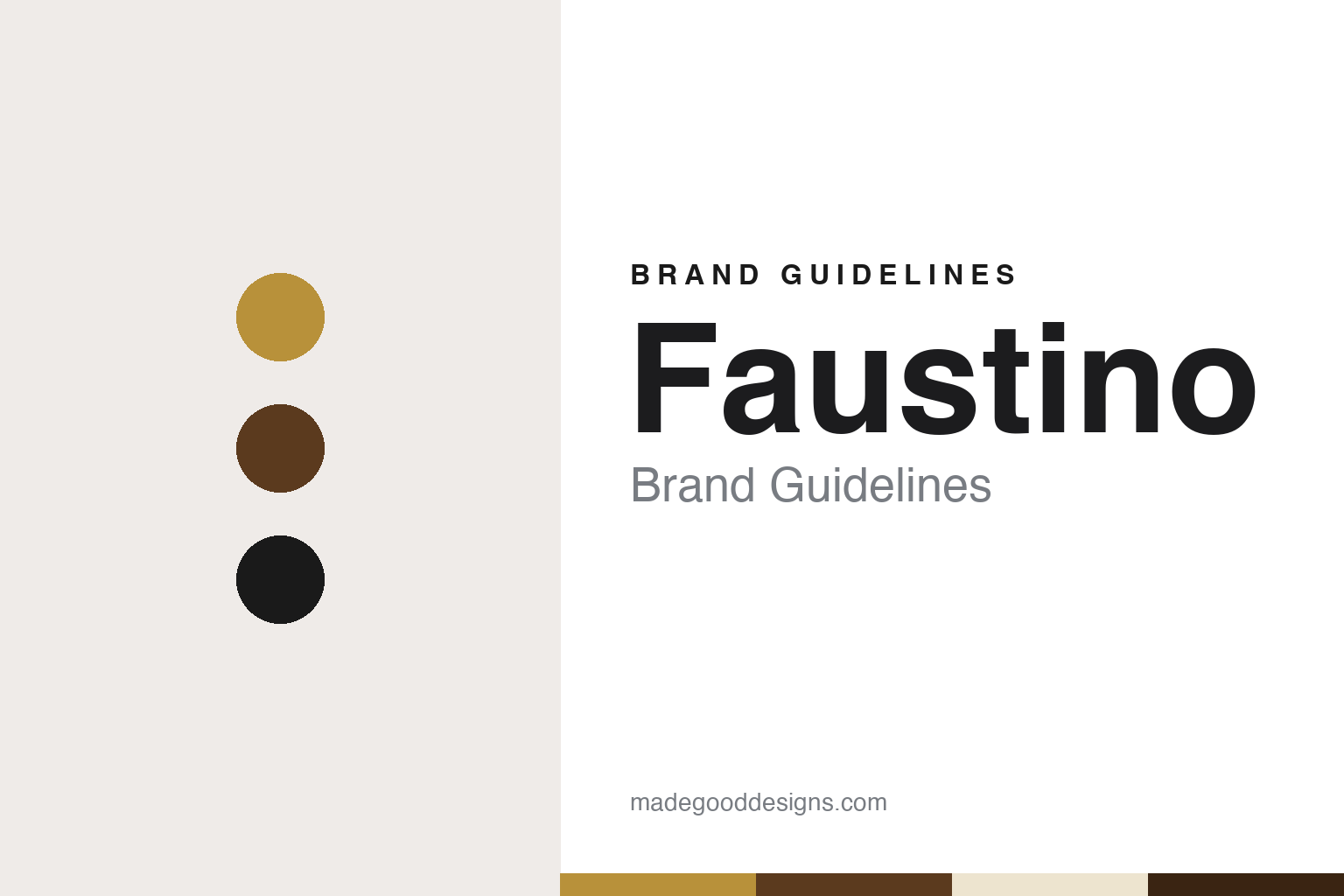
Two constants: an umber, gold wire and canvas cream palette and an old-style serif register. Abstract homage — not a Faustino product or mark; no label, portrait, logo or bottle is reproduced.
Four generations in Oyón
From bulk wine to a numbered Gran Reserva.
Bodegas Faustino is a family winery in Oyón, in the Rioja Alavesa, the part of the Rioja region that lies in the Basque province of Álava, a few kilometres from Logroño. English Wikipedia dates it to 1861, when Eleuterio Martínez Arzok bought a palace and vineyards in the village; the aim at first was to make wine and sell it in bulk. The digital food magazine Directo al Paladar, in a history of the brand published in April 2026, gives the same year, place and founder.
Bottling came with the next generation. English Wikipedia says that Faustino Martínez Pérez de Albéniz took charge in 1930 and was the first in the family to bottle the wine within Rioja, under names drawn from the vineyards of origin; Directo al Paladar places the start of bottling in the 1920s, so the two accounts differ by a few years. It was Faustino who gave the business the name it still carries.
The brand as it is known abroad was the work of the third generation. English Wikipedia says Julio Faustino Martínez became head of the company in 1957 and launched Faustino as an international brand; Directo al Paladar says he was the first in the family to look beyond the Pyrenees and began with exports to Austria in the early 1960s. Almost in parallel came the wine that made the name: Faustino I Gran Reserva, made from the 1958 vintage and released in 1964, according to Directo al Paladar. Julio Faustino named it in homage to his father, the weekly Qué! reported in 2021.
The range is organised by Roman numerals. English Wikipedia explains that the top wines carry the numeral I, the middle range V and the entry range VII, each then labelled crianza, reserva or gran reserva according to its ageing.
Colour
A Dutch merchant’s face, a gold net and frosted glass.
Faustino’s defining image is a face. Since the 1960s the label of Faustino I has carried a portrait painted by Rembrandt, Qué! reported in 2021. English Wikipedia identifies it as the portrait of Nicolaes van Bambeeck, the Amsterdam merchant whom Rembrandt painted in 1641, a canvas now in the Royal Museums of Fine Arts of Belgium in Brussels, where it hangs as the pair to his portrait of Van Bambeeck’s wife, Agatha Bas. Directo al Paladar describes the sitter as a cloth merchant who was no Rioja grower, and says Julio Faustino chose the image to honour his grandfather Eleuterio.
The bottle carries its own codes. English Wikipedia notes that Faustino wines usually come in a Burgundy-style bottle and that the Gran Reserva bottles are wrapped in a thin, twisted gold wire mesh, the Rioja device for preventing refilling. Directo al Paladar adds that the Faustino I bottle has softer shoulders than the Bordeaux shape and frosted glass, chosen to protect the wine better from sunlight.
In 2021 the family updated the Faustino I Gran Reserva label as a tribute to Julio Faustino. Qué! reported in November 2021 that the bottle itself and its light-blocking finish were unchanged, while a new collar shaped like a cigar band nodded to Don Julio’s fondness for cigars and the label gained the words “Legado de Don Julio”. The round portrait stayed at the centre, framed by a finely stamped border; the redesign was led by the family’s fourth generation and arrived with the 2010 vintage, which also introduced a magnum.
Typography
Design and documentation.
The seven brands in this group are all wine names: Marqués de Riscal, Faustino, Mionetto, La Marca, Nederburg, KWV and Two Oceans. Wine brands in general sit at many different points in the trade, from family houses that still carry a founder’s name to labels that now belong to much larger drinks groups, and a single brand can be sold everywhere from a corner shop to a restaurant list.
A wine brand’s identity is usually carried less by a single bottle than by a label, a name and the place it promises, because the company behind the name may have changed hands, moved its production or grown far beyond the place where it started. That makes the questions behind each name worth asking plainly: who started it, who owns it now, and where its wine is actually made and bottled.
Each guide separates what independent sources record from what the company says about itself — its founding story, its owners over time, where its wine is made and how its labels have changed — and marks plainly what rests only on the company’s own word.
Aa
An old-style serif for a label built around an Old Master portrait. (Specimen set in EB Garamond, a serif STAND-IN; NOT the Faustino logo.)
Familia Martínez Zabala
One winery grown into a family group.
Faustino is now the flagship of a wider group, long known as Grupo Faustino and now presented as Familia Martínez Zabala, after the fourth generation of the family. English Wikipedia lists its other wineries as Campillo and Marqués de Vitoria in Rioja, Valcarlos in Navarra, Condesa de Leganza in La Mancha, Portia in Ribera del Duero and Bodegas Victorianas. When Lourdes Martínez Zabala received the Gran Emprendedor de Álava award in May 2023, press reports in The Objective and Nuevecuatrouno described her as part of the fourth generation and credited the group’s growth to her and her sister Carmen; their father had received the same award in 2005.
The family has also turned to architecture. Foster + Partners, which had already designed the group’s Bodegas Portia in Ribera del Duero, designed El Legado de Bodegas Faustino, a visitor building and renovation at Oyón, announced in 2023 and opened in October 2024 with Norman Foster in attendance, Foods & Wines from Spain reported. The company says Faustino I is the best-selling Rioja Gran Reserva in the world and that it is sold in about 140 countries, and Vinetur reported in April 2026 that Faustino remained among Drinks International’s 50 most admired wine brands.
The future shape of the group was an open question in late 2025: Nuevecuatrouno reported in October 2025 that the family had hired Rothschild & Co to value the business, and Vinetur reported in November 2025 that García Carrión was studying an offer; no sale had been reported by April 2026, when Vinetur still described the winery as family-owned. “Faustino” is also a common Spanish given name, so the brand’s own site is bodegasfaustino.com.
For a design guide, Faustino shows how a borrowed Old Master portrait, a gold net and a Roman numeral can make a Rioja instantly recognisable across many countries, and how a family can refresh a label without touching its central image. Compare Marqués de Riscal, the Elciego house that made the gold mesh famous, and Casillero del Diablo, another wine sold on a single story. For this guide we use umber, gold wire and canvas cream with a serif, an unofficial interpretation; no product or logo is reproduced.
Explore & save
Keep Faustino’s identity on hand — save it to a board in the Made Good inspiration library.
Faustino identity set
Pin the Faustino umber, gold wire and canvas cream palette and the old-style serif register to your own board.