Casillero del Diablo Brand Guidelines
Concha y Toro’s devil’s cellar wine, launched 1966.
Aa
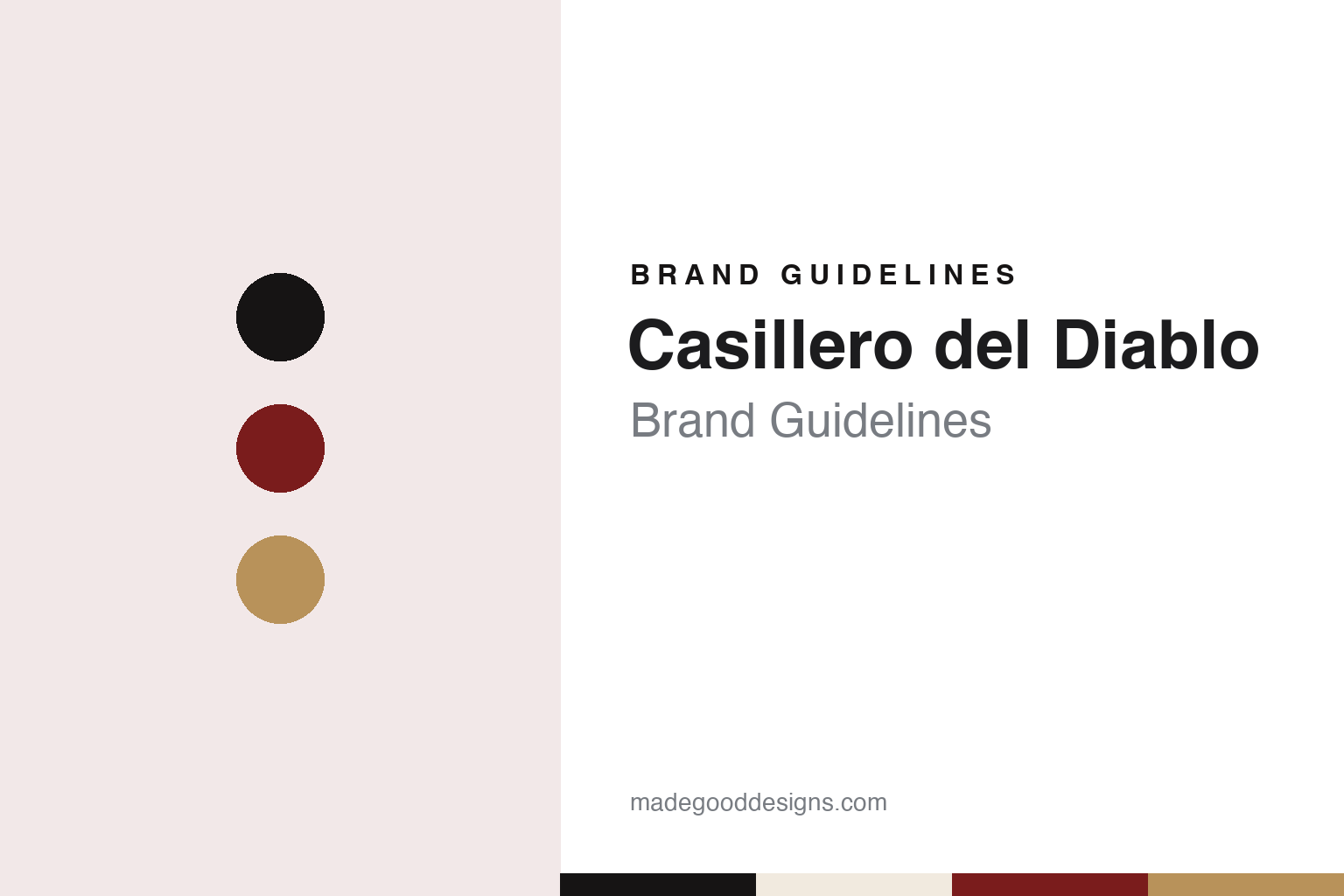
Two constants: a cellar black, devil red and bronze palette and an engraved capital serif register. Abstract homage — not a Casillero del Diablo product or mark; no label, logo or bottle is reproduced.
A cellar and a rumour
A Pirque winery, a locked gate and a story about the Devil.
Casillero del Diablo — Spanish for “the Devil’s cellar” — is the best-known brand of Viña Concha y Toro, the Chilean wine company based in Santiago with its vineyards and production in Pirque, in the Maipo Valley at the foot of the Andes. English Wikipedia, citing the company’s history, says the winery was founded in 1883 by Melchor de Santiago Concha y Toro, a former Chilean minister of finance, and his wife Emiliana Subercaseaux. Concha y Toro became a stock company in 1923 and first exported wine in 1933, to Rotterdam.
The brand’s name comes from a story the company tells about its founder. In Concha y Toro’s account, Don Melchor kept his finest wines in a private cellar behind a locked wrought-iron gate, yet bottles kept disappearing even though he held the keys. Rather than post guards, the company says, he spread a rumour that the Devil lived in the cellar, and the thefts stopped. The company presents the tale as a legend. Visitors to the Pirque estate are still taken down into the old cellar where the story is told.
The wine itself came much later. English Wikipedia and the company both date the launch of Casillero del Diablo to 1966, more than eight decades after the winery’s founding; Concha y Toro calls the brand its hallmark. The company’s first premium wine under the founder’s name, Don Melchor, followed in 1987, so the founder’s name and the legend told about him now sit side by side in one portfolio. Concha y Toro’s first exports, to Rotterdam in 1933, came a generation before the Casillero del Diablo name existed.
Colour
A devil on the label and a devil on the shirt.
The devil is the brand’s organising idea, and it shaped its biggest sponsorship. In 2010 Concha y Toro became the official wine partner of Manchester United — the first global official wine deal for an English club, Inside World Football reported in October 2016 — with Casillero del Diablo as the brand at the centre of the deal. English Wikipedia, citing the Chilean outlet El Mostrador, says the partnership rested partly on the match between the two brands’ symbols: the club is nicknamed the Red Devils and carries a devil on its crest.
The deal was renewed in October 2016 for three more seasons, running from 2016–17 to 2018–19, Inside World Football and the Manchester business site TheBusinessDesk reported. By then a limited-edition Legendary Collection made with the club, launched in 2014, had sold about 300,000 bottles, according to Inside World Football. The Drinks Business also covered the renewal in October 2016.
The range has grown in tiers. The brand’s own site lists a core Reserva line alongside Reserva Especial, Reserva Privada and the Devil’s Collection blends, and the Devil’s Carnaval wines, covering reds, whites, rosé and sparkling wine. Concha y Toro’s own wine site names Marcelo Papa as the company’s technical director.
Typography
Design and documentation.
The seven brands in this group are all wine and sake names: Yellow Tail, Jacob’s Creek, Penfolds, Casillero del Diablo, Concha y Toro, Barefoot and Gekkeikan. Wine and sake brands in general sit at many different points in the trade, from family houses that still carry a founder’s name to labels that now belong to much larger drinks groups, and a single brand can be sold everywhere from a corner shop to a restaurant list.
A wine or sake brand’s identity is usually carried less by a single bottle than by a label, a name and the place it promises, because the company behind the name may have changed hands, moved its production or grown far beyond the place where it started. That makes the questions behind each name worth asking plainly: who started it, who owns it now, and where its wine or sake is actually made and bottled.
Each guide separates what independent sources record from what the company says about itself — its founding story, its owners over time, where its wine or sake is made and how its labels have changed — and marks plainly what rests only on the company’s own word.
Aa
An engraved capital serif for a wine named after a legend. (Specimen set in Cinzel, a serif STAND-IN; NOT the Casillero del Diablo logo.)
Casillero del Diablo
The flagship of a Chilean family-led wine group.
The brand’s best-known industry award came in November 2020, when Wine Enthusiast named Casillero del Diablo its New World Winery of the Year, part of its annual Wine Star Awards, according to a press release published by Wine Industry Advisor. The consultancy Wine Intelligence ranked Casillero del Diablo the second most powerful wine brand in the world from 2018 to 2020, English Wikipedia says, and Drinks International named Concha y Toro the world’s most admired wine brand three years running, from 2011 to 2013.
Behind the brand stands a company that has stayed close to a small group of Chilean families. English Wikipedia says ownership and management have remained associated with the founding family and with the Guilisasti and Larraín families; Eduardo Guilisasti Tagle chaired the company from 1971 to 2018. Concha y Toro listed its shares on the New York Stock Exchange in 1994 and ended that listing in 2018, and it bought the Californian winery Fetzer Vineyards in 2011. Viña Concha y Toro was certified as a B Corporation in 2021 — B Lab’s directory dates the certification to January, while the company announced it in April — and, the company says, was recertified in 2024. English Wikipedia lists Eduardo Guilisasti Gana as chief executive. In June 2026 the company said that IWSR data placed it third among the world’s wine companies by value at the end of 2025.
The brand’s name and story come from the same source. The company’s legend supplies the devil, the cellar and the wrought-iron gate, and the Manchester United partnership, by English Wikipedia’s account, drew on a shared devil symbol.
For a design guide, Casillero del Diablo shows how a single cellar story can name a wine, choose a sponsor and carry a brand across markets for six decades. Compare Concha y Toro, the Pirque company behind it, and Penfolds, the Adelaide winery behind Grange. For this guide we use cellar black, a devil red and bronze with an engraved capital serif, an unofficial interpretation; no product or logo is reproduced.
Explore & save
Keep Casillero del Diablo’s identity on hand — save it to a board in the Made Good inspiration library.
Casillero del Diablo identity set
Pin the Casillero del Diablo cellar black, devil red and bronze palette and the engraved capital serif register to your own board.