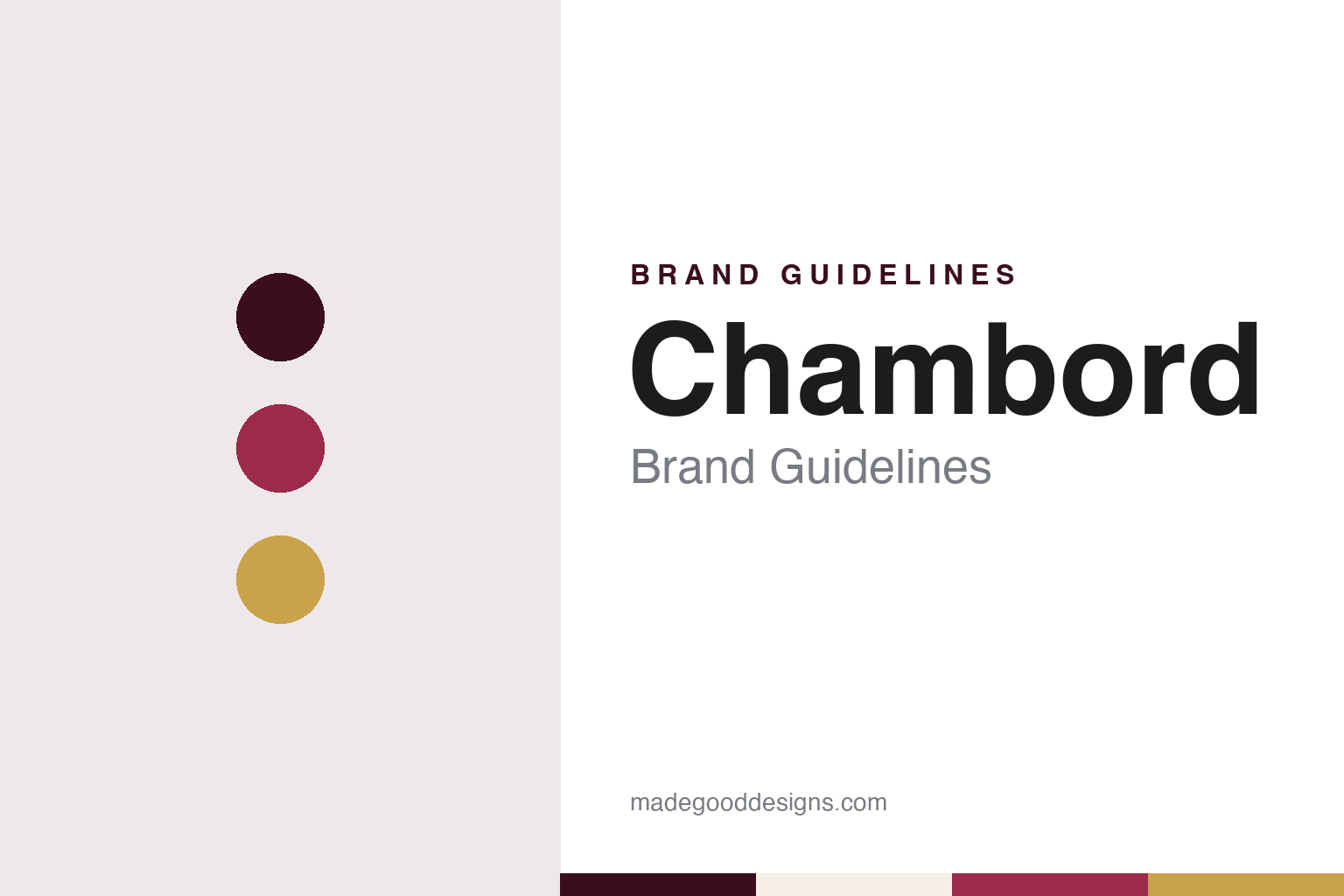
Chambord Brand Guidelines
The Loire raspberry liqueur in an orb.
Aa
Two constants: a black raspberry, berry and gold palette and a courtly high-contrast serif register. Abstract homage — not a Chambord product or mark; no bottle, label or logo is reproduced.
A Philadelphia family and a Loire recipe
An American cordial house builds a French liqueur.
Chambord is a French liqueur with an American family behind it. English Wikipedia, citing Liquor.com, says the brand was developed in 1982 by Norton “Sky” Cooper at his family’s cordial company, Charles Jacquin et Cie; VinePair, in a 2019 profile by Tim McKirdy, dates its debut to 1981, so the sources differ by a year. Brown-Forman’s own announcement of March 2006 described the brand as having a “25-year history,” which fits either date. Charles Jacquin is a Philadelphia house known for sweet, syrupy cordials, Adweek reported in 2022, and coverage of the 2006 Chambord sale in the food-industry press described it as a privately held producer, marketer and distributor of spirits, with names such as Pravda, Jacquin and Bartender Cocktails in its range.
The liqueur takes its idea from an older French tradition. English Wikipedia says Chambord was inspired by a raspberry liqueur made in the Loire Valley in the late 1600s, which is said to have been introduced to Louis XIV during one of his visits to the Château de Chambord, the royal hunting lodge in the Loire. VinePair says the name is believed to be inspired by the château; the liqueur is a brand, and the château itself is a separate, state-owned estate.
From the start the product was made in France. Brown-Forman’s 2006 release called Chambord a liqueur “produced and bottled in France,” and VinePair places production at Cour-Cheverny, in the Centre-Val de Loire region, less than ten miles from the commune of Chambord. The brand’s own website calls the Loire Valley “the birthplace of Chambord” and the place where the liqueur is made.
Colour
Berries, French spirits and a royal orb.
The company describes a slow, three-stage process. Its website says whole raspberries, blackberries and blackcurrants are first infused in French spirits for four weeks, then given a second infusion of two weeks, after which the berries are pressed to capture their juice. The resulting infusion is blended with black raspberry flavours, Madagascan vanilla, Moroccan citrus peel and honey, along with spices that it names as ginger, cloves, nutmeg and cinnamon. VinePair adds XO cognac to the blend and names the master blender as Stéphane Cantin. The liqueur is bottled at 16.5% alcohol by volume.
The bottle is the brand’s most recognisable asset. Brown-Forman’s 2006 announcement singled out its “distinctive oval packaging,” and the company website today calls it an “elegant orb shaped bottle.” English Wikipedia, citing a 2016 travel and food blog, says the round bottle was modelled on a globus cruciger, the cross-topped orb carried as a royal emblem; until 2010 it wore a gold plastic lettered belt around its middle and a crown on its lid.
That changed in 2010. English Wikipedia, citing Packaging Digest in 2011, says the US bottle was redesigned that summer, with changes to the belt, lid and other elements. VinePair says Brown-Forman replaced the belt with a label and removed the crown to improve usability, and that a raspberry-flavoured vodka launched under the Chambord name the same year has since been discontinued. English Wikipedia lists the drinks most often made with the liqueur as including the French Martini, the Kir Impérial, which pairs Chambord with champagne, a raspberry margarita, a French manhattan and a Chambord royal spritzer.
Typography
Design and documentation.
The seven brands in this group are all liqueurs from France and elsewhere in Europe: Cointreau, Grand Marnier, Chartreuse, Bénédictine, Chambord, St-Germain and Cherry Heering. European liqueur brands in general sit at many different points in the trade, from family houses that still carry a founder’s name to names that now belong to much larger drinks groups, and a single brand can be poured everywhere from a hotel bar to a kitchen table.
A liqueur brand’s identity is usually carried less by a single product than by a bottle, a name and the drink it promises, because the company behind the name may have changed hands, moved its production or grown far beyond the place where it started. That makes the questions behind each name worth asking plainly: who started it, who owns it now, and where its liqueurs are actually made and bottled.
Each guide separates what independent sources record from what the company says about itself — its founding story, its owners over time, where its liqueurs are made and how its bottles and labels have changed — and marks plainly what rests only on the company’s own word.
Aa
A courtly high-contrast serif for a liqueur named after a royal château. (Specimen set in Cormorant Garamond, a serif STAND-IN; NOT the Chambord logo.)
Chambord
From a family firm to Brown-Forman.
Chambord stayed with the Cooper family for about a quarter of a century. On 16 March 2006 Brown-Forman, the Louisville, Kentucky, company behind Jack Daniel’s, announced it had agreed to buy the Chambord brand and all related assets from Charles Jacquin et Cie, which it described as the liqueur’s owner and producer. N.J. Sky Cooper, then Jacquin’s chief executive, was quoted in the release saying he looked forward to watching “our family’s brand” grow under its new owner. A Brown-Forman filing with the US Securities and Exchange Commission shows the purchase closed on 1 June 2006; The Moodie Davitt Report noted at the time that the deal included the Chambord trademark, the French manufacturing operations where the liqueur is made and the services of the 20 employees who worked at the facility.
Brown-Forman remains the owner. The Chambord website, checked in October 2026, carries a 2026 Brown-Forman copyright and says the liqueur is imported into the United States by Brown-Forman of Louisville, and the company still lists Chambord among its brands. The Cooper family went on to make another French liqueur: Norton Cooper’s son Robert, who had overseen Chambord at Jacquin, later created the elderflower liqueur St-Germain. Since 2007, English Wikipedia says, Chambord has won silver and bronze medals at the San Francisco World Spirits Competition.
For a design guide, Chambord shows how a single bottle shape can carry a brand: the orb, its belt and its crown did the work of a logo, and the 2010 redesign kept the sphere while simplifying the rest. Compare it with St-Germain, the Cooper family’s later liqueur, and with Cointreau, another French liqueur sold in a distinctive bottle. For this guide we use black raspberry, berry red and a muted gold with a serif, an unofficial interpretation; no product or logo is reproduced.
Explore & save
Keep Chambord’s identity on hand — save it to a board in the Made Good inspiration library.
Chambord identity set
Pin the Chambord black raspberry, berry and gold palette and the courtly high-contrast serif register to your own board.