St-Germain Brand Guidelines
The elderflower liqueur in an Art Deco bottle.
Aa
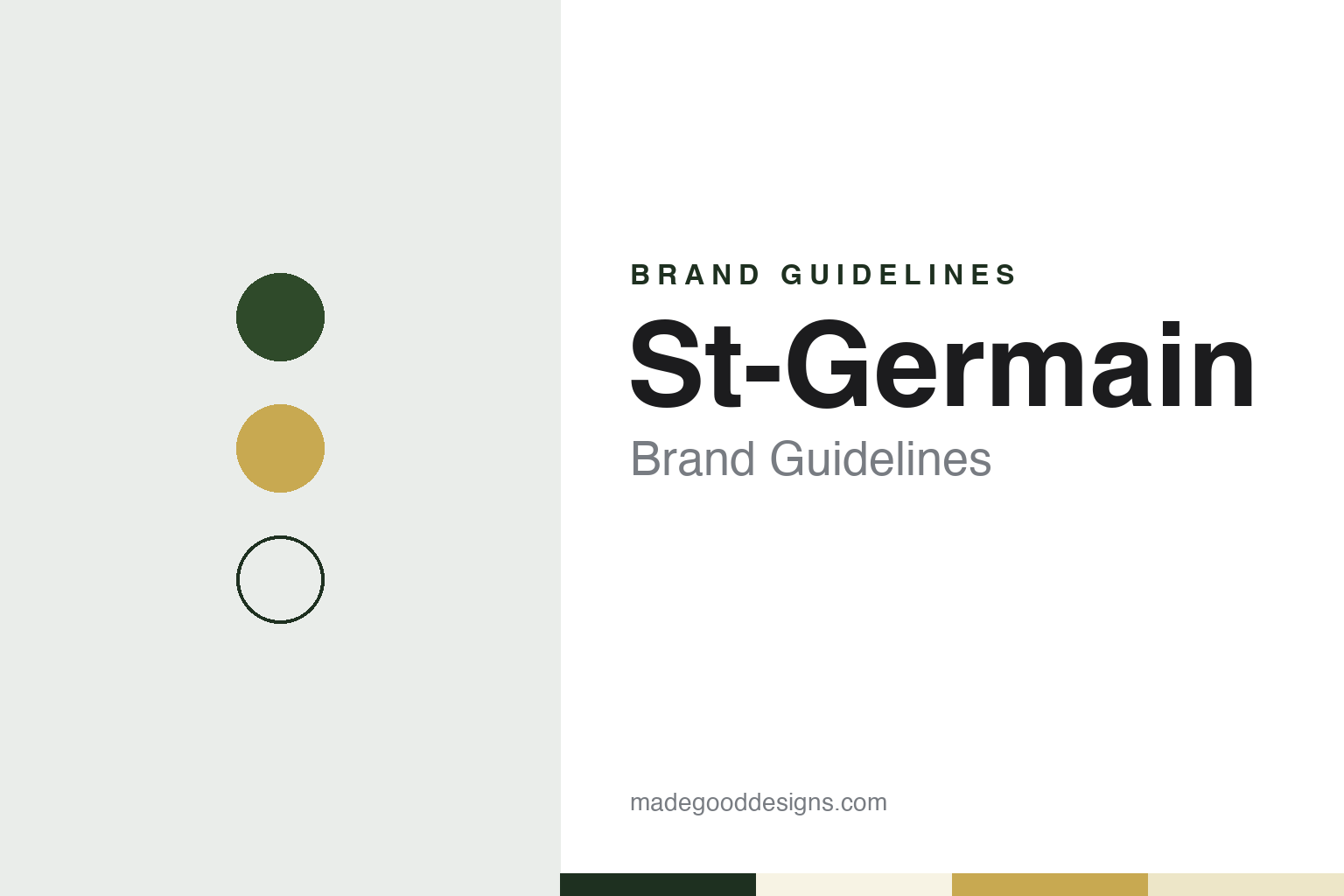
Two constants: a bottle green, Deco gold and elderflower cream palette and an Art Deco display sans register. Abstract homage — not a St-Germain product or mark; no bottle, label or logo is reproduced.
A distiller’s son and a London cocktail
Elderflower, a new company and a Paris name.
St-Germain was the work of Robert J. Cooper, who came from a family of drinks makers. His father, Norton J. “Sky” Cooper, ran Charles Jacquin et Cie, a Philadelphia cordial house, and the younger Cooper was already overseeing Jacquin’s raspberry liqueur, Chambord, Adweek reported in 2022. The brand’s own website calls him a third-generation distiller.
The idea came from a drink. Adweek says Cooper first tasted elderflower in a cocktail at Hakkasan, the London restaurant, and English Wikipedia, citing The New York Times, dates his London encounter with an elderflower cocktail to 2001. Adweek says Cooper was 31 when he took the idea of an elderflower liqueur to his father, an ingredient the magazine describes as flavourful but fickle.
He set up his own business to do it. English Wikipedia says The Cooper Spirits Company was founded in 2006 and based in New York, and that it launched St-Germain in 2007; Shanken News Daily reported in 2013 that the launch was in the US market. The company website describes St-Germain as the “world’s first elderflower liqueur,” a claim made by the brand. The name comes from Saint-Germain-des-Prés, the Left Bank quarter of Paris; the liqueur has no connection with the Paris football club or the town of Saint-Germain-en-Laye.
Colour
Harvest by bicycle, an eight-sided bottle.
The brand’s story is built around the harvest. Bacardi’s January 2013 announcement described St-Germain as a handcrafted French liqueur made from fresh elderflower blossoms picked once a year over four to six weeks in late spring. It said the harvesters are paid by weight and work independently, taking the flowers to small collection stations, sometimes on specially fitted bicycles, and that the blossoms are macerated quickly. English Wikipedia, citing HuffPost in 2012, says the flowers are those of Sambucus nigra from the Savoie region of France, gathered over three to four weeks each spring and often carried by bicycle to avoid bruising the petals; the two accounts differ on the length of the harvest. The company says up to 1,000 flowers go into each bottle.
The packaging was Cooper’s own design. The D&AD awards archive credits the client, Cooper Spirits International, with a 2008 Wood Pencil in packaging design for St-Germain, and its entry says Robert Cooper created the bottle shape, drawing on French Art Deco and the eclectic style of Paris. The entry adds that the shape made labelling difficult, so a full identity system was built to place the liqueur between high-end French luxury and the ease of a Parisian bistro, echoing the Left Bank.
Bacardi’s 2013 release described the bottle as eight-sided, a nod to the Art Deco and Belle Époque era of Saint-Germain-des-Prés, with a heavy stopper set with an enamelled coin. Each bottle is individually numbered and marked with a vintage year, tied to that year’s elderflower harvest. The brand website today calls the bottle a testament to the Art Deco movement of the Belle Époque.
Typography
Design and documentation.
The seven brands in this group are all liqueurs from France and elsewhere in Europe: Cointreau, Grand Marnier, Chartreuse, Bénédictine, Chambord, St-Germain and Cherry Heering. European liqueur brands in general sit at many different points in the trade, from family houses that still carry a founder’s name to names that now belong to much larger drinks groups, and a single brand can be poured everywhere from a hotel bar to a kitchen table.
A liqueur brand’s identity is usually carried less by a single product than by a bottle, a name and the drink it promises, because the company behind the name may have changed hands, moved its production or grown far beyond the place where it started. That makes the questions behind each name worth asking plainly: who started it, who owns it now, and where its liqueurs are actually made and bottled.
Each guide separates what independent sources record from what the company says about itself — its founding story, its owners over time, where its liqueurs are made and how its bottles and labels have changed — and marks plainly what rests only on the company’s own word.
Aa
An Art Deco display sans for a liqueur named after a Paris quarter. (Specimen set in Poiret One, a sans STAND-IN; NOT the St-Germain logo.)
St-Germain
Awards, Bacardi and a brand guardian.
St-Germain collected trade awards early. English Wikipedia says it won a Grand Gold Medal at the Monde Selection in 2007, 2008, 2009, 2010 and 2012, and the Chairman’s Award in the liqueur category at the Ultimate Spirits Challenge in 2010. The liqueur was quickly taken up by bartenders: VinePair wrote in 2016 that it was adopted by trend-setting bartenders looking for unusual flavours and was jokingly called “bartender’s ketchup” because it turned up in so many cocktails, and Adweek used the same nickname in the headline of its 2022 profile of the brand.
On 8 January 2013 Bacardi Limited, the privately held spirits company based in Hamilton, Bermuda, announced that it had acquired St-Germain; Shanken News Daily reported that the seller was Cooper Spirits and that terms were not disclosed. Bacardi said Cooper would stay on as the brand’s guardian and spokesperson and would keep running its bartender programmes, and its chief executive, Ed Shirley, said the company intended to take the liqueur to consumers worldwide. Robert Cooper died in April 2016, aged 39, The New York Times reported.
Under Bacardi the brand has kept its Paris theme. English Wikipedia says it launched a two-part online video series, Salon St-Germain, in 2020, modelled on the historic French salon, and that a second project, Fleuriste St-Germain, opened in New York in August 2021 with the ballet dancer James Whiteside and the director Laura Kim. Bacardi said in 2013 that the liqueur was already sold in all 50 US states. The brand website still links to Bacardi and carries the trademarked line “La Vie Parisienne en Bouteille.”
For a design guide, St-Germain shows how a new brand can borrow a period and a place: an eight-sided bottle, a numbered vintage and a Paris quarter’s name gave a 2007 launch the look of an old French house. Compare it with Chambord, the Cooper family’s earlier liqueur, and with Bénédictine, another French liqueur in Bacardi’s portfolio. For this guide we use bottle green, Deco gold and elderflower cream with a sans, an unofficial interpretation; no product or logo is reproduced.
Explore & save
Keep St-Germain’s identity on hand — save it to a board in the Made Good inspiration library.
St-Germain identity set
Pin the St-Germain bottle green, Deco gold and elderflower cream palette and the Art Deco display sans register to your own board.