Cherry Heering Brand Guidelines
The Copenhagen cherry liqueur dated to 1818.
Aa
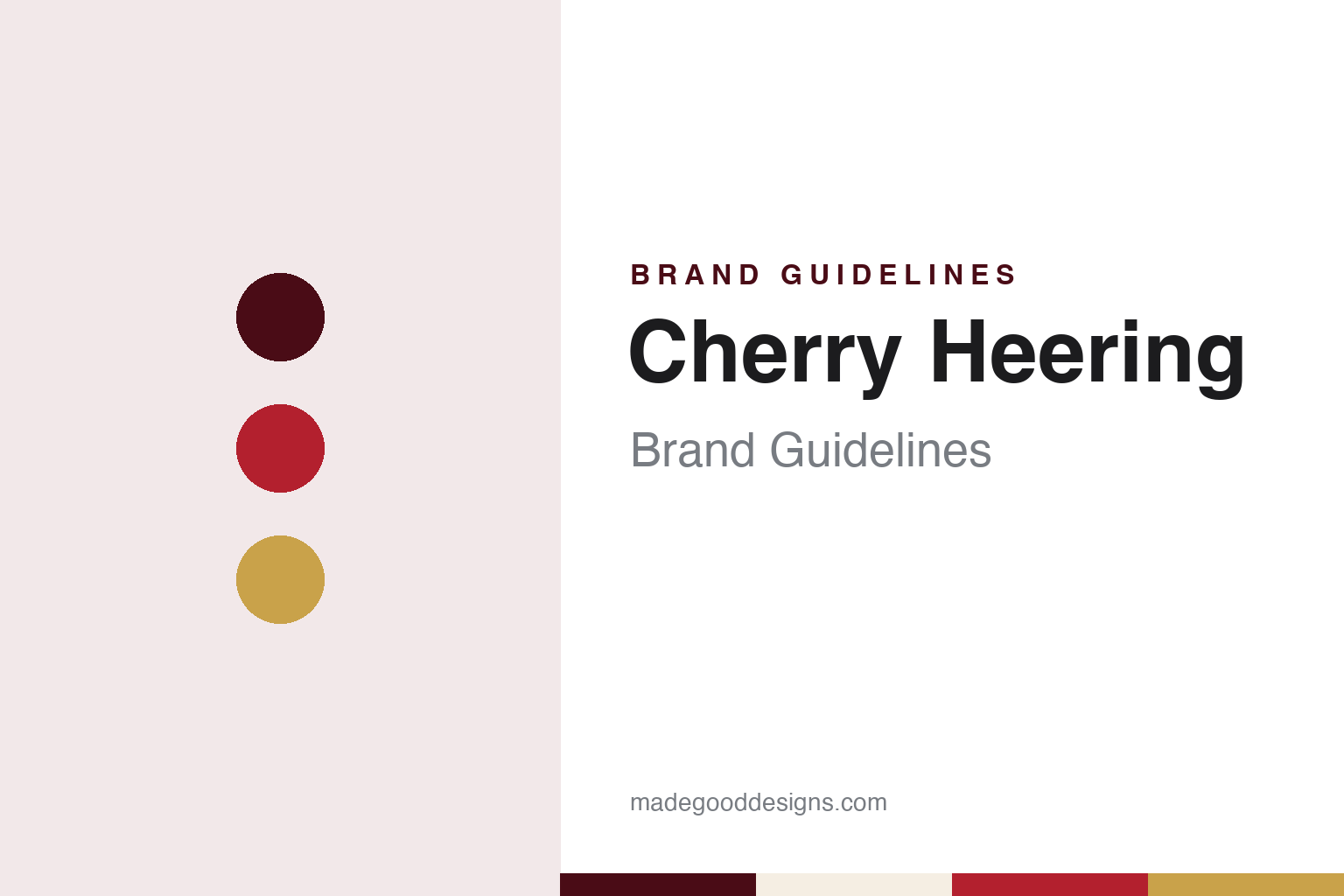
Two constants: a dark cherry, cherry red and medal gold palette and a Danish merchant serif register. Abstract homage — not a Cherry Heering product or mark; no bottle, label or logo is reproduced.
A Copenhagen grocer and a cherry recipe
From a merchant’s shop to a Christianshavn warehouse.
Cherry Heering takes its name from its maker, Peter Frederik Suhm Heering, a merchant from Roskilde. Danish Wikipedia, drawing on the first edition of Dansk Biografisk Lexikon, says he was apprenticed in 1807 to an urtekræmmer, a Copenhagen grocer and dealer in herbs and spices, and that in 1818 he opened a grocer’s shop of his own in the city with the help of friends. That shop is the date the brand uses: its owners have described the liqueur as produced since 1818, and the trade press repeats the year.
The same source gives a slightly different starting point for the drink itself. It says Heering began making cherry liqueur on a small scale in 1819, using a recipe he had from the widow of his former master, the grocer Johan Carstensen. The brand’s founding year and the first documented liqueur are therefore a year apart, and both are recorded here. The Spirits Business, reporting in 2017, said the liqueur is thought to be the world’s oldest cherry liqueur, and its current owner calls it the world’s first; both are claims made for the brand.
The business grew well beyond a single shop. Danish Wikipedia says Heering bought a waterfront property in Christianshavn, the canal district of Copenhagen, in 1838 and moved there the following year, became a wholesale merchant in 1841, and from 1833 also ran a shipping firm whose ships were built at Svaneke on Bornholm. From 1875, according to Dansk Biografisk Lexikon, his son Peter Nicolai Heering carried the firm on under the family name.
Colour
Danish cherries, a cellar and a famous sling.
The liqueur is made from cherries, and the company has long put Danish fruit at the centre of its story. A 2017 report in Gama Consumer, citing FoodBev, said the brand was promoted as made with natural ingredients, including Danish-grown cherries, and without artificial additives. The food encyclopaedia CooksInfo says the recipe uses dark sour cherries of the Stevns variety, crushed together with their stones, which it credits for a note of almond, and that the company bought its own cherry orchard at Dalby in southern Denmark in 1944 and moved production there from Copenhagen. Its owner’s 2024 announcement describes the liqueur as originating in Copenhagen and made to an old family recipe with real cherries and botanicals.
Much of the brand’s fame comes from the bar. English Wikipedia lists Cherry Heering as an ingredient in the Singapore Sling and the Blood and Sand, and The Spirits Business reported in 2017 that it was used in the first Singapore Sling. English Wikipedia’s article on the cocktail credits it to Ngiam Tong Boon, a bartender at the Long Bar of the Raffles Hotel in Singapore, in 1915, while noting that the drinks historian David Wondrich, writing in Esquire, argued for an earlier origin; early printed recipes simply call for cherry brandy.
The name also reached the screen. Danish Wikipedia, citing the Danish Film Institute’s database, records an eleven-minute documentary called Cherry Heering, directed by Theodor Christensen in 1939, in which a message in a bottle reports that the last bottle of Heering on a deserted island has been drunk, and the film then shows where the liqueur comes from and how it is made. English Wikipedia also says the company is a purveyor to the Royal Danish Court.
Typography
Design and documentation.
The seven brands in this group are all liqueurs from France and elsewhere in Europe: Cointreau, Grand Marnier, Chartreuse, Bénédictine, Chambord, St-Germain and Cherry Heering. European liqueur brands in general sit at many different points in the trade, from family houses that still carry a founder’s name to names that now belong to much larger drinks groups, and a single brand can be poured everywhere from a hotel bar to a kitchen table.
A liqueur brand’s identity is usually carried less by a single product than by a bottle, a name and the drink it promises, because the company behind the name may have changed hands, moved its production or grown far beyond the place where it started. That makes the questions behind each name worth asking plainly: who started it, who owns it now, and where its liqueurs are actually made and bottled.
Each guide separates what independent sources record from what the company says about itself — its founding story, its owners over time, where its liqueurs are made and how its bottles and labels have changed — and marks plainly what rests only on the company’s own word.
Aa
A Danish merchant serif for a liqueur named after its 19th-century maker. (Specimen set in Libre Baskerville, a serif STAND-IN; NOT the Cherry Heering logo.)
Cherry Heering
A Dutch owner and a new bottle.
The brand left Danish hands in October 2017. The Spirits Business reported on 4 October that the Dutch family-owned distiller De Kuyper had acquired Cherry Heering and Heering Coffee Liqueur from the Danish producer Peter F. Heering for an undisclosed sum; Gama Consumer added that the coffee liqueur had been launched in 2007 and that the cherry liqueur was sold in more than 100 countries across North America, Europe, the Middle East and Asia. De Kuyper’s chief executive, Mark de Witte, called the liqueur “the global reference” for a range of classic cocktails, and Peter F. Heering’s chief executive described the deal as two family businesses teaming up. De Kuyper’s portfolio at the time included Peachtree, Rutte and Mandarine Napoléon.
Under De Kuyper the bottle changed for the first time in decades. The Spirits Business reported on 6 December 2024 that the new design was the brand’s first in three decades, and a De Kuyper Royal Distillers press release that month called it the first bottle revision in over 30 years. The bottle gained a squared base and a narrower neck to make it easier to hold and pour, a red logo meant to recall the colour of cherries and a new metal screw cap. The label borrows from vintage bottles, bringing back gold medals and the Danish coat of arms, and the 70cl bottle was due in Europe from January 2025, followed by a 75cl version in the United States. De Kuyper’s marketing director, Godelief van Erve, said the aim was to show the liqueur as a versatile ingredient for drinks beyond complex classics such as the Singapore Sling.
For a design guide, Cherry Heering shows how a heritage liqueur can be refreshed by reaching back into its own archive: the 2024 bottle kept the founder’s name and the cherry red while restoring medals and a national crest from older labels. Compare it with Chambord, another fruit liqueur defined by its bottle, and with Grand Marnier, another family house that passed to a larger group. For this guide we use dark cherry, cherry red and medal gold with a serif, an unofficial interpretation; no product or logo is reproduced.
Explore & save
Keep Cherry Heering’s identity on hand — save it to a board in the Made Good inspiration library.
Cherry Heering identity set
Pin the Cherry Heering dark cherry, cherry red and medal gold palette and the Danish merchant serif register to your own board.