Grand Marnier Brand Guidelines
The 1880 cognac-and-orange liqueur named by César Ritz.
Aa
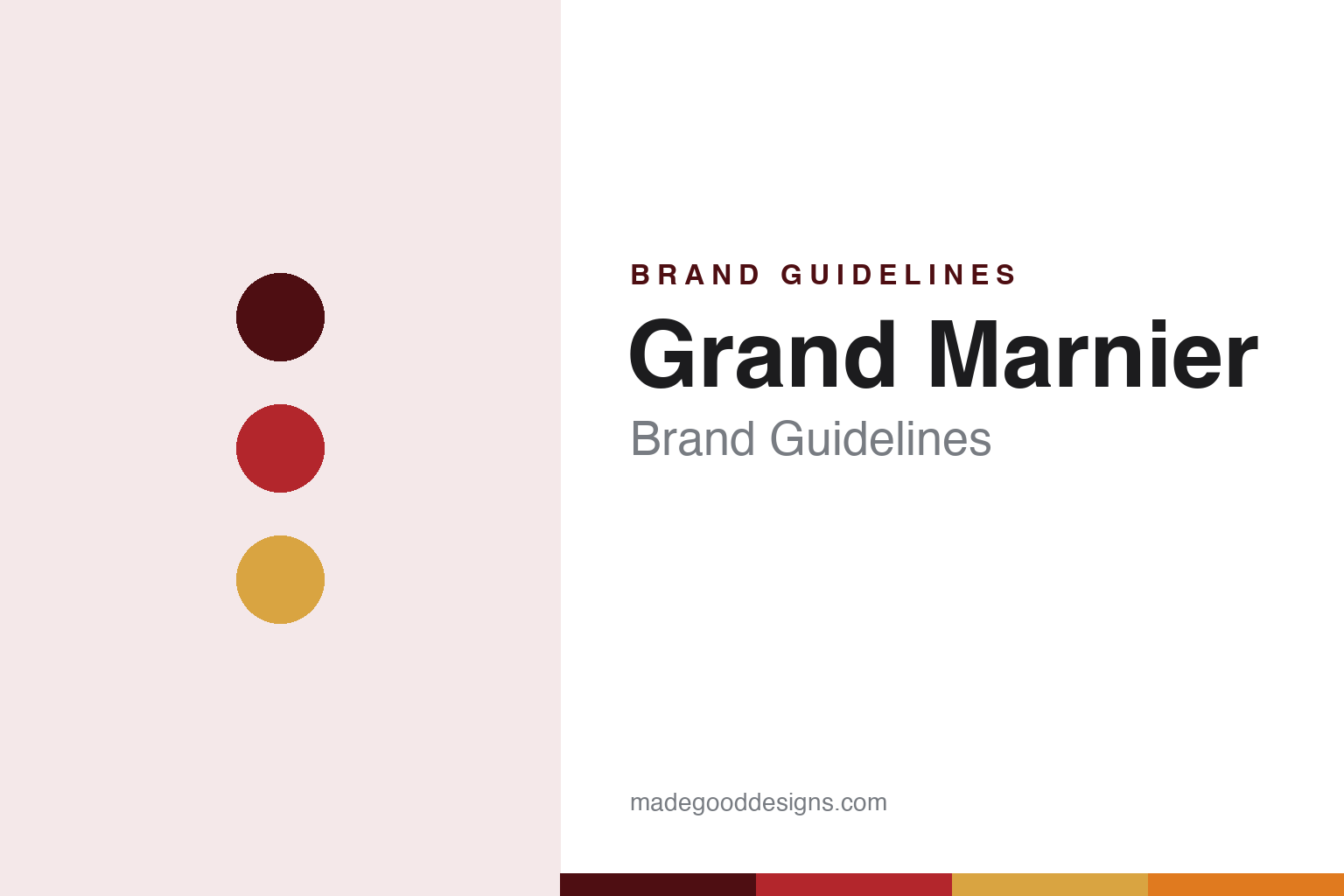
Two constants: a cordon red, cognac gold and bitter orange palette and a classical old-style serif register. Abstract homage — not a Grand Marnier product or mark; no bottle, ribbon, seal or logo is reproduced.
Neauphle-le-Château
A village distillery, a marriage and a cognac.
Grand Marnier’s story begins with a distillery. In 1827, according to the family’s own accounts and English Wikipedia, Jean-Baptiste Lapostolle founded a distillery making fruit liqueurs at Neauphle-le-Château, a village west of Paris near Versailles. French Wikipedia dates the house’s Cherry Marnier, a griotte cherry liqueur, to that year and says it was dropped after the 2016 change of ownership.
The Marnier name arrived by marriage. English Wikipedia says that in 1876 Lapostolle’s granddaughter, Julia, married Louis-Alexandre Marnier, and the family name became Marnier Lapostolle. In 1880, French Wikipedia says, Louis-Alexandre Marnier Lapostolle created Grand Marnier at Neauphle-le-Château. The family’s Chilean wine estate, Lapostolle, describes it as a drink based on cognac and a rare variety of bitter oranges, which it says were then a luxury. The original liqueur of that year is the one now sold as Cordon Rouge, literally “red ribbon”.
The name has its own legend. English Wikipedia, citing Michelli, says the hotelier César Ritz coined “Grand Marnier” for his friend, and that Marnier Lapostolle in return helped Ritz buy and establish the Hôtel Ritz in Paris. The family’s wine estate tells the same story, crediting Ritz with “a great name for a great liqueur”. Several drinks-trade histories add that the liqueur was first sold as Curaçao Marnier before Ritz’s name took over.
Colour
Cordon Rouge and the anniversary cuvées.
The range has grown from that single liqueur by marking anniversaries. For the distillery’s centenary in 1927, the company released the Cuvée du Centenaire in limited quantities, French and English Wikipedia both say; English Wikipedia says it uses cognacs up to 25 years old. For the 150th anniversary in 1977 came the Cuvée Spéciale Cent Cinquantenaire, made with cognacs up to 50 years old and sold, English Wikipedia says, in frosted glass bottles with hand-painted Art Nouveau decoration. Its marketing could be self-mocking: English Wikipedia records a 2005 slogan calling it “hard to find, impossible to pronounce, and prohibitively expensive”. A Cuvée Louis-Alexandre, named after the founder of the liqueur and sold mainly in Europe and Canada according to French Wikipedia, followed, and French Wikipedia dates a Cuvée Quintessence to 2011.
Not every variant survived. Cordon Jaune, a yellow-ribbon triple sec that English Wikipedia says was made with neutral grain spirit instead of cognac, stopped production on 1 January 2017, after the change of ownership, English Wikipedia says. The awards record is concentrated on one event: at the San Francisco World Spirits Competition of 2001, both Wikipedias say, Cordon Rouge won a gold medal and the Cent Cinquantenaire was named best liqueur, with further golds for the Centenaire and the Cent Cinquantenaire in 2007.
The liqueur also travelled through kitchens. French Wikipedia describes Cordon Rouge as aged for several months in oak casks, amber with old-gold glints, and paired with crêpes Suzette, and a 1965 photograph in the Dutch National Archives shows a Montmartre pastry shop advertising crêpes au Grand Marnier. Today the brand’s US website is published by Campari America and gives much of its space to cocktails such as the Margarita.
Typography
Design and documentation.
The seven brands in this group are all liqueurs from France and elsewhere in Europe: Cointreau, Grand Marnier, Chartreuse, Bénédictine, Chambord, St-Germain and Cherry Heering. European liqueur brands in general sit at many different points in the trade, from family houses that still carry a founder’s name to names that now belong to much larger drinks groups, and a single brand can be poured everywhere from a hotel bar to a kitchen table.
A liqueur brand’s identity is usually carried less by a single product than by a bottle, a name and the drink it promises, because the company behind the name may have changed hands, moved its production or grown far beyond the place where it started. That makes the questions behind each name worth asking plainly: who started it, who owns it now, and where its liqueurs are actually made and bottled.
Each guide separates what independent sources record from what the company says about itself — its founding story, its owners over time, where its liqueurs are made and how its bottles and labels have changed — and marks plainly what rests only on the company’s own word.
Aa
A classical old-style serif for a cognac-based liqueur with a 19th-century name. (Specimen set in Cormorant Garamond, a serif STAND-IN; NOT the Grand Marnier logo.)
Grand Marnier
From Charente cellars to Campari.
For most of its history Grand Marnier belonged to the founding family. In 1921, according to Difford’s Guide and the regional guide Cognac-ton, the family bought the Château de Bourg at Bourg-Charente, on the Charente river near Jarnac, in the cognac region. French Wikipedia says the house moved its distillation there from Neauphle-le-Château in 2012. The family also branched out: the Lapostolle wine estate in Chile says Alexandra Marnier Lapostolle, a great-granddaughter of the creator of Grand Marnier, began her Chilean venture in 1994.
The family company, Société des Produits Marnier Lapostolle, was listed in Paris but controlled by the family. On 15 March 2016, Reuters and other outlets reported that the Italian drinks group Campari had agreed with the controlling family shareholders to take over the company in a friendly deal, buying an initial block of shares and launching a public tender offer. The offer ran from 18 May to 21 June 2016, the trade press reported, after which Campari held about 70% of the share capital and, together with family shares covered by its agreement, control of nearly 98%. Campari’s 2016 announcement said the agreement allowed it to buy the family’s remaining shares from 2021. French Wikipedia says the Marnier Lapostolle company was merged into its shareholder, Campari France, at the end of October 2025.
Under Campari the brand sits in a portfolio that also includes Appleton Estate rum from Jamaica, and its US marketing now runs through Campari America. The Lapostolle estate says Grand Marnier remains the most exported French liqueur.
For a design guide, Grand Marnier shows how a red ribbon, a famous name and a ladder of anniversary cuvées can turn one 1880 recipe into a whole family of bottles. Compare Cointreau, its long-time rival among French orange liqueurs, and Appleton Estate, a fellow Campari brand; For this guide we use a cordon red, a deep claret, a cognac gold and a bitter orange with a classical serif, an unofficial interpretation; no product or logo is reproduced.
Explore & save
Keep Grand Marnier’s identity on hand — save it to a board in the Made Good inspiration library.
Grand Marnier identity set
Pin the Grand Marnier cordon red, cognac gold and bitter orange palette and the classical old-style serif register to your own board.