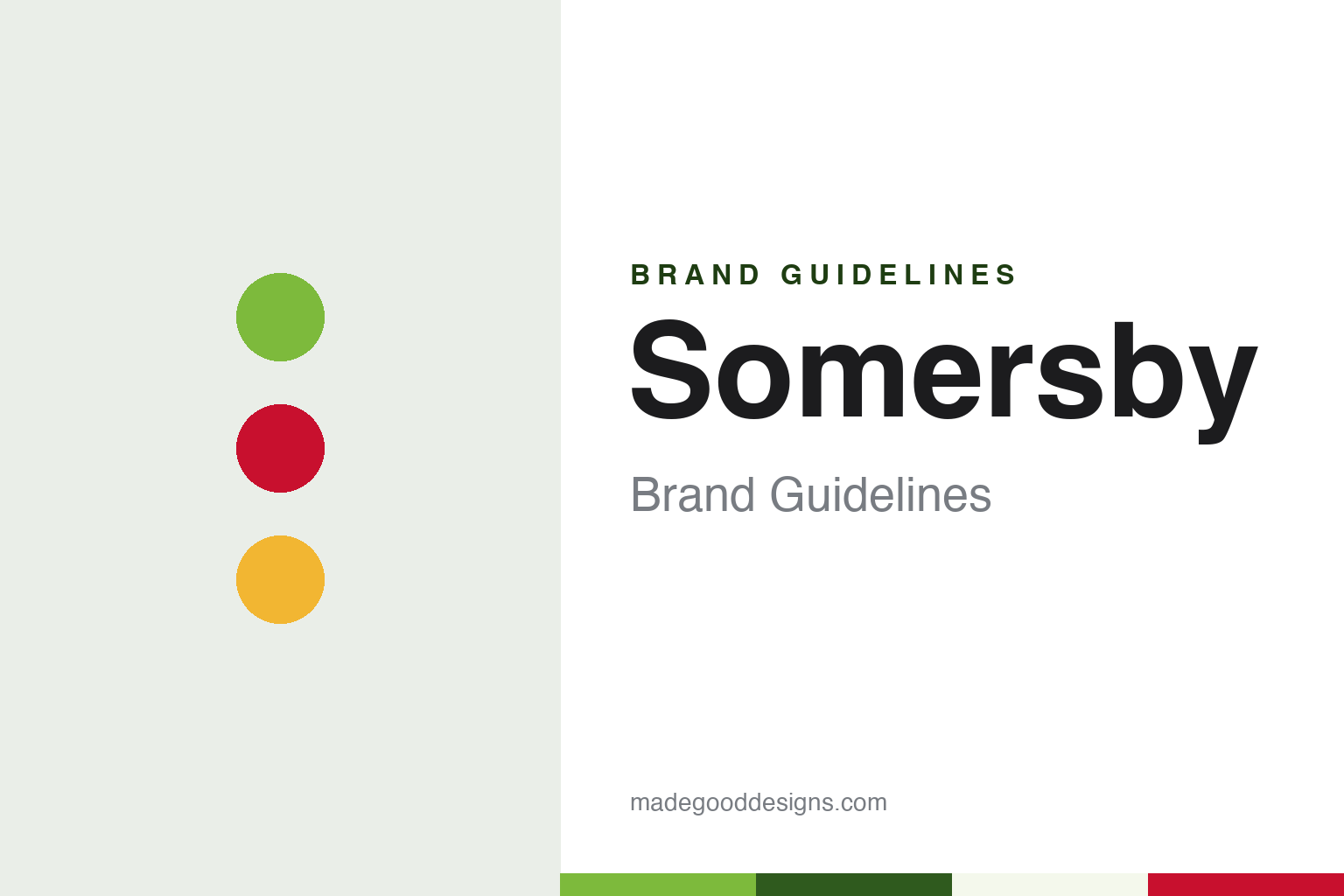
Somersby Brand Guidelines
Carlsberg’s Danish cider, its fictional lord and its living tree.
Aa
Two constants: a fresh green, orchard green and apple red palette and a soft display serif register. Abstract homage — not a Somersby product or mark; no label, logo or tree is reproduced.
A Danish brewer’s cider
Built in Copenhagen, introduced in the north of Europe.
Somersby is a cider brand of the Carlsberg Group, the Copenhagen brewer best known for its beers, including Tuborg and Kronenbourg. English Wikipedia, citing Carlsberg’s own product page, dates its launch in Denmark to 2008, and the trade site BeverageDaily reported in July 2012 that it was launched in Denmark and Norway that year. Carlsberg told the site the brand had been developed for Northern Europe, not for Britain.
The brand has an English back-story. English Wikipedia says that, despite its Danish origin, Somersby is marketed in many territories as the creation of “Lord Somersby,” a fictional English lord, and an early advertisement featuring the character dates from May 2008. Somersby is also the name of a village in Lincolnshire, but the cider is a Carlsberg creation from Denmark.
The brand spread quickly through Carlsberg’s markets. BeverageDaily counted 22 countries in 2012, across Northern and Western Europe and parts of Asia, and English Wikipedia lists markets from Australia and New Zealand to South Korea, Thailand, Canada and the United States. In some countries the name has been stretched to fit local rules: English Wikipedia says that in Poland, where cider was little drunk and advertising it was restricted, Carlsberg used the Somersby name for fruit-flavoured beer, and that in some markets a beer-and-apple blend has been sold as an “Apple Beer Drink.”
Britain came later. BeverageDaily reported that Carlsberg launched Somersby in the United Kingdom in July 2012, first in Tesco, in cans and bottles, with pubs to follow in 2013. Joanna Dring, Carlsberg’s external communications manager, told the site the company had spent about eighteen months on a recipe for British drinkers, and the report said the UK version was produced in Herefordshire.
Colour
From a plain apple tree to a canopy that changes by flavour.
The tree has been the brand’s emblem throughout. In December 2019 Carlsberg unveiled a new identity by the Leeds studio of Elmwood, Packaging Europe and Transform magazine reported. Elmwood gave the brand a new positioning, “Refreshingly Optimistic,” and presented Somersby as an occasion-based sparkling drink rather than a traditional cider. The plain apple tree of the earlier packs was replaced by what the designers called a “living tree”: its outline stays fixed while the canopy changes to show the tasting notes of each flavour, with brighter, fresher greens and swirling shapes that Elmwood said were meant to suggest togetherness. Packaging Europe reported that the studio also wrote a full set of Somersby brand guidelines covering the platform, the brand architecture and the visual system, for use across about 50 markets, mainly in Europe and Asia.
The colour system is built around the flavours. As 1000logos.net described it in December 2019, each taste is marked with its own colour and its own version of the living tree, so that pear, blackberry, watermelon and the rest of the range read as one family on the shelf.
Five years later the tree was simplified. In November 2024 Food Manufacture and Marketing Beat reported that Carlsberg had introduced a new global identity by the Leeds agency Born Ugly, with a simplified tree, an optimised marque and more vibrant colours, and a new brand framework, portfolio architecture and packaging. Anna Katrine Drumm-Hakim, Somersby’s global brand director, said the brand had become “somewhat of a victim of our own success” as it expanded, and that the new identity was “a big step for the brand to become more convivial and relevant.” Food Manufacture put the brand’s reach at 64 markets; Marketing Beat gave 46.
Typography
Design and documentation.
The seven brands in this group are all cider names: Strongbow, Magners, Bulmers, Somersby, Kopparberg, Rekorderlig and Thatchers. Cider brands in general sit at many different points in the trade, from family farms that still carry a founder’s name to labels that now belong to much larger drinks groups, and a single brand can be sold everywhere from a corner shop to a pub bar.
A cider brand’s identity is usually carried less by a single bottle or can than by a label, a name and the place it promises, because the company behind the name may have changed hands, moved its production or grown far beyond the place where it started. That makes the questions behind each name worth asking plainly: who started it, who owns it now, and where its cider is actually made and packed.
Each guide separates what independent sources record from what the company says about itself — its founding story, its owners over time, where its cider is made and how its labels have changed — and marks plainly what rests only on the company’s own word.
Aa
A soft display serif for an orchard name with an English accent. (Specimen set in DM Serif Display, a serif STAND-IN; NOT the Somersby logo.)
Somersby
Advertising that borrows from somewhere else.
Somersby’s advertising has often borrowed a familiar setting. In March 2013 its British television spot “The Somersby Store” parodied the launch hype of Apple’s shops, with staff in a minimalist store presenting a pint of cider as if it were a new gadget, Fortune and Luerzer’s Archive reported. The spot was made by the London agency Fold7 and directed by Mat Kirkby, and it signed off with the line “less apps, more apples.” The Guardian reviewed the advert in April 2013.
The brand has also widened what it sells under the name. English Wikipedia lists pear cider, flavoured apple ciders such as blackberry, elderflower and watermelon, and lighter sparkling drinks under the Somersby name, and the 2024 refresh was meant in part to give such line extensions a more premium pack, Food Manufacture reported. The brand’s site is somersby.com.
For a design guide, Somersby shows how a brewer can build a cider brand almost from nothing, with an English-sounding name, a fictional lord and a single tree that changes its canopy for each flavour, then simplify that tree as the range grows. Compare Kopparberg and Rekorderlig, the Swedish fruit ciders it competes with, and Tuborg, its Carlsberg stablemate. For this guide we use fresh green, orchard green and apple red with a serif, an unofficial interpretation; no product or logo is reproduced.
Explore & save
Keep Somersby’s identity on hand — save it to a board in the Made Good inspiration library.
Somersby identity set
Pin the Somersby fresh green, orchard green and apple red palette and the soft display serif register to your own board.