Kopparberg Brand Guidelines
The 1882 brewery in Bergslagen that the Bronsman brothers turned into a fruit cider maker.
Aa
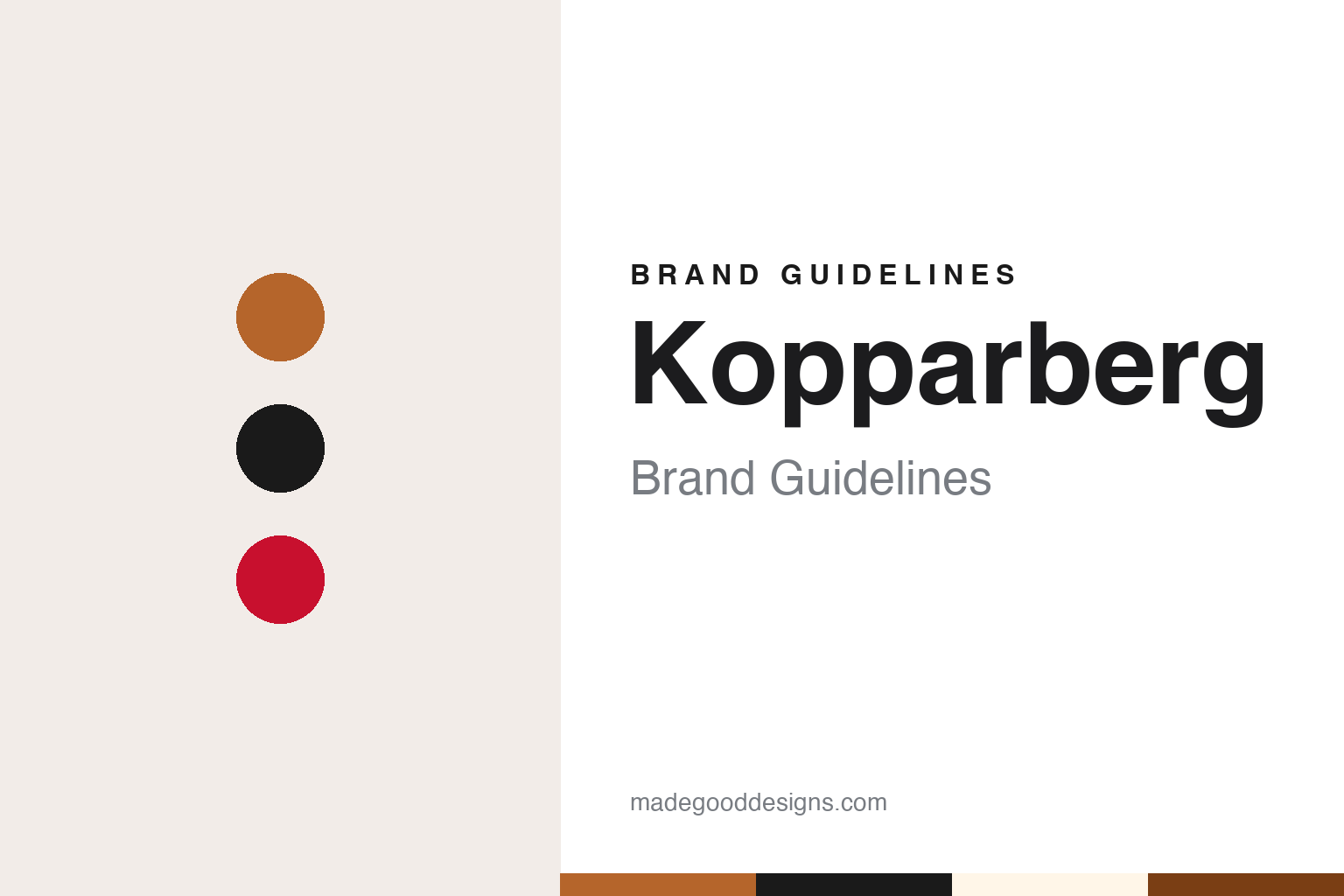
Two constants: a copper, brewery black and cream palette and a bold grotesque sans register. Abstract homage — not a Kopparberg product or mark; no label, logo or bottle is reproduced.
A brewery in Bergslagen
From table beer for a mining district to an empty building and a second start.
Kopparberg is the cider of Kopparbergs Bryggeri, a brewery in the small town of Kopparberg in Ljusnarsberg Municipality, Örebro County, in the Bergslagen region; English Wikipedia describes the brewery as the main employer of a town of about 4,000 people. The name means “copper mountain,” English Wikipedia notes. The brewery dates from 1882. According to the producer text published by Systembolaget, the Swedish state alcohol retailer, it was founded that year when 36 brewers joined together to make svagdricka, a weak, low-alcohol malt drink, which remained its business until 1988.
The decades that followed were unsettled. Systembolaget’s text says the brewery was sold in the 1980s to a foreign company that failed, after which a bank took over the business. Scottish Licensed Trade News (SLTN) reported in April 2014 that a Swiss owner had planned to turn the site over to bottled water, drawn by the soft water of the area.
The second start came in 1994. Systembolaget and Swedish Wikipedia both say the brothers Peter and Dan-Anders Bronsman bought Kopparbergs that year and hired the brewmaster Wolfgang Voigt; Swedish Wikipedia, citing the company, adds the bank director Per-Olof Olsson as one of the group that rebuilt the brewery. SLTN dated the purchase to March 1994 and the return of beer production to November 1994, and quoted Peter Bronsman recalling that he showed his wife a picture of the brewery and told her “we’ve done the best deal in the world.”
The next year nearly ended it. SLTN reported that early in 1995 a fire destroyed half the brewery and that production resumed about six months later; Swedish Wikipedia places the fire in the cellar. After the rebuilding, Swedish Wikipedia says, Kopparberg began making a sweet cider of around 4.5 per cent, in contrast to traditional dry cider, and calls the decision a stroke of luck. SLTN reported that pear and fruit ciders followed the beer.
Colour
Pear, mixed fruit and a British market built from Sweden.
Most of the cider leaves Sweden. Swedish Wikipedia, citing the magazine Land, says Kopparberg cider was exported first to England and later to around 40 other countries, and that in 2017 the company exported 94 per cent of the cider it produced; SLTN put the share at 95 per cent in 2014.
Britain became the largest stage, and two dates are given for the arrival. English Wikipedia says Kopparberg was introduced to the United Kingdom in 2003 by B O Times1 Limited. SLTN reported in 2014 that the brand made its official UK launch in 2006, through Cider of Sweden, a joint venture that markets and distributes it there; Kopparbergs’ 2010 annual report, cited by Swedish Wikipedia, lists Cider of Sweden Ltd as a 51 per cent subsidiary. Peter Bronsman told SLTN that Kopparberg was the first cider brand in the UK with pear, when the others were all apple, and that Mixed Fruit and Strawberry & Lime followed — the company’s account of its own role in the British fruit-cider boom.
The flavour list has kept growing. English Wikipedia says alcohol-free pear and mixed fruit versions came later and, citing the company, that the whole range was declared vegan in 2021; the trade site KamCity reported in March 2023 that Kopparberg had added an alcoholic orange ginger beer.
For years the bottle itself stayed put. In April 2022 Transform magazine reported that Ben McKay, a student at Ravensbourne University London, had won the chance to redesign limited-edition bottles of Strawberry & Lime, Mixed Fruit and Pear with street-art patterns in neon colours; the company’s head of marketing, Rob Salvesen, called it “a first for the brand since it launched.”
In March 2026 Food and Drink Technology reported a global rebrand across Kopparberg’s ciders, spirits and ready-to-drink cocktails: a refined, more legible brand mark, a decluttered label, a vibrant colour palette and bold fruit illustrations, with the aim of a consistent block on shelf that also takes in Fruit Lager, gin and the 0.0% range. The article did not name a design agency. One episode in British advertising drew a ruling: in November 2011 the Morning Advertiser reported that the Advertising Standards Authority had told Cider of Sweden to stop showing a television advert it judged likely to appeal strongly to under-18s.
Typography
Design and documentation.
The seven brands in this group are all cider names: Strongbow, Magners, Bulmers, Somersby, Kopparberg, Rekorderlig and Thatchers. Cider brands in general sit at many different points in the trade, from family farms that still carry a founder’s name to labels that now belong to much larger drinks groups, and a single brand can be sold everywhere from a corner shop to a pub bar.
A cider brand’s identity is usually carried less by a single bottle or can than by a label, a name and the place it promises, because the company behind the name may have changed hands, moved its production or grown far beyond the place where it started. That makes the questions behind each name worth asking plainly: who started it, who owns it now, and where its cider is actually made and packed.
Each guide separates what independent sources record from what the company says about itself — its founding story, its owners over time, where its cider is made and how its labels have changed — and marks plainly what rests only on the company’s own word.
Aa
A bold grotesque sans for a short Swedish place name. (Specimen set in Archivo, a sans-serif STAND-IN; NOT the Kopparberg logo.)
Kopparbergs Bryggeri
A cider brand inside a Swedish brewing group.
The cider is one brand in a wider company. Swedish Wikipedia describes Kopparbergs Bryggeri as Sweden’s second-largest Swedish-owned brewery, after Spendrups, names P & D Bronsman AB as its owner and parent, and lists Peter Bronsman as managing director. In the early 2000s it bought several smaller breweries: Sofiero in Laholm in 2000 and Banco and Zeunerts in 2002, the article says, and Banco was sold in 2018, the trade site Beernews reported. Its beers include Sofiero Original, Zeunerts Original and Höga Kusten, and it also makes soft drinks, the Dufvemåla water and Frank’s energy drink and vodka, with production in Kopparberg, Laholm and Sollefteå, according to Swedish Wikipedia. SLTN reported that Peter Bronsman was named Ernst & Young’s Swedish Entrepreneur of the Year in 2013.
The company also runs pubs. Swedish Wikipedia says Kopparbergs started the John Scott’s pub chain in 2013, and that by 2025 it had pubs in Sweden, Spain and Finland.
The name needs a little care. Kopparberg is a town in Örebro County, but until 1 January 1997 Kopparberg County (Kopparbergs län) was the official name of what is now Dalarna County, English Wikipedia notes, so older references to “Kopparberg” may mean a different place. The Swedish company site is kopparbergs.se.
For a design guide, Kopparberg shows how a brewery from a small town in Bergslagen, revived by two brothers after a fire, built an export brand on sweet fruit flavours and then redrew its packaging for a whole portfolio in 2026. Compare Rekorderlig, the Swedish fruit cider from Vimmerby, and Somersby, Carlsberg’s cider brand. For this guide we use copper, brewery black and cream with a bold sans, an unofficial interpretation; no product or logo is reproduced.
Explore & save
Keep Kopparberg’s identity on hand — save it to a board in the Made Good inspiration library.
Kopparberg identity set
Pin the Kopparberg copper, brewery black and cream palette and the bold grotesque sans register to your own board.