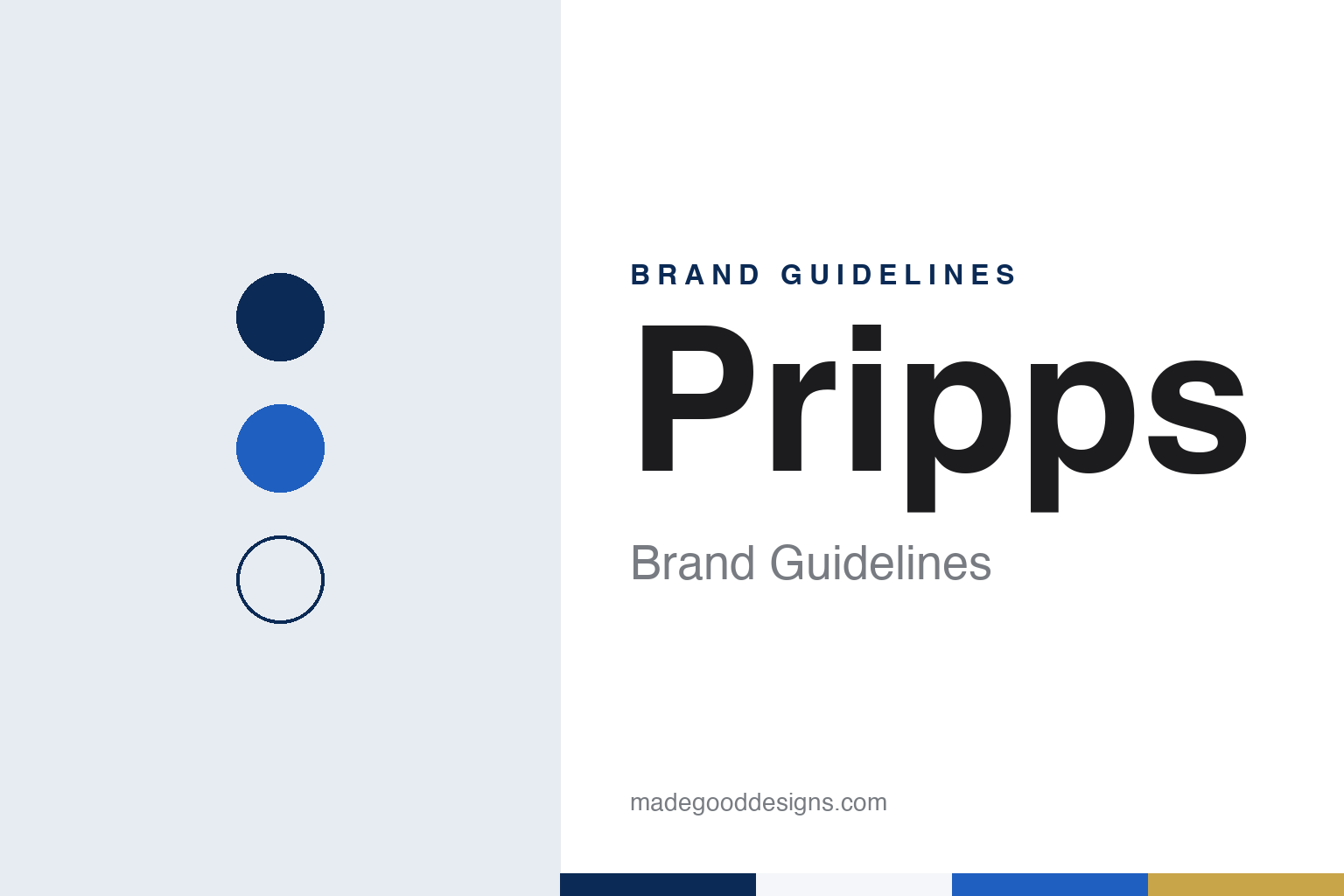
Pripps Brand Guidelines
The 1828 Gothenburg brewery behind Pripps Blå.
Aa
Two constants: an export blue, harbour navy and medal gold palette and a sturdy grotesque sans register. Abstract homage — not a Pripps product or mark; no can, label, pentagon or logo is reproduced.
The Bremberg brewery
A leased brewery, a son trained in Germany and a pentagon.
Pripps traces itself to Gothenburg in 1828, when Johan Albrecht Pripp began running a brewery in the city. Swedish Wikipedia, which cites the Nationalencyklopedin and a 1928 company history, gives the detail: Pripp leased an existing brewery from the heirs of the brewer Göran Bremberg, quoting a tax letter he signed on 8 March 1828, and bought the buildings outright in 1844. A brewery had stood on the site, near Stampen, since at least 1758. By 1840, Swedish Wikipedia says, Pripp’s was the largest brewery in Gothenburg. The brand’s own site says Pripps was founded when Pripp began brewing his own beer after being inspired by travels in Germany.
In 1859 his son Frosten Carl Pripp became a partner and the business took the name J. A. Pripp & Son. Swedish Wikipedia credits the son, who had studied brewing in Germany, with introducing Bavarian bottom-fermented beer. The firm became a limited company, Aktiebolaget J. A. Pripp & Son, on 7 February 1879. One unusual date in its history: on 17 May 1900, Swedish Wikipedia says, citing a Gothenburg local-history chronicle of 1982, Pripps test-drove what it describes as the first lorry in Sweden, a German-built vehicle bought to deliver beer, on a run from Gothenburg to Kungsbacka.
The company’s oldest symbol is a pentagon. Swedish Wikipedia says the name of the firm was set inside a five-sided figure that was stamped into the corks of beer bottles before paper labels came into use; the mark was in use from 1865 and was first registered on 10 January 1885. Carlsberg Sverige’s own design history, published in 2008, also dates the pentagon to 1865 and says it was burnt into the natural corks that sealed the bottles.
Colour
Mergers, the state, Volvo, Orkla and Carlsberg.
Pripps grew by merger. In 1927, Swedish Wikipedia says, it joined its Gothenburg rival J. W. Lyckholm & Co to form AB Pripp & Lyckholm, which went on to buy the Carnegie brewery in 1928, Apotekarnes in 1950 and Malmö Bryggerier in 1961. In 1964 it merged with AB Stockholms Bryggerier, then the country’s largest brewer, to form Pripp-Bryggerierna AB, headquartered in Stockholm but named after the Gothenburg firm. A large brewery opened in Bromma, Stockholm, in 1970, and a new Gothenburg plant at Västra Frölunda opened on 18 June 1976, replacing the old site at Stampen.
Ownership then changed several times. The Swedish state became majority owner in 1974, according to English Wikipedia, which cites a 2026 paper in the Scandinavian Economic History Review. Pripps later became part of the state industrial group that became Procordia, then passed to Volvo. In 1995 Volvo combined it with Orkla’s Norwegian brewer Ringnes as Pripps Ringnes, and in 1997 sold its share to Orkla, Swedish Wikipedia says. Carlsberg bought Pripps in 2000 and combined it with Falcon, which it already owned, to form Carlsberg Sverige, which Swedish Wikipedia dates to 2001. Production in Gothenburg and Bromma was wound down; Pripps stopped brewing at the listed Bromma building in 2004.
For decades Pripps also bottled soft drinks. Swedish Wikipedia says it made Coca-Cola under licence from the drink’s Swedish introduction in the 1950s, lost those rights in the mid-1990s and took over the Pepsi licence in Sweden instead. Today the beers are brewed by Carlsberg Sverige, whose only brewery is the Falcon plant in Falkenberg, according to Swedish Wikipedia’s articles on Pripps and on Carlsberg Sverige. Former Pripps staff in Gothenburg went on to found a small brewery of their own.
Typography
Design and documentation.
The seven brands in this group all make drinks, and all of them come from Sweden, Belgium or Spain: Pripps, Ramlösa, Jupiler, Estrella Damm, Mahou, Cruzcampo and Kas. Drink brands in general sit at many different points in the trade, from family firms that still carry a founder’s surname to names that now belong to much larger brewing and beverage groups, and a single brand can be sold everywhere from a corner bar to a supermarket shelf.
A drink brand’s identity is usually carried less by a single product than by a bottle, a label, a name and the occasion it promises, because the company behind the name may have changed hands, moved its brewery or bottling plant or grown far beyond the town where it started. That makes the questions behind each name worth asking plainly: who started it, who owns it now, and where its drinks are actually brewed, bottled and packed.
Each guide separates what independent sources record from what the company says about itself — its founding story, its owners over time, where its drinks are made and how its labels and advertising have changed — and marks plainly what rests only on the company’s own word.
Aa
A sturdy grotesque sans for a brewery that turned a colour into a name. (Specimen set in Libre Franklin, a sans STAND-IN; NOT the Pripps logo.)
Pripps Blå
A nickname, a ship, a horizon and a pentagon.
The brand’s best-known beer began as a nickname. In autumn 1959 AB Pripp & Lyckholm launched a strong beer called Pripps Export; Swedish Wikipedia, citing Gothenburg and Stockholm newspapers of October and December 1959, says it was named “Export” because until 1955 strong beer could be made in Sweden only for export. Carlsberg Sverige’s 2008 design history says the beer’s intense blue background, especially on the can, became its signature, and people in Gothenburg began calling it Pripps Blå, “Pripps Blue.” The same document says the bottle label took the shape of the pentagon, and that empty blue cans left on the city’s lawns in spring were nicknamed blåsippor, after the blue hepatica flower.
The name became official in 1975, the year the brand’s own site gives for the launch of Pripps Blå. Carlsberg Sverige says that year’s beer was a new, milder medium-strength brew made to compete with Falcon, and that its designers kept the blue, made it lighter, and gave the label a Gothenburg theme: a unicorn and a lion, and a sailing ship for the port city. It was sold first in western Sweden, then nationally. In 1989, the company says, a new design profile made the ship more prominent and reduced the old coat of arms to a quality stamp; in 1992 one design was applied across every strength and pack, with a faint horizon line and the word “blå” set on medals; and in 2002 the horizon line was made prominent, the ship updated and the 1865 pentagon brought back. Resumé reported the 2002 redesign under the headline that Pripps Blå was becoming “bluer.”
Advertising built the summer image. Swedish Wikipedia says Pripps moved the account to Brindfors Annonsbyrå in 1990, citing Dagens Industri, and that a relaunch the next year used Tomas Ledin’s song “Blå, blå känslor,” followed by films of sea, summer and the archipelago, including one with Tommy Nilsson’s “Dina färger var blå” in 1995; Resumé called it the campaign that made Pripps Blå the picture of a Swedish summer. A tougher tone tried from 1998 was dropped, and in March 2002 a film set to Uno Svenningsson’s “Vågorna” returned to the archipelago. The company also says the sailing ship Marité toured as the “Pripps Blå boat” in the 1990s.
For a design guide, Pripps shows how one colour, used consistently on a can, can become a brand name in its own right, with a 160-year-old pentagon kept in reserve. Compare it with its Carlsberg Sverige stablemate Ramlösa and with the Belgian lager Jupiler. For this guide we use export blue, harbour navy and medal gold with a sturdy grotesque sans, an unofficial interpretation; no product or logo is reproduced.
Explore & save
Keep Pripps’s identity on hand — save it to a board in the Made Good inspiration library.
Pripps identity set
Pin the Pripps export blue, harbour navy and medal gold palette and the sturdy grotesque sans register to your own board.