Ramlösa Brand Guidelines
Helsingborg mineral water from a 1707 spa.
Aa
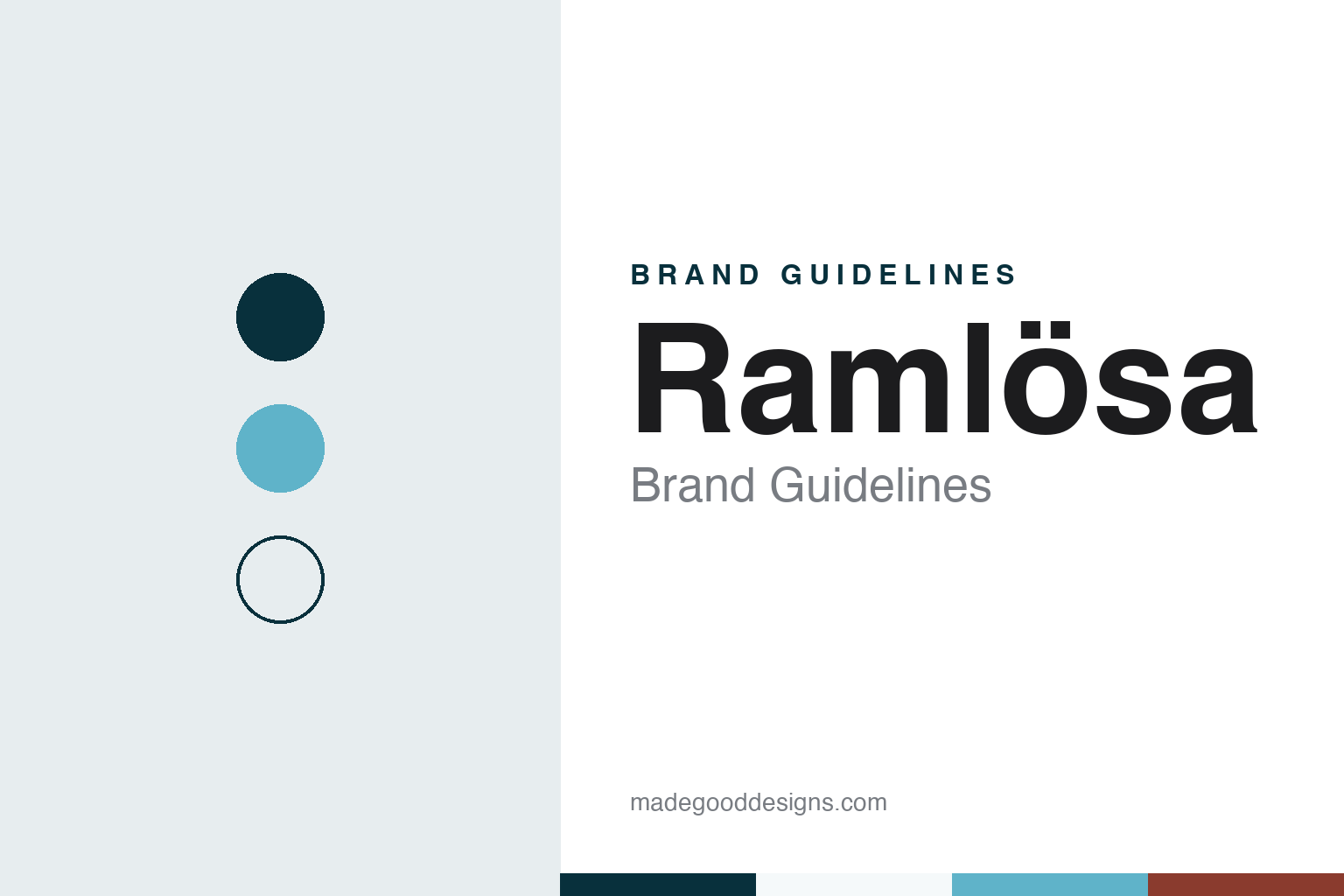
Two constants: a spring teal, drop blue and iron rock red palette and a classical spa serif register. Abstract homage — not a Ramlösa product or mark; no bottle, label or logo is reproduced.
A spa in Helsingborg
An iron spring, a physician and a king’s birthday.
Ramlösa began as a spa, not a drink. Swedish Wikipedia says the physician Johan Jacob Döbelius, a professor of medicine at Lund University, examined an iron-bearing spring at Ramlösa, south-east of Helsingborg, in 1701, 1705 and 1706, and with the backing of Magnus Stenbock, the governor of Skåne, opened a spa around it on 17 June 1707, the 25th birthday of King Karl XII. The brand’s own timeline gives the same date. Döbelius published a description of the spring the following year.
The spa became a fashionable resort for visitors from Sweden and Denmark. A company to run it was formed in 1798, according to Swedish Wikipedia, with landowners from Skåne, physicians and merchants among its first shareholders, and in 1801 it received its first royal privileges. Over the 19th century it gained a railway station, a hotel and, in 1877, a horse-drawn tramway to a bathhouse by the Öresund strait.
The water that is sold today came later. Swedish Wikipedia says that drilling for coal and clay near the park in the late 19th century struck large amounts of water instead, and that analysis showed it to be very pure and rich in minerals, comparable to the German Apollinaris water. The brand dates the discovery of its present source to 1895 and calls it a chance find. Two springs are now used: the alkaline source found by drilling, and a second, called Jacobs källa, rooted in the original iron spring of 1707.
Colour
A bottling plant, exports and four owners.
Bottling began in earnest in the 20th century. The company says Ramlösa went on sale outside the spa park in 1906, at first through pharmacies, and that its first factory opened in 1912, bottling the water directly at the source. Swedish Wikipedia also dates the first factory to 1912, beside the park’s bathhouse, and says that by the 1920s the water business earned more than the spa itself. In the 1930s Ramlösa was exported to Denmark, where it had long been known, and to Finland, Britain, the Netherlands, France, the Middle East and Egypt. The brand says it has been a Royal Swedish Purveyor since 1910.
During the Second World War, Swedish Wikipedia says, several of the park’s buildings housed Jewish refugees who had fled Denmark from 1943, and on 9 April 1945 prisoners freed from German concentration camps and brought by Folke Bernadotte’s White Buses were received at the spa.
After the war sales grew so fast that the factory was extended twice and then replaced: in 1973 bottling moved to a new plant in the Ättekulla industrial area, with the water carried there by an underground pipeline. The spa itself closed the same year. The brand’s own site still describes the water as bottled at the source.
Ownership changed several times. Swedish Wikipedia lists the brewer AB Consol as owner from 1943, Volvo from 1982 and Orkla from 1995 to 2001. AB Ramlösa Hälsobrunn ceased as a separate company in 1999, and since 2001 the business has been part of Carlsberg Sverige, the Danish group’s Swedish arm, which lists Ramlösa alongside Pripps Blå, Falcon and Somersby. Swedish Wikipedia describes Carlsberg Sverige as having two production sites, the Falkenberg brewery and the Ramlösa water plant.
Typography
Design and documentation.
The seven brands in this group all make drinks, and all of them come from Sweden, Belgium or Spain: Pripps, Ramlösa, Jupiler, Estrella Damm, Mahou, Cruzcampo and Kas. Drink brands in general sit at many different points in the trade, from family firms that still carry a founder’s surname to names that now belong to much larger brewing and beverage groups, and a single brand can be sold everywhere from a corner bar to a supermarket shelf.
A drink brand’s identity is usually carried less by a single product than by a bottle, a label, a name and the occasion it promises, because the company behind the name may have changed hands, moved its brewery or bottling plant or grown far beyond the town where it started. That makes the questions behind each name worth asking plainly: who started it, who owns it now, and where its drinks are actually brewed, bottled and packed.
Each guide separates what independent sources record from what the company says about itself — its founding story, its owners over time, where its drinks are made and how its labels and advertising have changed — and marks plainly what rests only on the company’s own word.
Aa
A classical spa serif for a water that dates its story to 1707. (Specimen set in Cormorant Garamond, a serif STAND-IN; NOT the Ramlösa logo.)
Ramlösa
Flavours, a drop-shaped bottle and a water fund.
For most of its life Ramlösa was a single, plain carbonated water. The brand says its first flavour, Ramlösa Citrus, arrived in 1990. Swedish Wikipedia, citing Göteborgs-Posten in 2007, says the company long resisted flavoured water and lost ground to Loka, which had moved into flavours early. In 2007, the spring’s 300th year, Carlsberg decided to keep a single water brand in Sweden and chose Ramlösa over Vichy Nouveau, which it also owned; the same year it launched Ramlösa Stilla, a still water drawn from Jacobs källa. The brand’s timeline says the range was widened again with a new line in 2026.
The pack is the brand’s best-known design. Ramlösa’s export bottle was a drop-shaped glass bottle. Swedish Wikipedia says that in 2011 it was replaced by a PET version that kept the basic drop form with a more crystal-like faceting, a change explained partly by the lower weight and smaller carbon footprint; it was designed by the Swedish agency NINE and, Swedish Wikipedia says, won “Best of the show” at the Pentawards packaging-design awards that year. The brand says a new, modern bottle “designed exclusively for Ramlösa” followed in spring 2016, and that Ramlösa received a new look in spring 2023.
Other parts of the identity are about place and occasion. The brand says the Nobel Foundation chose Ramlösa for the tables of the Nobel banquet in 1979, and its present tagline presents it as water for all of Sweden, from student parties to the royal court. Since 2011 the Ramlösa Vattenfond, run with the Swedish Red Cross, has donated the equivalent of a litre of clean water for every litre of Ramlösa sold, the brand says, and it reported passing one billion litres in 2025. The spa park in Helsingborg, with a water pavilion built in 1919–21 beside the rock face of the old iron spring, still stands, and many of its buildings are protected.
For a design guide, Ramlösa shows how a three-hundred-year spa story, a recognisable bottle shape and a plain name can carry a commodity product. Compare it with its Carlsberg Sverige stablemate Pripps and with the Swedish oat-drink maker Oatly. For this guide we use spring teal, drop blue and iron rock red with a classical serif, an unofficial interpretation; no product or logo is reproduced.
Explore & save
Keep Ramlösa’s identity on hand — save it to a board in the Made Good inspiration library.
Ramlösa identity set
Pin the Ramlösa spring teal, drop blue and iron rock red palette and the classical spa serif register to your own board.