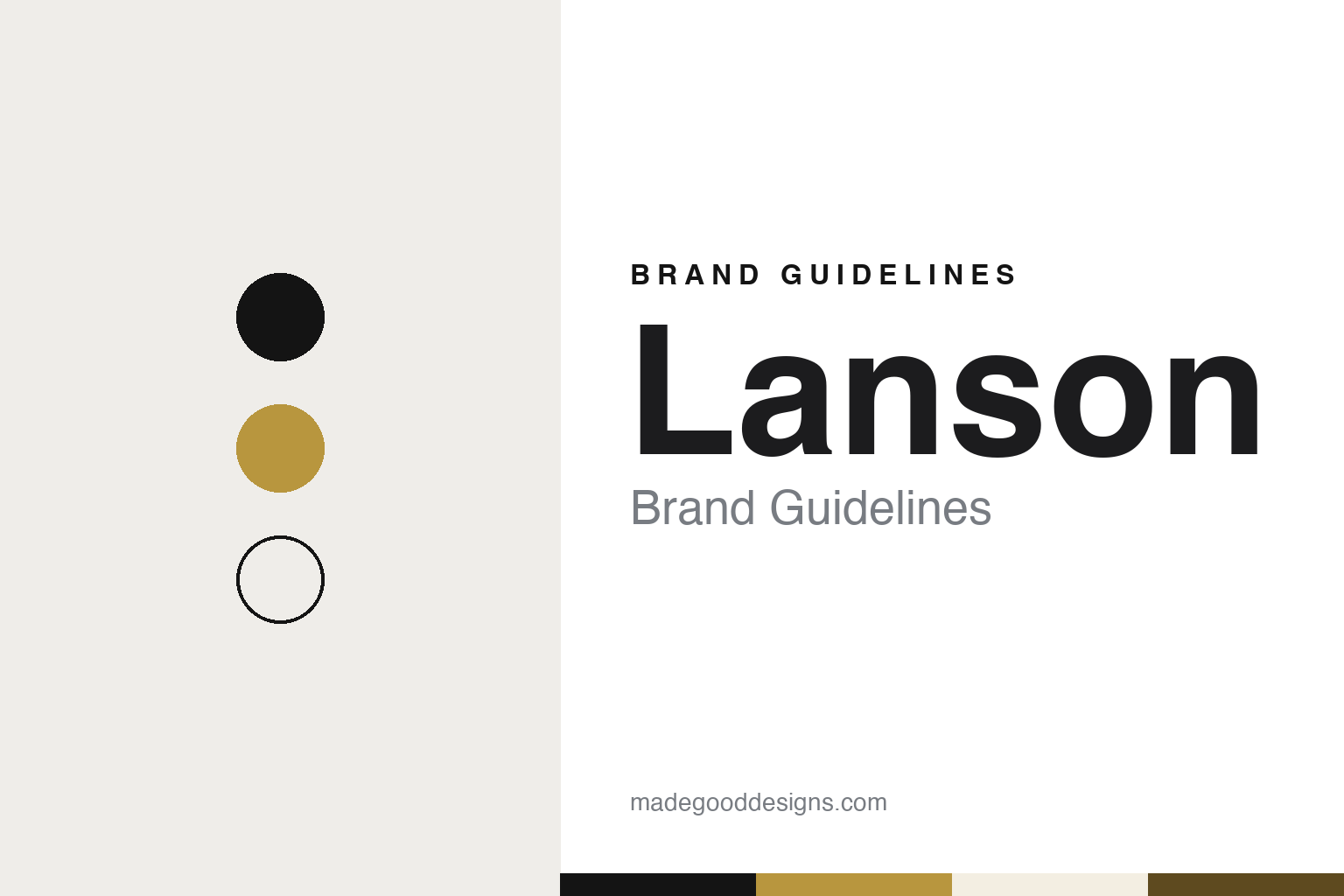
Lanson Brand Guidelines
The Reims Champagne house of the Maltese cross and Black Label.
Aa
Two constants: a Lanson black, gold and ivory palette and a classical serif register. Abstract homage — not a Lanson product or mark; no bottle, label, cross or logo is reproduced.
Delamotte
A magistrate’s house, a knight’s cross.
Lanson counts its history from 1760, when François Delamotte, a magistrate, set up a Champagne house in Reims. English and French Wikipedia both give that date and founder, and the house itself says it was “founded in 1760” and calls itself one of the oldest Champagne houses. The Lanson name came later. French Wikipedia says Delamotte’s younger son, Nicolas-Louis Delamotte, had been a knight of the Order of Malta and came back to Reims in 1798, the year Bonaparte took the island, to succeed his father.
That return gave the house its emblem. Nicolas-Louis adopted the Maltese cross as the firm’s commercial mark, French Wikipedia says, and the company’s own history puts it the same way: in 1798 the cross was taken up in honour of the founder’s son, a member of the Hospitaller Order of Malta. Lanson says the symbol was later redrawn as the “Croix Lanson” and still appears on its bottles.
Jean-Baptiste Lanson, a friend of the family, joined the Delamottes as a partner in 1828, according to French Wikipedia, and later renamed the business J-B Lanson et Compagnie; English Wikipedia dates the name Lanson et Cie to 1837, the year French Wikipedia says his sons Victor-Marie and Henri entered the firm. From the start the house looked abroad. In 1882 Victor-Marie Lanson signed an exclusive agency contract with Percy Fox in London that lasted a century, French Wikipedia says, and by the end of the nineteenth century Lanson supplied the royal courts of the United Kingdom, Sweden and Spain, according to English Wikipedia.
The British connection became formal on 4 December 1900, when, the company says, Queen Victoria granted Lanson a Royal Warrant; Lanson says it held the warrant for 122 years, renewed under Elizabeth II, until 2022. In 1937 Victor Lanson created the cuvée he called Black Label, aimed at Britain, the house’s first market, French Wikipedia says.
Colour
From family firm to a listed group.
Lanson stayed in family hands into the 1970s. In 1927 Victor Lanson bought the Binet buildings and cellars on the rue de Courlancy in Reims, French Wikipedia says, and from 1967 Étienne Lanson ran the house and began keeping back older vintages, building a library of aged wines. The company dates its collection of vintages to 1976.
Then came a run of owners. French Wikipedia, citing Les Échos and Le Monde, gives the sequence: the Gardinier group bought Lanson in 1975; BSN, the food group later known as Danone, bought it from Gardinier in 1984; in 1991 BSN sold Lanson and Pommery to LVMH, which three months later sold the Lanson brand on to Marne et Champagne while keeping the vineyards. At the end of 2004 Marne et Champagne renamed itself Lanson International.
In 2006 the Boizel Chanoine Champagne group, known as BCC, bought Champagne Lanson together with Maison Burtin, the former Marne et Champagne, according to the group’s own history and Le Monde. BCC had been formed in 1994 by joining Chanoine Frères with Champagne Boizel, and had since added Philipponnat, de Venoge and Alexandre Bonnet. In 2010, the year of Lanson’s 250th anniversary, BCC renamed itself Lanson-BCC “to better reflect its international dimension,” the group says; French Wikipedia records the change at an anniversary celebration at Versailles. The group lists a further acquisition in 2025: Champagne Heidsieck & C° Monopole.
The look of the bottles has moved with the owners. English Wikipedia describes a major repackaging in 2008 that recalled the Lanson house style of the 1980s. Hervé Dantan, cellar master since 2013 by the company’s account, reworked the flagship in 2023 as Le Black Création and the rosé in 2024 as Le Rosé Création.
Typography
Reims, chalk and freshness.
The seven brands in this group are all champagne houses: Taittinger, Laurent-Perrier, Krug, Mumm, Lanson, Piper-Heidsieck and Ruinart. Champagne houses in general sit at many different points in the trade, from firms that still carry a founding family’s name to names that now belong to much larger drinks groups, and a single house can be sold everywhere from a wine merchant to a supermarket shelf.
A champagne house’s identity is usually carried less by a single wine than by a label, a name and the occasion its bottles promise, because the company behind the name may have changed hands, bought or sold vineyards or grown far beyond the cellars where it started. That makes the questions behind each name worth asking plainly: who started it, who owns it now, and where its wines are actually made and aged.
Each guide separates what independent sources record from what the house says about itself — its founding story, its owners over time, where its wines are made and how its labels and packaging have changed — and marks plainly what rests only on the house’s own word.
Aa
A classical serif — the register of an old Reims house. (Specimen set in Cormorant Garamond, a serif STAND-IN; NOT the Lanson logo.)
Lanson
A cross, a label and a tournament.
Lanson is based in Reims. French Wikipedia puts its own planted vineyard at about 57 hectares, supplemented by bought-in grapes, and describes about seven kilometres of chalk cellars holding close to 20 million bottles, citing a 2014 report in L’Hebdo du Vendredi. It also notes a technical choice that shapes the house style: Lanson does not put its wines through malolactic fermentation, which French Wikipedia says preserves more acidity. The company frames its approach under the line “Release the freshness.” Its walled one-hectare Clos Lanson, planted with chardonnay, released its first vintage in 2016, Lanson says, and the Malmaison estate, bought in 2010, has been farmed organically since then by the company’s account.
The range runs from the Black Label line and rosé to a blanc de blancs, an organic Green Label and the prestige Noble Cuvée, which the company says became Noble Champagne in 2022. Lanson also says the first rosé appears in its cellar records in 1833, and that a rosé became a signature cuvée in 1952.
Its best-known public stage is tennis. Lanson has been a partner of Wimbledon since 1977, the company and French Wikipedia say; L’Union marked 42 years of the partnership in 2019.
For a design guide, Lanson shows how a single emblem with a dated origin can carry a house through a dozen owners: the cross adopted in 1798 is still on the bottle. Compare Piper-Heidsieck, another Reims house dating from the eighteenth century, and Mumm, also of Reims. For this guide we use black, gold and ivory with a serif, an unofficial interpretation; no product or logo is reproduced.
Explore & save
Keep Lanson’s identity on hand — save it to a board in the Made Good inspiration library.
Lanson identity set
Pin the Lanson black, gold and ivory palette and the classical serif register to your own board.