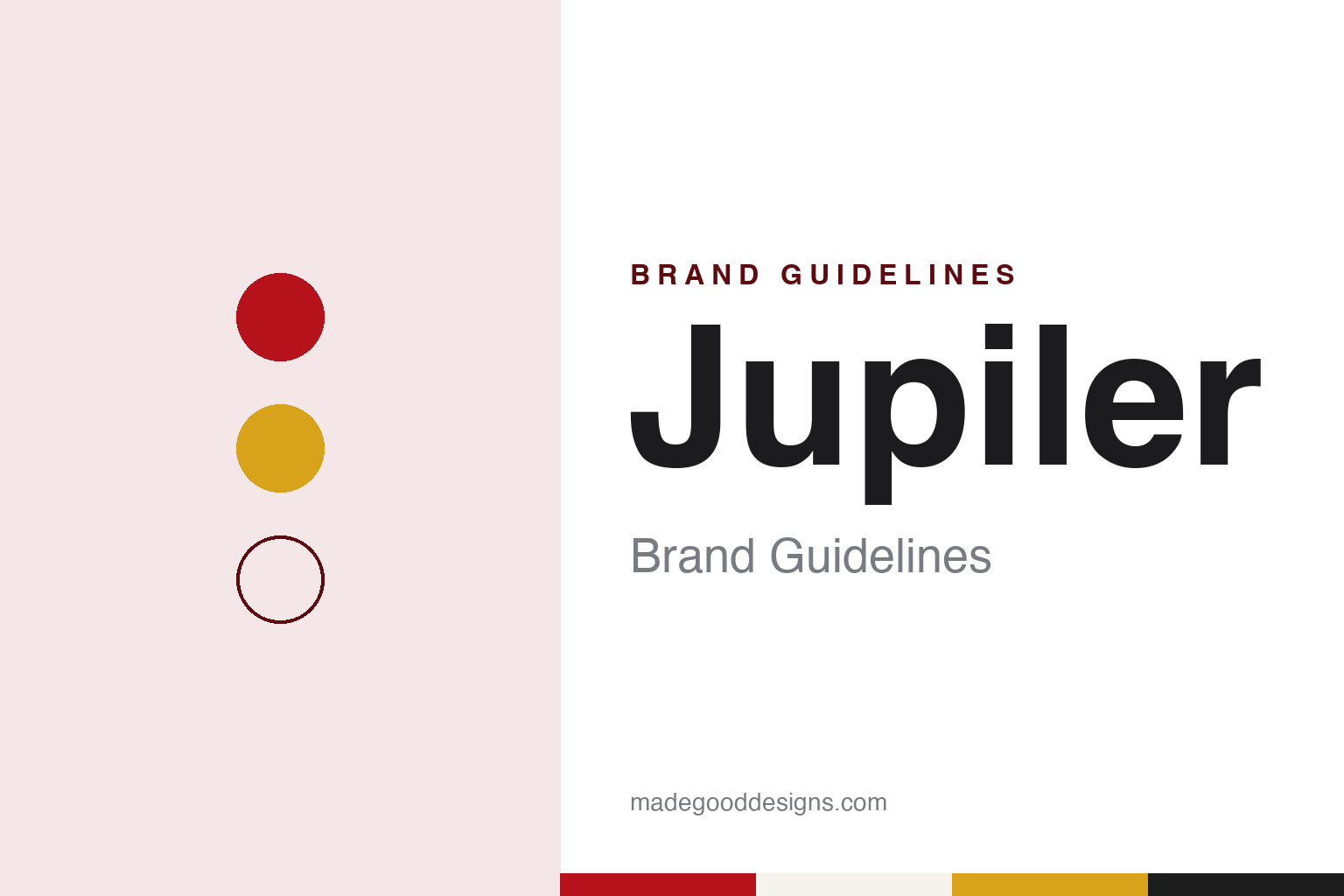
Jupiler Brand Guidelines
The Liège pils named after its brewery village.
Aa
Two constants: a Jupiler red, gold and foam-white palette and a condensed sans register. Abstract homage — not a Jupiler product or mark; no bottle, glass, bull emblem or logo is reproduced.
Piedbœuf
A boiler works, a brewing family and a village on the Meuse.
Jupiler takes its name from Jupille-sur-Meuse, a district of Liège on the right bank of the Meuse, and from the brewery there. That brewery belonged to the Piedbœuf family, whose business began as something else. English Wikipedia says Jacques-Pascal Piedbœuf founded the company in Jupille in 1812 as a boiler works, making brewing equipment as well as boilers for engines, ships and locomotives.
Brewing came later. In 1853 his son Jean-Théodore Piedbœuf began brewing; French Wikipedia, citing La Libre Belgique, places that brewery at Jupille, while English Wikipedia says the first venture was set up in cellars and did not last, and that today’s brewery descends from one founded in 1873 by Henri Lhoest-Collinet, whose daughter married Théodore Piedbœuf, a nephew of Jean-Théodore, in 1892. Dutch Wikipedia gives 1853 as the brewery’s founding year.
For decades the brewery stayed local. English Wikipedia, citing a 1981 history of Liège industry, says it ranked only 724th in Belgium in 1921, then switched to bottom fermentation, the method used for lager, and had climbed to 21st by 1930. Between 1935 and 1939 it built the Tour Piedbœuf, a functionalist tower designed by the architect Léopold Broquet, with the family name spelled out in large art-deco letters, Dutch Wikipedia says.
The beer that became Jupiler had a forerunner. In the 1950s, French Wikipedia says, citing Focus on Belgium and 7sur7, Albert Van Damme, a member of the Piedbœuf family, created a pale bottom-fermented beer called Jupiler Urtyp in answer to German competition, with an “-er” ending chosen to sound Germanic.
Colour
Jupiler 5, a bull and “Men know why.”
The modern beer arrived in 1966. Piedbœuf delivered the first keg on 5 September 1966, the Belgian broadcaster RTBF reported when the beer turned fifty in 2016. It was launched as Jupiler 5; French Wikipedia says the figure referred to its strength and to its five ingredients, and the number was later dropped from the name. Dutch Wikipedia explains the name as the village name with the suffix “-er,” as German forms adjectives from place names such as Aachen.
The beer is a pale lager of the pils type, and English Wikipedia lists its ingredients as malt, maize, water, hops and yeast. It became Belgium’s best-selling beer: Bloomberg put its share at around 40 percent by volume in 2019, a figure the Belgian magazine Apache also gave that year.
Its emblem is a bull. Dutch Wikipedia says the bottles and glasses were redesigned in 2006, when the bull, previously shown rearing on its hind legs, was redrawn standing on all four, and the word “Jupiler” was set vertically on the glass. The bottles are brown.
The advertising has been as consistent as the emblem. The long-running line is “Men know why” — “Mannen weten waarom” in Dutch and “Les hommes savent pourquoi” in French — and French Wikipedia says early campaigns positioned Jupiler as a beer for men before it became tied to sport, with later campaigns aimed at women too. A Dutch variant, “Belgen weten waarom” (“Belgians know why”), is also recorded.
The range has grown around the original. Jupiler Blue followed in 2006; Jupiler Tauro, a stronger lager, ran from 2008 to 2012; Jupiler Force, a brewed soft drink, ran from 2011 to 2014, according to De Standaard and the trade site biernet; and Jupiler 0.0% replaced an earlier low-alcohol version at the end of 2016, Het Laatste Nieuws reported. AB InBev launched Pure Blonde by Jupiler in May 2018.
Typography
Brands from the north and south of Europe.
The seven brands in this group all make drinks, and all of them come from Sweden, Belgium or Spain: Pripps, Ramlösa, Jupiler, Estrella Damm, Mahou, Cruzcampo and Kas. Drink brands in general sit at many different points in the trade, from family firms that still carry a founder’s surname to names that now belong to much larger brewing and beverage groups, and a single brand can be sold everywhere from a corner bar to a supermarket shelf.
A drink brand’s identity is usually carried less by a single product than by a bottle, a label, a name and the occasion it promises, because the company behind the name may have changed hands, moved its brewery or bottling plant or grown far beyond the town where it started. That makes the questions behind each name worth asking plainly: who started it, who owns it now, and where its drinks are actually brewed, bottled and packed.
Each guide separates what independent sources record from what the company says about itself — its founding story, its owners over time, where its drinks are made and how its labels and advertising have changed — and marks plainly what rests only on the company’s own word.
Aa
A bold condensed sans for a beer sold in red. (Specimen set in Oswald, a condensed sans STAND-IN; NOT the Jupiler logo.)
Jupiler
From a family brewery to the world’s largest brewer.
Jupiler’s growth came with consolidation. By 1979 the Piedbœuf group employed 3,800 people and brewed 2.75 million hectolitres, English Wikipedia says. Dutch Wikipedia, citing De Standaard in 2020, says the Piedbœuf family shareholders made a secret agreement with the Artois brewery of Leuven, maker of Stella Artois, in 1971, forming a group controlled by the Artois families while the two brands stayed rivals in public. The two breweries merged to form Interbrew in 1987, according to English and French Wikipedia; Dutch Wikipedia gives 1988.
In March 2004 Interbrew merged with the Brazilian brewer AmBev to form InBev, and in 2008 InBev merged with Anheuser-Busch to form Anheuser-Busch InBev, which owns Jupiler today. The beer is still brewed at Jupille: a new industrial brewery opened on the enlarged site in 1992, French Wikipedia says, citing AB InBev’s Belgian news page, and the site now goes by the name Brasserie Jupiler.
Football has been the brand’s main stage. Jupiler is the title sponsor of Belgium’s top football division, the Jupiler Pro League, and sponsors the national team, the Red Devils. In the Netherlands it gave its name to the second division, the Jupiler League, from 2006 until 2018, Dutch Wikipedia says. On 20 February 2018 AB InBev announced that for five months the beer would be renamed “Belgium” in support of the national team at that summer’s World Cup, RetailDetail reported.
For a design guide, Jupiler shows how a place name, a single animal emblem and a slogan repeated for decades can carry a mass-market beer through several changes of owner. Compare Estrella Damm, a Barcelona lager whose star became its name, and Lotus Biscoff, another Belgian brand sold far beyond its home town. For this guide we use red, gold and foam-white with a condensed sans, an unofficial interpretation; no product or logo is reproduced.
Explore & save
Keep Jupiler’s identity on hand — save it to a board in the Made Good inspiration library.
Jupiler identity set
Pin the Jupiler red, gold and foam-white palette and the condensed sans register to your own board.