Harboe Brand Guidelines
The Skælskør family brewery of 1883 behind Bear Beer.
Aa
Two constants: a fjord blue and barley gold palette and an old-style brewery serif register. Abstract homage — not a Harboe product or mark; no can, bottle, label or logo is reproduced.
Harboe and Lotz
Two brothers, a merchant and a horse and cart.
Harboe began in Skælskør, a small fjord town in south-west Zealand, in 1883. The company says the brothers Jørgen and Adolph Harboe decided that year, together with the merchant Jørgen Lotz, to build a brewery to supply the town with beer. Danish Wikipedia describes Jørgen Harboe as a distillery owner and shipowner and Adolph Harboe as a timber merchant, and gives the brewery’s first name as Harboe & Lotz. The founders built a brewhouse and a brewmaster’s house, which Danish Wikipedia says are still in daily use, for malt-extract evaporation and for administration.
The first brewmaster was Gunner Harboe, Jørgen’s son, who was sent to Germany to learn to brew. On 2 August 1883, the company says, the first wooden barrels of beer left the brewery on a horse-drawn wagon, and customers came out to the street with jugs to have them filled. From 1884 Gunner brewed Bavarian-style beer to a German recipe; Danish Wikipedia says the first beers were hvidtøl, Danish “white beer,” and lager. From 1890 the brewery also bottled beer, brewed pilsner and filled mineral water, the company says.
Gunner retired in 1910 and handed over to his son Frederik, who modernised the plant. Until then the fermenting cellar had been kept cold with ice cut from a pond behind the brewery; Frederik installed a refrigeration plant, and in the mid-1920s added the first bottle-rinsing machine, a rotary filler and machines for capping, corking and labelling, according to the company’s history.
Colour
Malt extract, a bear and a brewery in the east.
After the Second World War Harboe added a product beyond drinks. The company says malt extract, a concentrate of dissolved malt from the brewing process, was first introduced as a substitute for sugar and soon became an essential ingredient for bakeries, with exports to Germany, Sweden, Norway, France, Finland and the Soviet Union. It still describes itself as one of Europe’s leading malt-extract producers. German Wikipedia says the brewery became a public limited company in 1957.
The brand that took Harboe abroad arrived in 1974, when the brewery launched Bjørne Bryg, “bear brew.” The company says it later became Bear Beer, now its leading brand across several pilsner and speciality beers, and that during the 1980s Bear Beer opened the way to a series of distribution agreements in Europe. By 1978, the company says, Harboe produced 40 million bottles of beer and soft drinks a year.
Leadership passed to an in-law. The company says Bernhard Griese, who came to Denmark from Germany in 1968 to work on a refinery project at Stigsnæs near Skælskør, married Gunner Harboe’s daughter Kirsten in 1971, joined the brewery in 1972 and later became technical director; in 1984 he took over as chief executive from Gunner Harboe. In 1989 the company was listed on the Copenhagen stock exchange, today Nasdaq Copenhagen.
In 1991 Harboe set up a brewery at Dargun in Mecklenburg, in the former East Germany; the company says it was the first Danish business to establish itself there after the fall of the Wall. German Wikipedia says it was founded on 29 May 1991 as the Darguner Klosterbrauerei and renamed Darguner Brauerei in March 1998 after a legal dispute; a plant for mineral water and soft drinks opened in October 2000. German Wikipedia also notes that Dargun’s 12th-century monastery held brewing rights in the Middle Ages.
Typography
Design and documentation.
The seven brands in this group all make food or drink, and all of them come from Denmark or Sweden: Tuborg, Faxe Kondi, Cocio, Harboe, Carletti, Festis and Loka. Danish and Swedish food and drink brands in general sit at many different points in the trade, from family firms that still carry a founder’s surname to names that now belong to much larger groups, and a single brand can be sold everywhere from a kiosk to a supermarket shelf.
A food or drink brand’s identity is usually carried less by a single product than by a pack, a name and the taste or occasion it promises, because the company behind the name may have changed hands, moved its production or grown far beyond the town where it started. That makes the questions behind each name worth asking plainly: who started it, who owns it now, and where its products are actually made and packed.
Each guide separates what independent sources record from what the company says about itself — its founding story, its owners over time, where its products are made and how its packaging has changed — and marks plainly what rests only on the company’s own word.
Aa
A sturdy old-style serif for a brewery that still runs from its 1883 town. (Specimen set in Alegreya, a serif STAND-IN; NOT the Harboe or Bear Beer logo.)
Harboe
Two breweries, a royal warrant and a sixth generation.
Today the group is built on two breweries. The company calls Darguner Brauerei its largest, supplying markets in Europe, South and Latin America, Asia, Africa and the Middle East with beer, soft drinks, energy drinks and malt drinks, and says the Skælskør and Dargun sites have a combined capacity of 10 million hectolitres. German Wikipedia adds that Dargun’s products are sold in Germany largely through retail chains, above all Netto, and that much of the range, including the Harboe soft drinks, is not sold in Germany at all. The group earlier also owned the Estonian brewery Viru Õlu at Haljala, and in 2009 took over GourmetBryggeriet, a Danish microbrewery founded in 2005, German Wikipedia says.
In Denmark Harboe is known as much for soft drinks as for beer. Danish Wikipedia lists sodas, Danish sparkling water, ciders, malt drinks and energy drinks alongside pilsner, Christmas and Easter beers, and calls Harboe Denmark’s third-largest brewery, a ranking the company also uses. In 2008 the brewery was named a Purveyor to the Royal Danish Court, the broadcaster DR reported that July.
The family is still in charge. In 2019 Bernhard Griese handed the chief executive role to his son-in-law, Søren Malling, and the company says the sixth generation of the Harboe family now runs the business day to day and shares ownership with almost 5,000 shareholders. Its building has a design story of its own: the company says its visitor centre on the edge of Skælskør fjord, designed by PLH Architects under Søren Mølbak and completed in 2017, takes the form of a ship’s bow and waves, with hop flowers worked into the pattern of its timber-clad walls. The company says it hosted the official lunch there during a visit by Queen Margrethe II in August 2022.
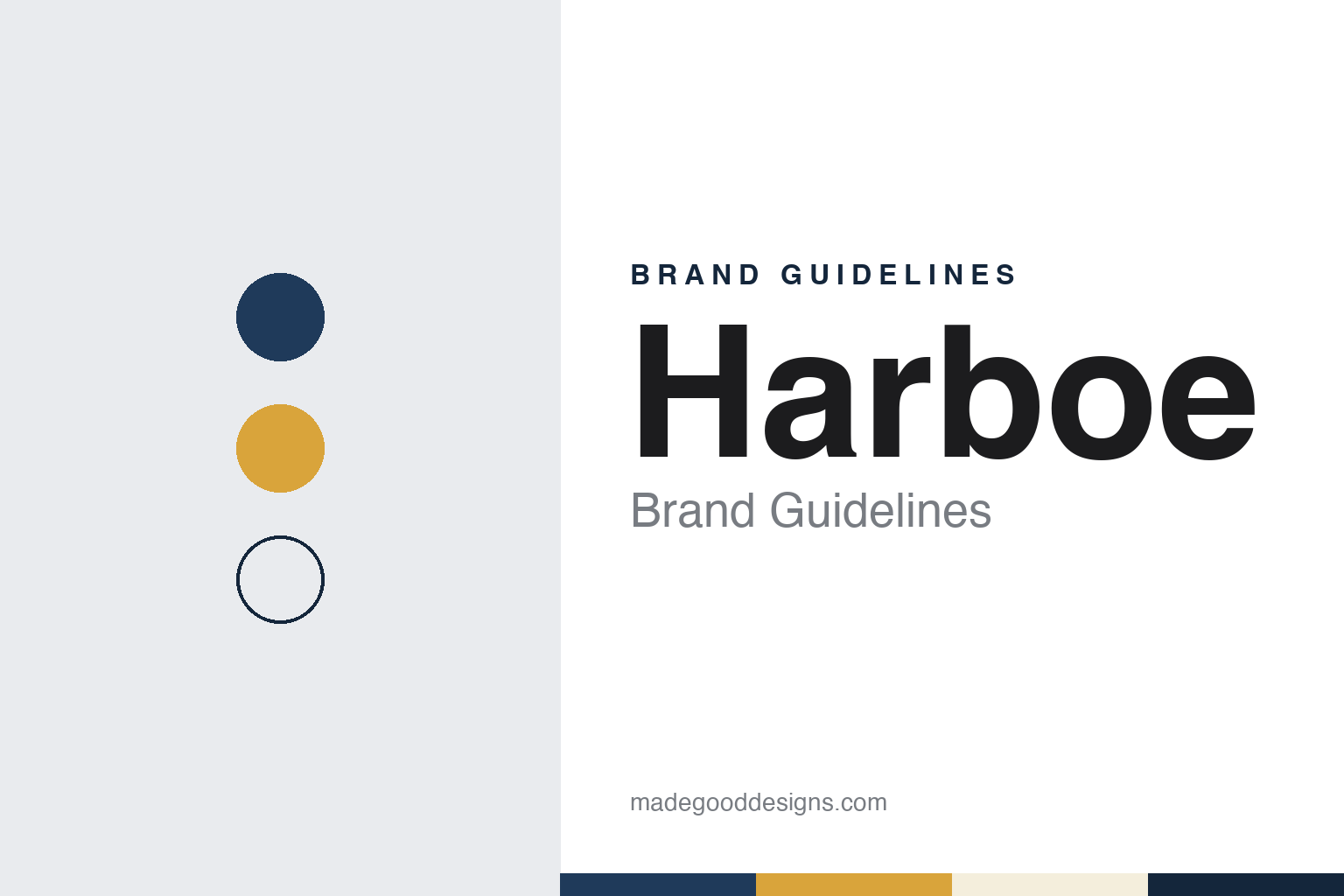
For a design guide, Harboe shows how a small-town family brewery can carry a local name and an export bear side by side, with malt extract quietly underneath. Compare Tuborg, the Copenhagen beer brand, and Faxe Kondi, another Danish soft drink from a brewer. For this guide we use fjord blue, barley gold and a malt cream with an old-style serif, an unofficial interpretation; no product or logo is reproduced.
Explore & save
Keep Harboe’s identity on hand — save it to a board in the Made Good inspiration library.
Harboe identity set
Pin the Harboe fjord blue, barley gold and malt cream palette and the old-style brewery serif register to your own board.