Club Colombia Brand Guidelines
Bavaria’s premium lager and its pre-Columbian gold emblem.
Aa
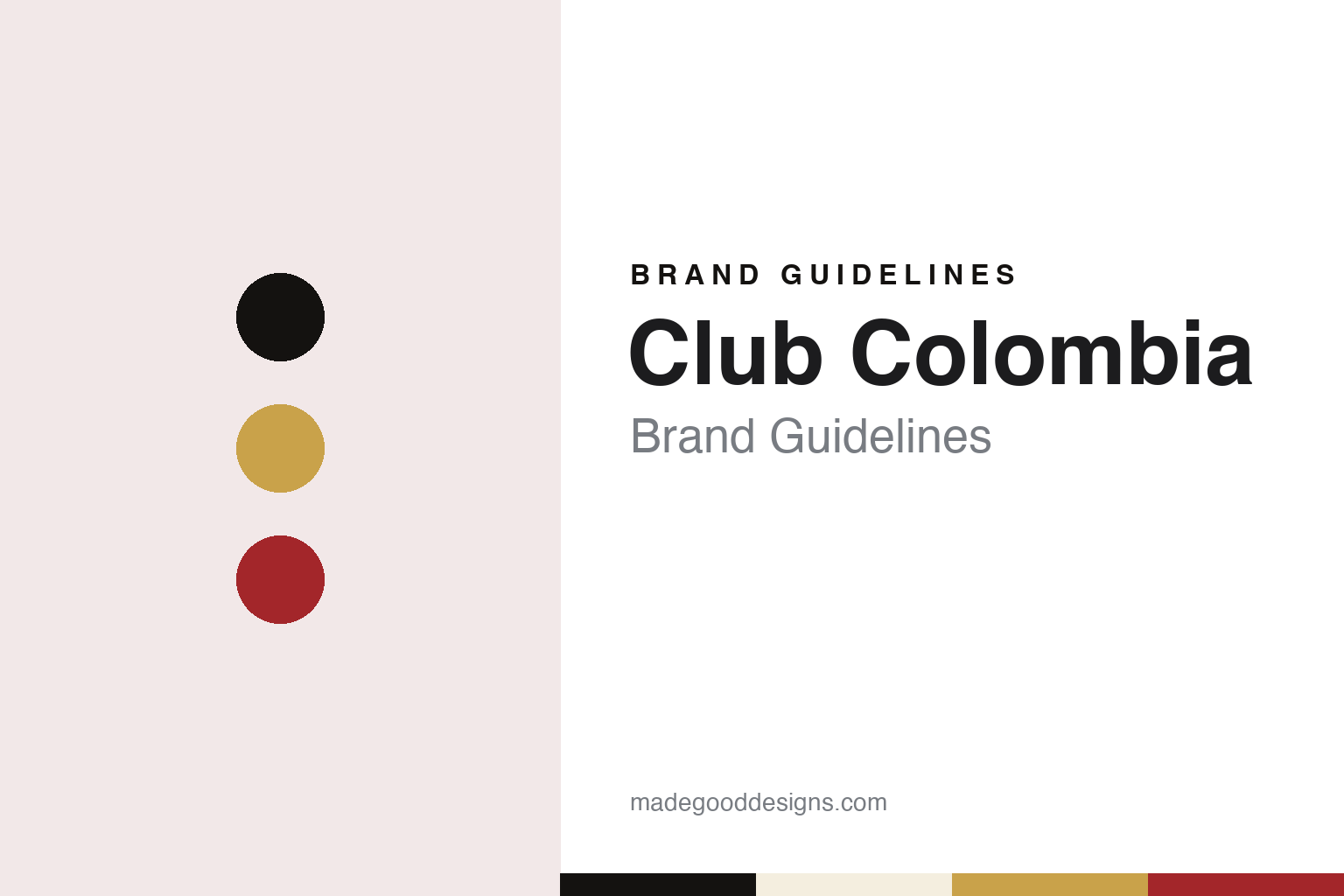
Two constants: a gold, red and black palette and a classic display serif register. Abstract homage — not a Club Colombia product or mark; no bottle, label or emblem is reproduced.
Club 60
A sixtieth-birthday beer from a German immigrant’s brewery.
Club Colombia is older than its name. It is made by Bavaria, the Bogotá brewer founded by Leo S. Kopp, a German immigrant; English Wikipedia dates the company to 4 April 1889, when a plot for the brewery was registered in Bogotá. Bavaria’s own history says Leo Siegfried Kopp and his brother Emil arrived from Germany in 1876, and that its first popular brand was La Pola, named after the independence heroine Policarpa Salavarrieta — a name that, the company says, became Colombian slang for any beer.
Spanish Wikipedia says the beer that became Club Colombia was born in 1949 as Club Sesenta, or Club 60, to mark the sixtieth anniversary of Bavaria’s founding, and was planned as the company’s first premium beer. It credits the brewmaster Guillermo Blaschke and Bavaria’s old brewery on Calle 28 in Bogotá, and says Club 60 had two lives, from 1949 to 1952 and from 1957 to 1960. In February 1957 it was relaunched, the article says, as one of the first beers sold in a six-bottle cardboard carrier, and in 1958 it received a distinction from a beer tasters’ congress held at the Brussels World’s Fair.
In 1961, by the same account, Club 60 went on general sale with a label, a neck band and a gold foil capsule, and was sold as “extra seca,” extra dry — a description its successor inherited. Bavaria’s own history puts the handover in one line: Club 60 “gave way to” Club Colombia.
Colour
A new name, a new bottle and an export campaign.
Spanish Wikipedia gives 6 January 1962 as the official launch of Club Colombia, with a new bottle — slimmer and taller — and a new label, both credited to the designer Martin J. Ferguson. The name, the article says, was meant to make the beer an ambassador for Colombia abroad. In 1963 it began exports to the United States, backed by advertising in Miami and New York, and arriving international passengers at Bogotá’s El Dorado airport were handed a bottle; in May that year it replaced Club 60 in the Valle, Antioquia and Caldas regions. The slogan of the moment was “De las colombianas, la mejor es ésta” — of the Colombian beers, this is the best — followed in 1964 by “Aquí y en el exterior, Club Colombia es superior,” here and abroad.
The advertising kept returning to connoisseurship. The article lists “Club Colombia, cerveza Extra Seca, sólo para conocedores” — only for connoisseurs — in 1975 and “Sólo para Conocedores” in 1982; “Club Colombia, Perfecta” in 1992, alongside a 300 cc bottle and a 10-ounce can; and “La perfección no se detiene” in 2005.
The pack changed with the slogans. Spanish Wikipedia says a new bottle and label arrived in 1970; that by 2000 the bottle carried a black label; and that in 2004 a redesign shifted the emphasis from black to gold, with a red label. On 23 November 2006 a new image was launched under the line “Las mejores cosas de la vida toman tiempo” — the best things in life take time — with the golfer Camilo Villegas, the chef Harry Sasson and the restaurateur Andrés Jaramillo of Andrés Carne de Res. In December 2010 a limited-edition Club Colombia Roja followed, then a Negra in 2011, both of which stayed on sale. In 2015 the line “Maestría Cervecera,” brewing mastery, arrived with another new bottle and visual identity.
Through every change one element stayed: a pre-Columbian gold figure. Spanish Wikipedia describes it both as a replica of a tunjo, the small votive figures of Colombia’s pre-Hispanic goldwork, and as an anthropozoomorphic pectoral of the Tolima culture, and says it has been on the brand since it began.
Typography
Food, drink and documentation.
The seven brands in this group are all food and drink names from Latin America: Club Colombia, Jet, Cachantun, Evercrisp, Yoki, Vigor and Pullman. Latin American food and drink brands in general sit at many different points in the trade, from family firms that still carry a founder’s name to names that now belong to much larger food and drink groups, and a single brand can be sold everywhere from a corner shop to a supermarket shelf.
A food or drink brand’s identity is usually carried less by a single product than by a pack, a name and the meal, snack or drink it promises, because the company behind the name may have changed hands, moved its production or grown far beyond the place where it started. That makes the questions behind each name worth asking plainly: who started it, who owns it now, and where its products are actually made and packed.
Each guide separates what independent sources record from what the company says about itself — its founding story, its owners over time, where its products are made and how its packaging has changed — and marks plainly what rests only on the company’s own word.
Aa
A classic display serif for a premium register. (Specimen set in Playfair Display, a serif STAND-IN; NOT the Club Colombia logo or lettering.)
Club Colombia
From Bavaria to SABMiller to AB InBev.
Ownership moved twice in eleven years. Bavaria says that on 18 July 2005 Grupo Empresarial Bavaria signed a merger agreement with SABMiller, then the world’s second-largest brewer, and English Wikipedia notes that before the deal Bavaria was the second-largest brewer in South America. On 10 October 2016 Anheuser-Busch InBev completed its purchase of SABMiller, Forbes reported that day, and Bavaria says it has been part of the AB InBev family since October 2016. It remains headquartered in Bogotá.
Bavaria says it brews in Colombia at seven breweries — in Barranquilla, Bucaramanga, Itagüí, Yumbo, Tibasosa, Tocancipá and, most recently, Palmar de Varela in Atlántico — and runs two malting plants. Spanish Wikipedia calls Club Colombia the top-tier beer among Bavaria’s brands, which also include Águila, Póker and Costeña. Spanish Wikipedia, citing archived lists from the International Taste & Quality Institute in Brussels, says the beer received the institute’s Superior Taste Award with three stars in 2011 and 2012.
For a design guide, Club Colombia shows how a single heritage emblem can hold a brand together through half a century of new bottles, labels and slogans. Compare Jet, a Colombian chocolate bar from the same years, and Jumex, a Latin American drinks brand built on one pack. For this guide we use gold, red and black with a serif, an unofficial interpretation; no product or logo is reproduced.
Explore & save
Keep Club Colombia’s identity on hand — save it to a board in the Made Good inspiration library.
Club Colombia identity set
Pin the Club Colombia gold, red and black palette and the classic display serif register to your own board.