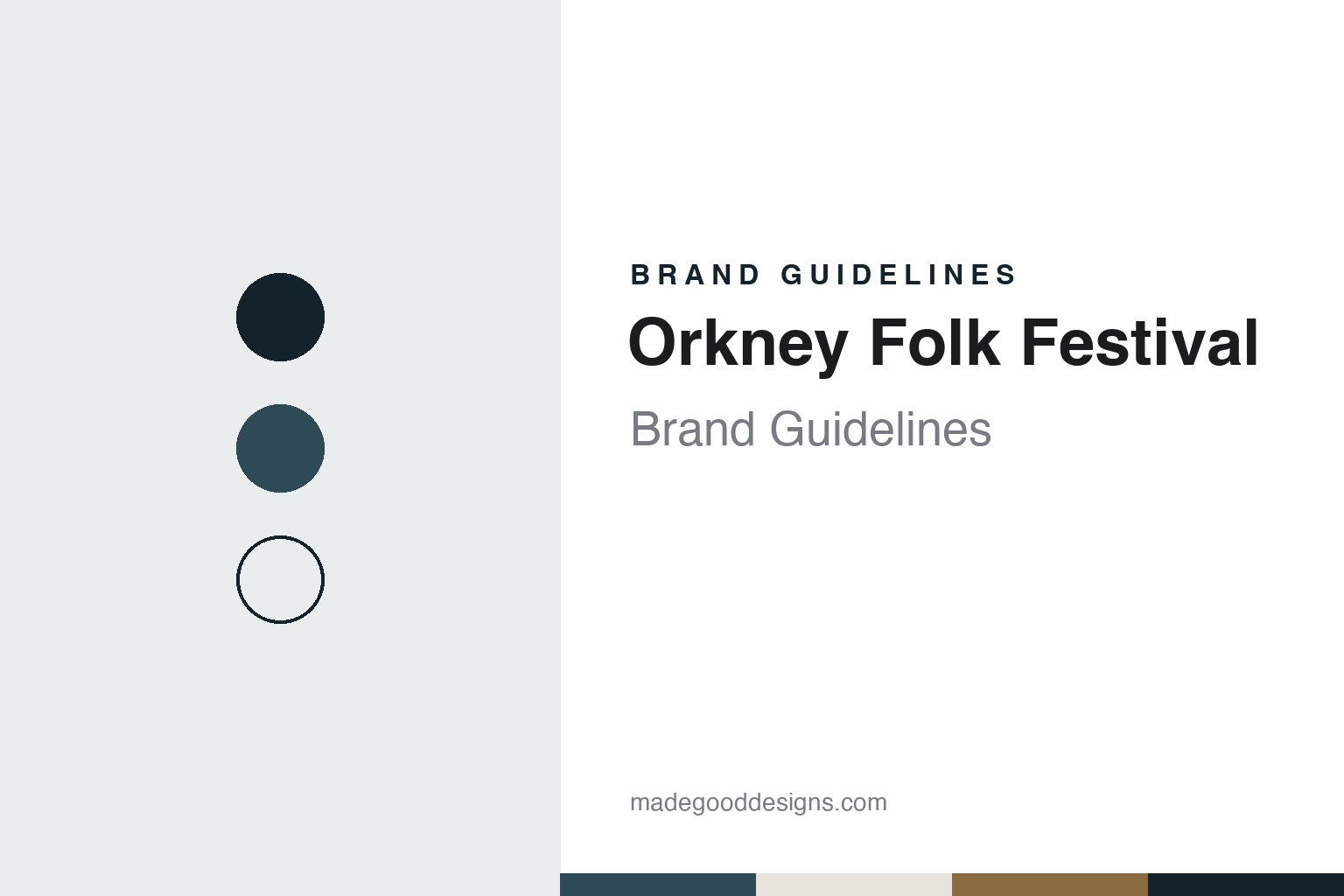
Orkney Folk Festival Brand Guidelines
A May weekend of folk music based in Stromness and spread across the islands.
Aa
Two constants: a harbour slate, sea mist and flagstone ochre palette and a harbour-town serif register. Abstract homage — not an Orkney Folk Festival poster or mark; no logo or artwork is reproduced.
A committee in Stromness
A radio station, a tourist board and a fiddlers’ rally.
Orkney Folk Festival was set up in 1982 and held its first event in May 1983, the festival says. It traces its start to a first festival committee established by BBC Radio Orkney and the Orkney Tourist Board. In its own account of those years, the festival says both tourism and traditional music in Orkney were facing challenges in the early 1980s: the summer visitor season was shrinking, and folk and traditional music was seen as unfashionable, particularly by younger people. A spring festival of music was one answer to both.
The edition numbers fit that start. When the 31st festival opened in May 2013, The Orcadian reported, it was in Stromness, with a capacity audience in the Town Hall for the opening concert. The festival called its 2023 edition its 40th anniversary festival, and The Orkney News described the 2025 festival as running in its 42nd year. The festival’s 2026 edition was its 43rd, the festival says.
One event links the first festival to the present. The Fiddlers’ Rally has been part of every Orkney Folk Festival since the first, in 1983, the festival said when it announced its 2023 programme. It is hosted by the West Mainland Strathspey and Reel Society, brings together players from Orkney and beyond to play traditional tunes, and welcomes other instruments; participants book a free ticket and can download the year’s music in advance. The festival also names visiting bands with long histories on its stages: announcing its 40th anniversary programme, it noted that the Scottish folk group Capercaillie had first appeared in the county at the fourth festival, in 1986.
From the start the festival has mixed local and visiting musicians. The Living Tradition describes a deliberate policy of combining well-established folk musicians and emerging performers from outside Orkney with the islands’ own musicians, some of them well known in their own right. The festival makes the same point about itself, calling the mix of visiting and local acts one of its most important characteristics.
Colour
One town, many islands.
Stromness, on Orkney’s West Mainland, is the festival’s hometown and the centre of its programme. When the 31st festival opened in 2013, The Orcadian reported, two local acts shared the Town Hall bill with visiting groups including Boys of the Lough and Blazin’ Fiddles, while concerts also took place in Kirkwall and Birsay on the same first evening. That night’s edition of the radio programme Travelling Folk, hosted by Bruce Macgregor, featured sets recorded at the festival earlier in the day. The festival says the BBC Radio Scotland programme returned to broadcast live from the opening day in 2026.
The festival has spread its events further across the islands over the years. For its 40th anniversary in 2023 it announced 47 events in 18 venues, held over 25–28 May. The Orkney News reported that the 2025 festival ran from 22 to 25 May, with Stromness as the main centre and events in Birsay, Deerness, Finstown, Harray, Hoy, Kirkwall, Sanday, Sandwick, St Margaret’s Hope, Stenness and Tankerness. The festival had sold 8,600 tickets by the opening event, the paper reported, and it listed 60 acts and 55 events. In 2026 the festival ran from 21 to 24 May, with 52 acts and 53 events; more than half of the events were in Stromness, with others in places including Holm, Orphir and Rousay, the festival says.
The programme is built from many small formats rather than one main stage. The festival lists concerts, dances, “stomps,” lounge performances, workshops and family events, and in 2023 it introduced the Family Folkie, a pair of Saturday afternoon events for families in Stromness Academy. Each year’s Gathering concerts put Orcadian music at the centre of an expansive show with guests, the festival says; in 2023 a homegrown Orcadian group led it. The festival also has a touring strand, the Island Hop, first delivered in 2007, which it describes as taking acts by boat, with a production crew and sound system, to bring a full festival concert to smaller islands before they join the main weekend.
Audiences build their own weekend. In 2025 the festival’s producer told The Orkney News that every show was individually ticketed, so that visitors could put together an itinerary to suit them, from one concert to a dozen.
Typography
Setting and calendar.
A folk festival rarely has a single building to stand for it. Its identity is carried instead by a place and a date: a seaside town that turns its gardens and promenade into stages for a week, an island whose villages and halls share the programme, a showground or estate field where marquees go up for a long weekend, a cultural village set in a rainforest, or a run of community halls in the cold months. The setting gives the festival its name, and the calendar fixes it in the memory, whether that is the week that takes in the first Monday in August or a bank holiday weekend at the end of summer.
The programme is the second layer. Concert marquees, standing big tops, dance houses, storytelling tents and children’s areas are usually given names of their own, and those names recur in programmes, on site maps and on stage boards year after year. Dance displays and processions take the festival out into the streets, so that teams of morris, sword, rapper or clog dancers become part of the look of the event as much as any printed material.
Print and lettering then travel from one edition to the next. A festival may commission a new poster each year while keeping the same wordmark, or keep a house style while changing its artwork; edition numbers, founding years and the name of the host town often sit beside the title on programmes, wristbands and listings. When a festival changes its name, moves to a new site or passes to a new organiser, these repeated elements are what carry its identity across the change.
The guides in this group look at folk festivals through those elements: where they are held, when they fall in the year, how their sites and stages are named, and how their names and printed matter have been handled over time. The colours and typefaces shown are our own interpretation, not official assets.
Aa
A bookish serif for a festival of town halls and island venues. (Specimen set in Spectral, a serif STAND-IN; NOT the Orkney Folk Festival logo.)
Orkney Folk Festival
A volunteer charity and a late-May date.
Orkney Folk Festival is organised by a charity. The festival describes itself as a Scottish Charitable Incorporated Organisation, with a board of trustees and a management committee, and its office in Stromness. Its committee works year-round and is supported by hundreds of volunteers at festival time, the festival says, and it describes volunteer running as one of its founding principles. The Orkney News reported in 2025 that the festival had been run entirely by volunteers since 1982, with more than two hundred helpers joining the year-round committee and board in the run-up to each edition. Craig Corse is named by the festival as its producer.
The calendar is part of the identity. The festival has settled on a long weekend in late May, from Thursday to Sunday, with an opening concert on the Thursday and the Fiddlers’ Rally on the Sunday afternoon. It runs a supporter scheme, Orkney Friends, whose members get first access to tickets, and a mailing list for programme news.
The festival’s visual material is built around that programme: a list of acts from Orkney and from abroad, a run of venues from the Stromness Town Hall to village halls on other islands, and a four-day timetable. Its website and announcements describe events by format, from ceilidh dances to workshops for small children, rather than by stage.
For a design guide, Orkney Folk Festival shows how a festival can take its identity from a harbour town and its islands rather than a field or a single hall. Compare Celtic Connections, another Scottish folk festival, held in Glasgow each January, and the BBC, whose Radio Orkney station helped form the festival’s first committee. For this guide we use a harbour slate, sea mist and a flagstone ochre with a serif, an unofficial interpretation; no product or logo is reproduced.
Explore & save
Keep Orkney Folk Festival’s identity on hand — save it to a board in the Made Good inspiration library.
Orkney Folk Festival identity set
Pin the Orkney Folk Festival harbour slate, sea mist and flagstone ochre palette and the harbour-town serif register to your own board.
Source & notes
Frequently Asked Questions
What font can I use to match the Orkney Folk Festival look?
This guide describes Orkney Folk Festival’s type as “A bookish serif for a festival of town halls and island venues”. Its type specimen is set in Spectral from Google Fonts as a stand-in; Spectral is not Orkney Folk Festival’s own lettering.
What colours are in the Orkney Folk Festival palette?
This guide’s Orkney Folk Festival palette is Harbour slate #2E4A57, Ink #14232B, Sea mist #E6E4DC, Flagstone ochre #8A6A3F and Paper #F6F5F1. The tones are the guide’s own unofficial interpretation, not official Orkney Folk Festival hex codes.
When was Orkney Folk Festival founded?
Orkney Folk Festival was founded in 1982 (first festival May 1983), in Stromness, Orkney, Scotland.
Who founded Orkney Folk Festival?
On who started Orkney Folk Festival, this guide’s facts panel reads: A committee set up by BBC Radio Orkney and the Orkney Tourist Board.