New Orleans Jazz & Heritage Festival Brand Guidelines
A heritage fair at a racetrack, with a poster every year.
Aa
Two constants: a live oak, claret and brass palette and a poster serif register. Abstract homage — not a New Orleans Jazz & Heritage Festival poster or mark; no logo, artwork or photograph is reproduced.
A heritage fair in Congo Square
A producer from Newport and a nonprofit owner.
The New Orleans Jazz & Heritage Festival was first held in 1970. Its history page says George Wein, the producer behind the Newport Jazz Festival and the Newport Folk Festival, begun in 1954 and 1959, was hired that year to design and produce a festival for New Orleans. The 64 Parishes encyclopedia of Louisiana, in an entry first published in 2011 and updated in 2024, adds that Wein had set up Festival Productions in 1969 and that the company remained the festival’s production arm.
Ownership sits with a nonprofit. The festival says the New Orleans Jazz & Heritage Foundation was established to oversee the event, and 64 Parishes describes the foundation, founded in 1970, as the nonprofit arm that owns and oversees it. English Wikipedia gives the organisation’s formal name as the New Orleans Jazz & Heritage Festival and Foundation Inc. Beyond the festival, the foundation runs the radio station WWOZ and an archive of festival recordings, posters and photographs, according to 64 Parishes.
Wein brought in local music enthusiasts to book the first event, among them Quint Davis, who the festival says became its main creative force and remains its producer and director. The format came from Wein’s idea of a Louisiana Heritage Fair: a large daytime fair with several stages of local music, booths of Louisiana food and arts and crafts, plus an evening concert series.
The first festival ran from 22 to 26 April 1970 in Congo Square, then called Beauregard Square, in what is now Louis Armstrong Park, 64 Parishes records. About 350 people attended, according to both the encyclopedia and the festival. The first line-up included Duke Ellington and Mahalia Jackson, who joined a second-line parade led by the Eureka Brass Band, an episode the festival’s own history page tells as the start of the event’s spirit. The festival says the name “Jazz Fest” was in use almost at once.
Colour
A racetrack infield and two weekends.
In 1972 the festival moved to the infield of the Fair Grounds Race Course, a racetrack the festival says has been open since 1872, and it gradually came to use the whole 145-acre site. The festival gives attendance of 80,000 for 1975. It ran across two full weekends from 1976 to 1978 and three in 1979 for its tenth anniversary; 64 Parishes notes that evening concerts in theatres and clubs filled the days between weekends in the 1980s, and that an extra Thursday was added to the second weekend in 1991. The encyclopedia records 650,000 visitors over seven days in 2001.
The calendar is now fixed to the last weekend of April and the first weekend of May. The 2026 festival ran from Thursday 23 April to Sunday 3 May, WVUE reported. English Wikipedia records that the festival was not held in 2020 or 2021 and resumed in 2022.
Production has been shared since 2004. 64 Parishes reports that the foundation’s board put production out to bid that year, kept Festival Productions, and that Festival Productions then partnered with AEG Live; the festival’s history page also dates AEG Live’s involvement to 2004. Since 2006, the festival says, Shell has been its presenting sponsor, and the official title is now the New Orleans Jazz & Heritage Festival presented by Shell.
The site is laid out as a fair. 64 Parishes describes large Acura and Gentilly stages at either end of the grounds, the Congo Square stage for world music, hip-hop, R&B and soul, and the Fais Do-Do stage for Cajun, zydeco and folk, with tents for gospel, blues and contemporary jazz and the Economy Hall Tent for traditional jazz. Crafts are grouped in the African Marketplace, Contemporary Crafts and the Louisiana Marketplace, with demonstrations in the Louisiana Folklife Village. The festival’s FAQ lists the music as every style tied to the city and state, from blues and gospel to Cajun, zydeco and jazz.
Typography
How a festival carries its name.
A jazz festival is rarely remembered for a single concert. Its identity is carried by a setting and a date: a converted cannery where every stage sits under one roof, a palace square turned into an open-air arena for a summer fortnight, a riverside town that fills with music in spring, a harbour city whose clubs host a festival in the dark months of winter, or a racecourse in New Orleans whose stands and paddocks become a field of stages. The setting gives the festival its look, and the calendar fixes it in the memory, whether that is a run of late-May nights, a numbered week in August or a pair of spring weekends.
Print is the second layer. Many festivals commission a new poster every year, and the run of posters becomes a record of the festival in its own right, with each edition’s artist or designer named alongside the date. Some keep the same wordmark for decades and let the artwork change; others redraw the name as the programme widens. Edition numbers and founding years often sit beside the title, so that the long count becomes part of the identity.
Behind each name stands an organisation. Jazz clubs, non-profit foundations, associations, municipal bodies and production companies keep festivals going across changes of venue, director and programme, and festival names often survive moves from one hall, park or district to another. When a festival changes its title or passes to a new organiser, the repeated elements, from the place name to the poster series, carry it across the change.
Audiences meet the identity in practical form: programme booklets, day schedules and stage maps, wristbands and festival passes, venue signs and apps that list who plays where and when. The guides in this group look at jazz festivals through those elements. The colours and typefaces shown are our own interpretation, not official assets.
Aa
A poster serif — for headline type with the warmth of a printed legend. (Specimen set in Fraunces, a serif STAND-IN; NOT the New Orleans Jazz & Heritage Festival logo.)
New Orleans Jazz & Heritage Festival
Silkscreen posters and schedule cubes.
One of the festival’s design constants is its annual poster. Both the festival and 64 Parishes date the limited-edition silkscreen poster series to 1975; the encyclopedia says the posters feature paintings of Louisiana musicians by major artists. Relix, in an April 2019 feature for the festival’s 50th anniversary, traced the series to an entrepreneurship class project by Bud Brimberg at Tulane University Law School, and reported that a numbered edition was joined by an artist-signed edition in 1976 and that the posters raise money for the foundation. The festival’s FAQ names Art4Now as the publisher of its limited-edition posters.
A second series followed. Relix dates the Congo Square poster series, tied to the stage of that name, to 1994, and singled out its 2007 edition for working the written legend, the text that sets a poster apart from other artwork, into the image itself. For 2019 the magazine described a 50th-anniversary “Family Portrait” poster inspired by the photograph “A Great Day in Harlem” and printed in 18 colours, bringing the festival’s history, New Orleans music and the city’s architecture into a single image.
The practical layer has its own look. Each spring the organisers release the schedule as a set of “cubes,” grids that show when and where each artist performs; WVUE reported their release for 2026 on 24 March of that year. The nickname “Jazz Fest” works as a second name next to the long official title and its sponsor line, and the festival’s FAQ uses it in its first answer.
For a design guide, the New Orleans Jazz & Heritage Festival shows how a yearly printed poster can carry a festival’s identity more firmly than a logo. Compare the Newport Jazz Festival, George Wein’s earlier festival, and the Cape Town International Jazz Festival, another multi-stage festival rooted in its own city. For this guide we use a live oak green, a claret, a brass gold and a bayou green with a serif, an unofficial interpretation; no product or logo is reproduced.
Explore & save
Keep New Orleans Jazz & Heritage Festival’s identity on hand — save it to a board in the Made Good inspiration library.
New Orleans Jazz & Heritage Festival identity set
Pin the New Orleans Jazz & Heritage Festival live oak, claret and brass palette and the poster serif register to your own board.
Source & notes
Frequently Asked Questions
What font can I use to match the New Orleans Jazz & Heritage Festival look?
This guide describes New Orleans Jazz & Heritage Festival’s type as “A poster serif — for headline type with the warmth of a printed legend”. Its type specimen is set in Fraunces from Google Fonts as a stand-in; Fraunces is not New Orleans Jazz & Heritage Festival’s own lettering.
What colours are in the New Orleans Jazz & Heritage Festival palette?
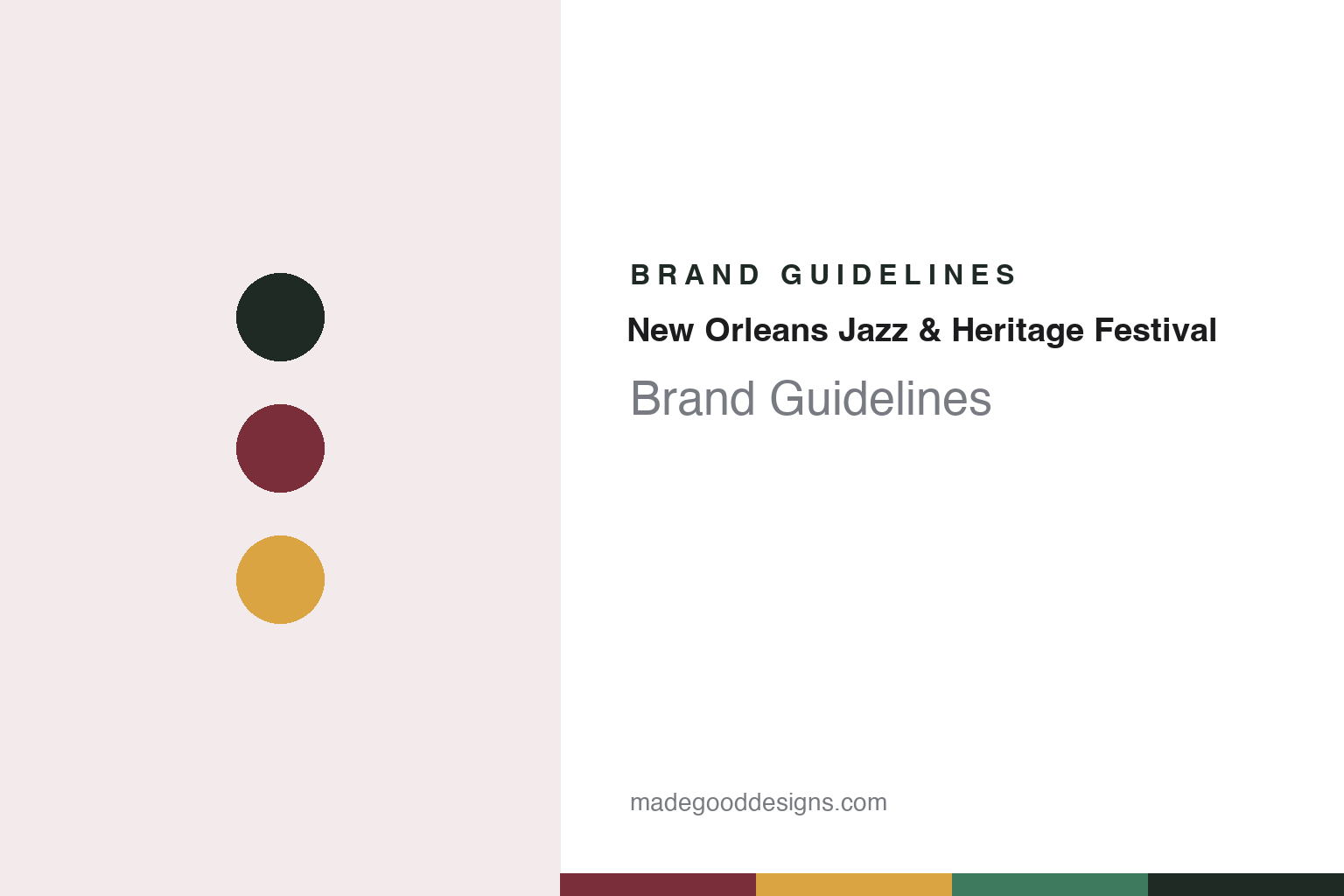
This guide’s New Orleans Jazz & Heritage Festival palette is Live oak green #1F2A24, Second-line claret #7A2E3A, Brass band gold #D9A441, Bayou green #3E7A5E and Poster cream #F7F0E2. The tones are the guide’s own unofficial interpretation, not official New Orleans Jazz & Heritage Festival hex codes.
When was New Orleans Jazz & Heritage Festival founded?
New Orleans Jazz & Heritage Festival was founded in 1970, in New Orleans, Louisiana.
Who owns New Orleans Jazz & Heritage Festival?
New Orleans Jazz & Heritage Festival is owned by New Orleans Jazz & Heritage Foundation (nonprofit).