Stockholm Jazz Festival Brand Guidelines
A summer harbour festival that moved indoors and became an October map of the city.
Aa
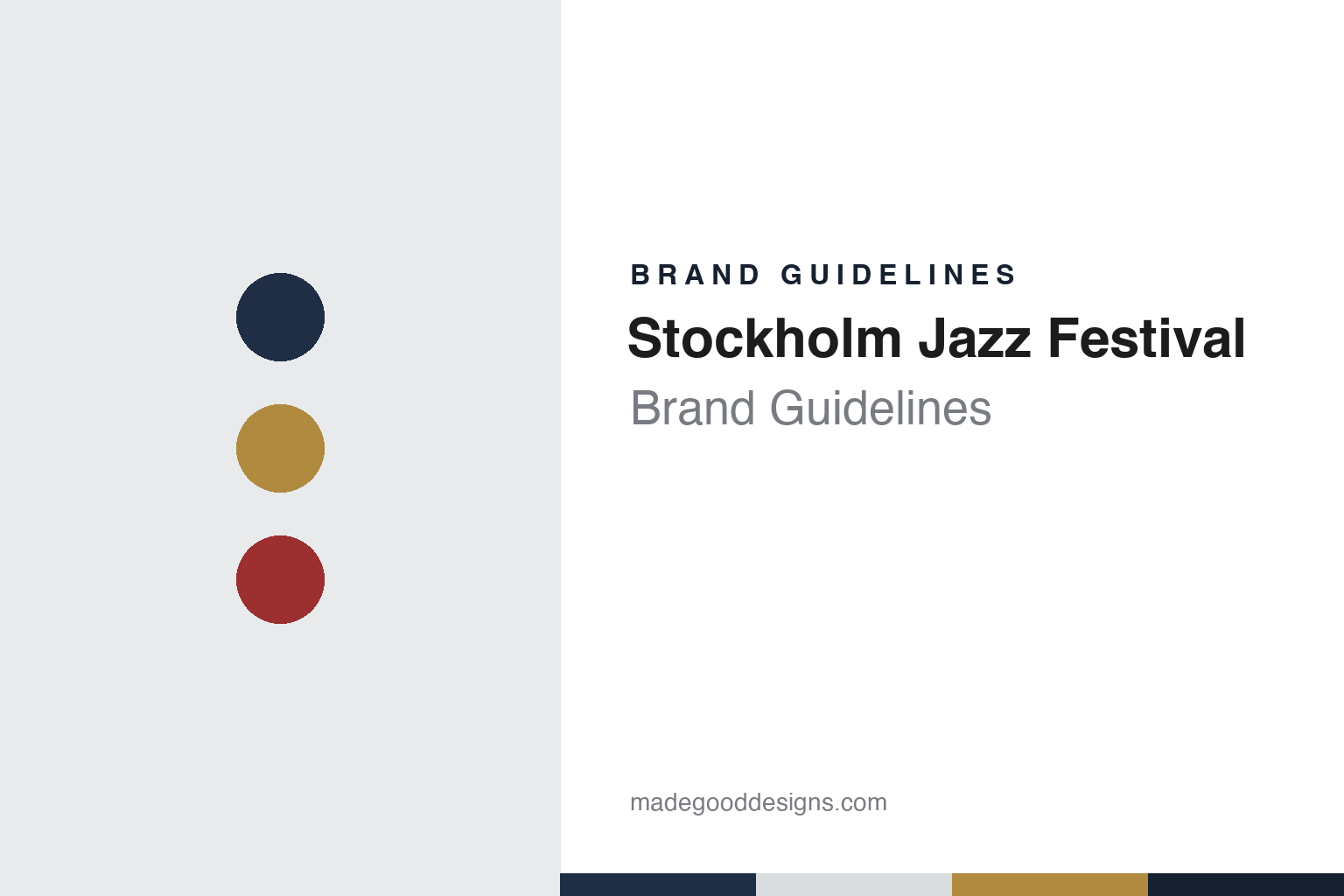
Two constants: a harbour navy, brass and club red palette and a city-map sans register. Abstract homage — not a Stockholm Jazz Festival logo, poster or mark; nothing of the festival’s own identity is reproduced.
Skeppsholmen
A summer festival on a harbour island.
Stockholm Jazz Festival began in 1980 as the Stockholm Jazz & Blues Festival, an open-air summer event on Skeppsholmen, the small island in the Stockholm harbour, just below the art museum Moderna Museet. Swedish Wikipedia names its founder as the entertainment entrepreneur Bosse Stenhammar, who ran the festival from 1980 to 2000. Time Out Stockholm noted in October 2026 that Dizzy Gillespie played in its first year, and English Wikipedia says part of that first festival was broadcast on Swedish television.
For three decades the festival stayed on the island, held in the middle of July each year, according to Swedish Wikipedia, and the original name was later shortened to Stockholm Jazz Festival. English Wikipedia describes the main venue on Skeppsholmen, with the harbour as its backdrop, as the distinguishing mark of the festival in those years. In April 2007 the Swedish business site Realtid reported that a company owned by the Canadian promoter and saxophonist John Nugent held half of the festival, with the investment fund Industrifonden and SAMI, the Swedish artists’ and musicians’ organisation, holding further shares; the same report described a summer site with room for 12,000 people.
The format then changed in steps. Swedish Wikipedia says the festival moved to the middle of June in 2010, and that before the 2011 edition it was renamed Stockholm Jazz Fest and moved to Skansen, the open-air museum on Djurgården. In 2012 it moved indoors and from summer to autumn. The first indoor week, 1–7 October 2012, presented 60 concerts on stages around the city, among them Kulturhuset, Konserthuset, S:ta Clara and the jazz club Fasching, and drew more than 12,000 visitors, Swedish Wikipedia reports. The festival’s own history describes that change under the motto “follow us into the warmth,” with eleven stages in the first indoor year, and divides its past into two eras: Skeppsholmen, and the indoor festival from 2012.
Colour
Fasching, Konserthuset and seventy stages.
The indoor festival grew quickly. In 2013 it filled 21 stages with more than 100 concerts over the week of 14–20 October, according to Swedish Wikipedia, and in 2014 it expanded to ten full days, with attendance above 21,000, English Wikipedia reports from the festival’s own figures. English Wikipedia also says the festival puts weight on world music and improvised music alongside jazz.
DownBeat reviewed the edition of 7–16 October 2016 and counted 164 shows at 36 venues, ranging from small clubs such as Glenn Miller Café and Plugged Records to the Konserthuset concert hall, Vasateatern and TeaterStudio Lederman. The bassist Avishai Cohen played the sold-out closing night at the Konserthuset; and on each Tuesday of the festival the jazz club Fasching hosted the concert for Swedish Radio P2’s Jazzkatten prize, broadcast live on P2. Late-night jam sessions at Fasching ran over both festival weekends, the magazine wrote. A year later, reviewing the edition of 6–15 October 2017, it described the Swedish quartet Tonbruket opening the music at Studion in Kulturhuset.
The club at the centre of the festival is Fasching, on Kungsgatan, which DownBeat noted would mark its 40th anniversary in 2017. Time Out Stockholm reported on 7 October 2026 that since 2012 the festival has been held indoors in the autumn with Fasching as its organiser, and called the club the heart of the festival. There is no festival site in the usual sense: concerts are spread across jazz clubs, concert halls, museums and bars. Konserthuset, the city’s concert hall, says it has for many years been one of the festival’s partners, with many festival concerts held in its halls each autumn.
The scale has kept rising. Reviewing the 2025 edition for the culture magazine Opulens on 21 October 2025, its critic counted around 250 concerts on 70 stages over ten days. The festival opened with Marcus Miller at a largely sold-out Konserthuset, and its stages that year included Studion, the former Lava, the auditorium of Kulturhuset and the small stage at Krematoriet. The festival says that since 2025 its programme has been split in two: a main programme it curates itself, and an open community programme in which Stockholm’s own venues, clubs and promoters set the agenda.
The 2026 edition ran from 9 to 18 October, Time Out Stockholm reported, with the club Slaktkyrkan, in the Slakthusområdet district, among the main venues, evening concerts at the Haymarket hotel by Hötorget, and weekend afternoon concerts in the auditorium of Moderna Museet, close to where the festival began on Skeppsholmen.
Typography
Setting, season and the people who keep a name going.
A jazz festival is rarely remembered for a single concert. Its identity is carried by a setting and a date: a converted cannery where every stage sits under one roof, a palace square turned into an open-air arena for a summer fortnight, a riverside town that fills with music in spring, a harbour city whose clubs host a festival in the dark months of winter, or a racecourse in New Orleans whose stands and paddocks become a field of stages. The setting gives the festival its look, and the calendar fixes it in the memory, whether that is a run of late-May nights, a numbered week in August or a pair of spring weekends.
Print is the second layer. Many festivals commission a new poster every year, and the run of posters becomes a record of the festival in its own right, with each edition’s artist or designer named alongside the date. Some keep the same wordmark for decades and let the artwork change; others redraw the name as the programme widens. Edition numbers and founding years often sit beside the title, so that the long count becomes part of the identity.
Behind each name stands an organisation. Jazz clubs, non-profit foundations, associations, municipal bodies and production companies keep festivals going across changes of venue, director and programme, and festival names often survive moves from one hall, park or district to another. When a festival changes its title or passes to a new organiser, the repeated elements, from the place name to the poster series, carry it across the change.
Audiences meet the identity in practical form: programme booklets, day schedules and stage maps, wristbands and festival passes, venue signs and apps that list who plays where and when. The guides in this group look at jazz festivals through those elements. The colours and typefaces shown are our own interpretation, not official assets.
Aa
A clean city-map sans for a festival spread across clubs, halls and museums. (Specimen set in Work Sans, a sans STAND-IN; NOT the Stockholm Jazz Festival logo.)
Stockholm Jazz Festival
From a harbour backdrop to a map of October venues.
The festival’s identity has always been tied to place and season more than to any single stage. In its first three decades the picture was the summer harbour: an outdoor stage on Skeppsholmen below Moderna Museet, with the water of central Stockholm behind it. Since 2012 the picture has been a city in October: a jazz club on Kungsgatan, a concert hall at Hötorget, a museum auditorium, a club in the Slakthusområdet district and dozens of smaller rooms. The festival keeps the founding year in its own story, describing itself as having shown jazz in its full breadth since 1980, and its website offers the festival logo to the press as a download.
That shift from one site to many changes what an identity has to do. A single summer stage could rely on the view; an indoor festival of some 70 stages has to work as a programme and a map, so that one name holds together concerts in rooms that each keep their own character. The split since 2025 between a curated main programme and an open community programme, as the festival describes it, extends the same idea to the city’s own clubs and promoters.
The festival also connects to its Nordic neighbours through the musicians it books. The Swedish group Cosmic Ear appears in Swedish Wikipedia’s list of 2025 performers, and a year later it opened the weekend programme of the 45th Tampere Jazz Happening in Finland, Jazz in Europe reported in November 2026.
For a design guide, Stockholm Jazz Festival shows how a festival can keep its name and its founding year while trading a summer harbour island for an autumn city of clubs. Compare Tampere Jazz Happening, the autumn festival in Finland where Cosmic Ear played in 2026, and Copenhagen Jazz Festival, another Nordic capital’s festival spread across many venues. For this guide we use a deep harbour navy, a warm brass, a club red and a fog grey with a sans, an unofficial interpretation; no product or logo is reproduced.
Explore & save
Keep Stockholm Jazz Festival’s identity on hand — save it to a board in the Made Good inspiration library.
Stockholm Jazz Festival identity set
Pin the harbour navy, brass and club red palette and the city-map sans register to your own board.
Source & notes
Frequently Asked Questions
What font can I use to match the Stockholm Jazz Festival look?
This guide describes Stockholm Jazz Festival’s type as “A clean city-map sans for a festival spread across clubs, halls and museums”. Its type specimen is set in Work Sans from Google Fonts as a stand-in; Work Sans is not Stockholm Jazz Festival’s own lettering.
What colours are in the Stockholm Jazz Festival palette?
This guide’s Stockholm Jazz Festival palette is Harbour navy #1F2E45, Night ink #16202F, Brass #B08A3E, Club red #9C2F2F and Fog grey #DADDE0. The tones are the guide’s own unofficial interpretation, not official Stockholm Jazz Festival hex codes.
When was Stockholm Jazz Festival founded?
Stockholm Jazz Festival was founded in 1980 (as Stockholm Jazz & Blues Festival), in Stockholm, Sweden.
Who founded Stockholm Jazz Festival?
Stockholm Jazz Festival was founded by Bosse Stenhammar in 1980 (as Stockholm Jazz & Blues Festival).