Copenhagen Jazz Festival Brand Guidelines
Ten July days of jazz spread across a whole capital.
Aa
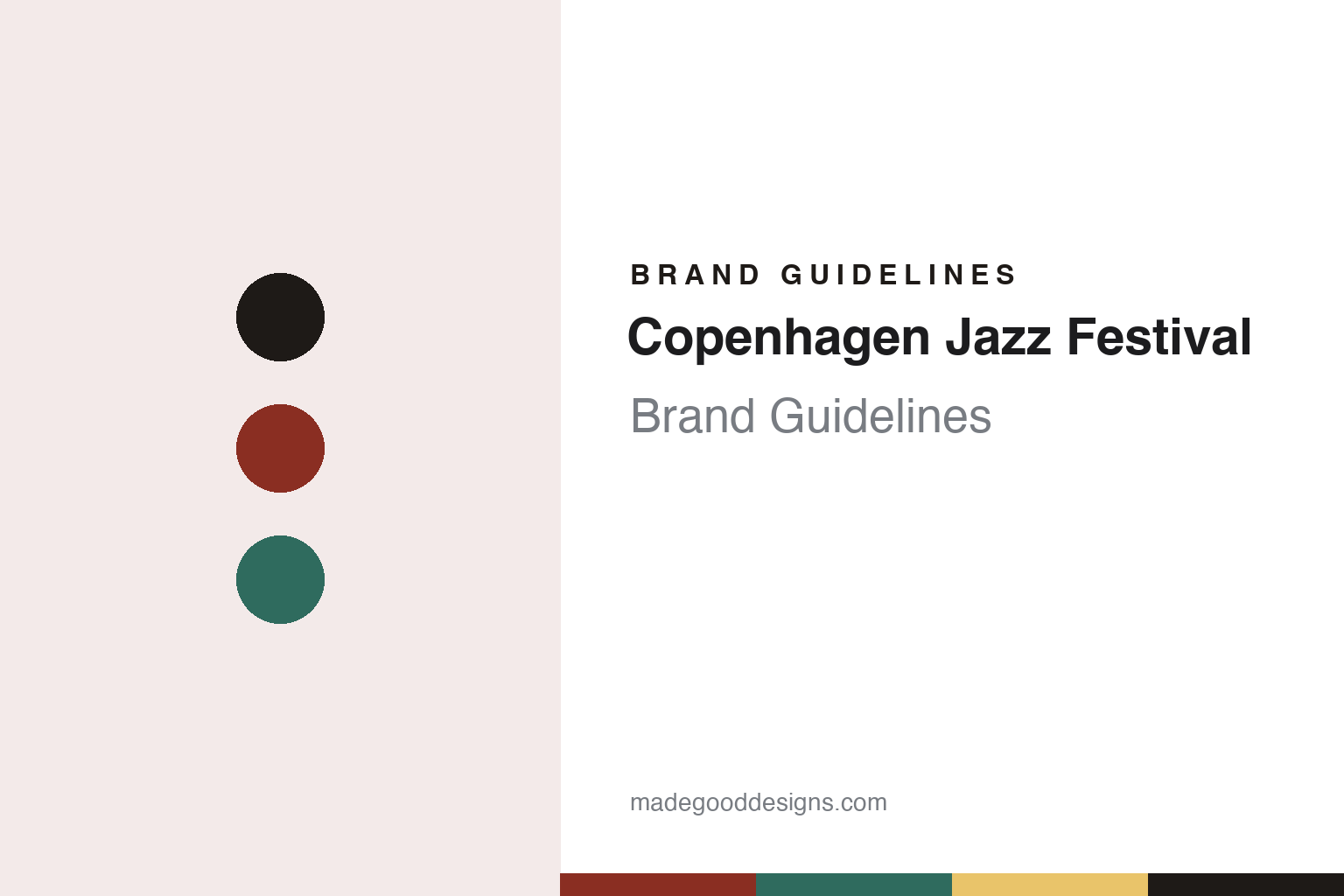
Two constants: a brick red, copper green and summer yellow palette and a display serif register. Abstract homage — not a Copenhagen Jazz Festival poster or mark; no logo or artwork is reproduced.
A festival without a fence
A city-centre initiative from 1979.
Copenhagen Jazz Festival has run every July since 1979, the festival says. English Wikipedia credits the initiative to Poul Bjørnholt, a lawyer and project manager at Københavns City Center, the city-centre business association, who in 1978 saw how jazz clubs, public spaces, theatres and larger venues could work together on one event. Danish Wikipedia, citing the history Jazz i Danmark 1950–2010 (Politikens Forlag, 2011), says he launched it in July 1979 together with the club Jazzhus Montmartre and the city’s other jazz venues, as a week-long festival of 75 concerts.
The name is older than that festival. Danish Wikipedia records “Copenhagen Jazz Festival” as the title of a one-day event in 1962, and of a concert series with visiting American musicians from 1964, which opened at the K.B. Hallen on 4 October 1964 and was held in the concert hall at Tivoli from 1965 to 1969. The festival itself dates its present form from 1979.
The city setting matters to the story the festival tells. Its own history page describes Copenhagen in the 1950s and 1960s as a base for American jazz musicians who settled there, and the club Jazzhus Montmartre as the meeting point of that scene.
The organisation took its lasting form in 1985, when, according to Danish Wikipedia, the festival became a self-owning foundation with a board drawn from the jazz scene, the press and the tourist industry. The same source dates the first large open-air concerts to that year, on the square in front of Christiansborg Palace, followed by concerts at the Ridebanen riding ground behind the palace in 1986 and 1987 and, under the name Giant Jazz, from 1990 to 1994; a children’s programme, later called Jazz for Kids, began in 1987.
Colour
Clubs, concert halls, parks and the harbour.
The festival is not held on one site. Its own facts page describes about 1,200 concerts at around 120 venues over ten days, in clubs, cafés, bars and concert halls and on open-air stages in the city’s parks and squares and along the harbour front, with a large share of the concerts free. It puts the total audience at more than 250,000 and says it engages more than 200 volunteers.
Visiting critics describe the same spread. Writing in DownBeat on 18 July 2017, its reviewer reported that the ten-day festival had taken place every July since 1979, “completely taking over” the city’s theatres, clubs, parks and streets, with gigs across the whole city and its suburbs rather than in one downtown hub. He picked out free afternoon concerts in the foyer of the Skuespilhuset, the Royal Danish Playhouse; late sets in a converted slaughterhouse; and evening concerts in the garden of the Royal Danish Horticultural Society.
Danish Wikipedia lists the outdoor places where the festival’s free concerts have been heard, among them the squares of Gråbrødre Torv, Gammeltorv, Nytorv and Kultorvet and the King’s Garden, Kongens Have. The festival names the larger halls: the Royal Danish Theatre, the Copenhagen Opera House and the Koncerthuset concert hall. Around them sit the jazz clubs, among them Jazzhus Montmartre, La Fontaine and Copenhagen Jazzhouse, which Danish Wikipedia describes as part of the festival’s umbrella from its first years.
The festival also runs named strands within the programme: Jazz for Kids in the parks, and Something Else, for music at the edge of jazz and other genres, the festival says.
The organiser today is Copenhagen Jazz Festival Fonden, which describes itself as a non-profit foundation. It books and produces about 120 concerts a year itself, markets the festival, and also runs a second festival, Vinterjazz. Established in 2001, Vinterjazz is a nationwide festival held over three weeks in February, with more than 600 concerts at about 150 venues across Denmark, from Aalborg, Aarhus, Odense and Esbjerg to Copenhagen, organised in collaboration with independent venues and promoters, according to the foundation.
Typography
Design and documentation.
A jazz festival changes its line-up every year, so the parts of its identity that last tend to sit elsewhere. Many began with one person or one small group: a promoter, a publisher, a club owner or a city-centre association that put a name on a weekend and kept booking it. That origin often stays in the festival’s own telling, in the name of a prize, a hall or a history page, long after the organisation has passed to a foundation, a non-profit society or a concert company.
Place does much of the remaining work. Some festivals are tied to one town or one site, an amphitheatre, a fairground, a park or a congress centre, and audiences come to know the building as well as the music. Others spread across a whole city, using clubs, concert halls, squares and harbour fronts at once, so that the city itself becomes the venue. In both cases the stage names matter: a hall named after a river, a stage named after a founder or a square known by its street name becomes part of the vocabulary that returning visitors use.
The annual poster is the object people take home. Many festivals commission a different artist or designer each year, or run a competition among art students, and the run of posters becomes a record of the festival’s history that people collect and museums sometimes keep. Names change too: a title sponsor’s name can be attached to the front of a festival’s name for a period of years and later removed, while the core name stays.
Then there is the practical layer that audiences handle every day of the festival: the printed programme or app, the day schedule laid out stage by stage, wristbands and passes, maps and venue signage. With many concerts running at once, this material is how most visitors actually meet the festival’s typography and colours, and, like the poster, it is often redesigned from one edition to the next.
Aa
A display serif for a festival that runs across a whole city. (Specimen set in DM Serif Display, a serif STAND-IN; NOT the Copenhagen Jazz Festival logo.)
A poster each year
Artists’ posters and a printed programme.
The festival’s visual identity changes every summer with its poster. Danish Wikipedia keeps a list of the festival’s poster artists from 1982 to 2025, mostly Danish painters, illustrators and designers, with one name per year.
One of them is now a museum object. The Victoria and Albert Museum in London holds the 1983 poster by the Danish designer Per Arnoldi, a colour offset lithograph of about 80 by 60 centimetres, given by the artist. The museum’s catalogue describes his vivid colour as an expression of the music on offer, with the word “Jazz” stretched along a saxophone as if part of the instrument or the written music. Arnoldi returned to make the poster again in 2003, according to Danish Wikipedia’s list.
The practical layer has to work for a festival with no gate. With concerts spread across a whole city, the programme is the map: the festival says it publishes the programme in print, in an app and on its website, and that most ticketed concerts can be booked online, with tickets at the door where available. The visitor plans a day by district, a point DownBeat’s reviewer made in 2017, advising grouping a few concerts in one part of the city rather than crossing it all day.
The name does the rest. Copenhagen Jazz Festival is a plain place-name title, used for the summer event, while Vinterjazz, “winter jazz,” gives the foundation’s February festival a Danish name of its own.
For a design guide, Copenhagen Jazz Festival shows how a festival without one venue can build an identity from a city, a month and a poster commissioned anew each year. Compare Tivoli Gardens, whose concert hall hosted the earlier concert series under the same name, and North Sea Jazz Festival, another July jazz festival in northern Europe, held under one roof. For this guide we use a brick red, a copper green and a summer yellow with a serif, an unofficial interpretation; no product or logo is reproduced.
Explore & save
Keep Copenhagen Jazz Festival’s identity on hand — save it to a board in the Made Good inspiration library.
Copenhagen Jazz Festival identity set
Pin the brick red, copper green and summer yellow palette and the display serif register to your own board.
Source & notes
Frequently Asked Questions
What font can I use to match the Copenhagen Jazz Festival look?
This guide describes Copenhagen Jazz Festival’s type as “A display serif for a festival that runs across a whole city”. Its type specimen is set in DM Serif Display from Google Fonts as a stand-in; DM Serif Display is not Copenhagen Jazz Festival’s own lettering.
What colours are in the Copenhagen Jazz Festival palette?
This guide’s Copenhagen Jazz Festival palette is Brick red #8A2E22, Ink #1E1A17, Copper green #2F6B5E, Summer yellow #E9C46A and Paper #F8F4EC. The tones are the guide’s own unofficial interpretation, not official Copenhagen Jazz Festival hex codes.
When was Copenhagen Jazz Festival founded?
Copenhagen Jazz Festival was founded in 1979, in Copenhagen, Denmark.