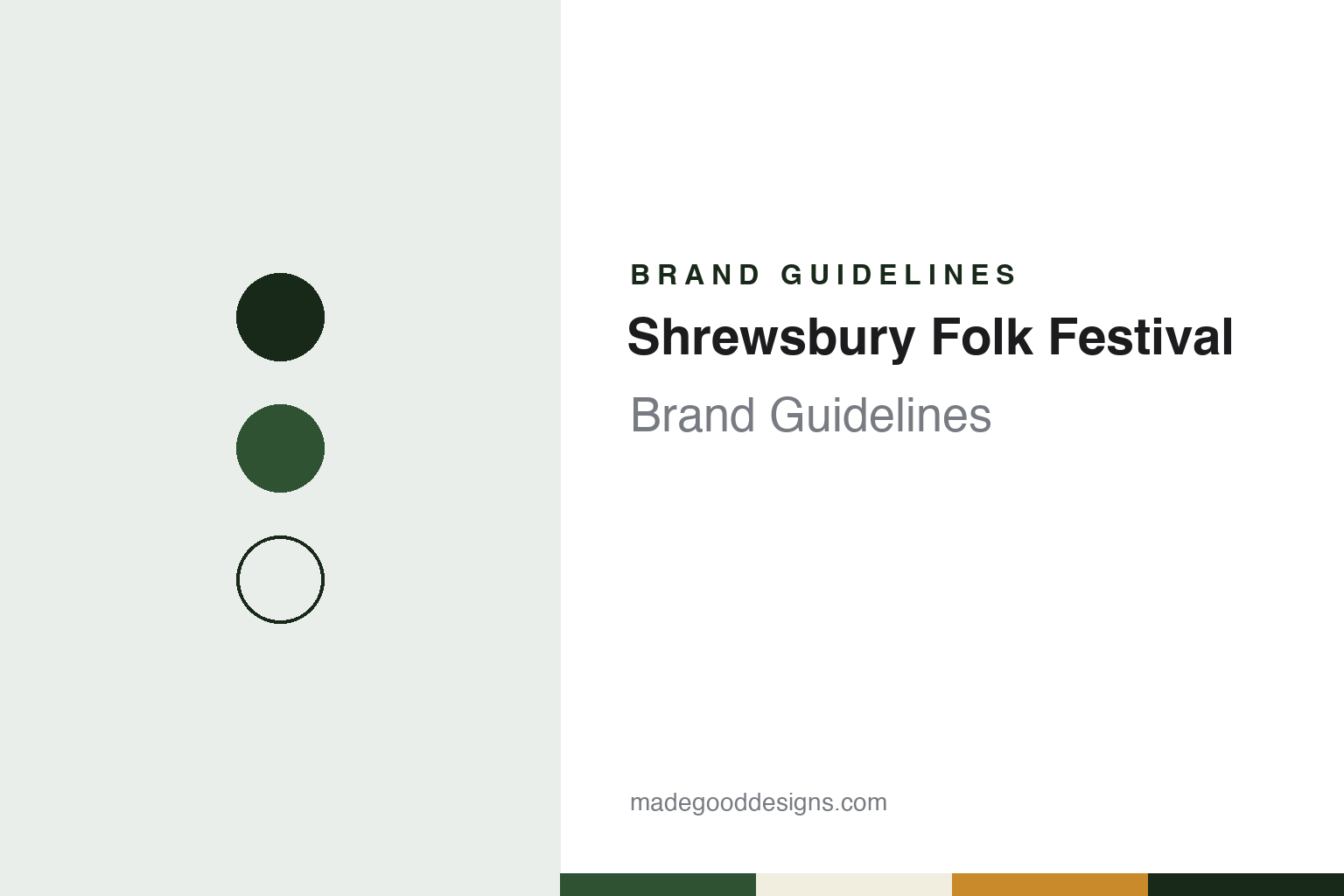
Shrewsbury Folk Festival Brand Guidelines
A bank-holiday folk weekend on a riverside showground.
Aa
Two constants: a river meadow green, canvas and amber palette and a friendly grotesque register. Abstract homage — not a Shrewsbury Folk Festival poster or mark; no logo or artwork is reproduced.
From Bridgnorth
A husband-and-wife festival that moved up the river.
Shrewsbury Folk Festival began in another Shropshire town. In a June 2015 interview with the Shropshire edition of What’s On, the festival director Alan Surtees described how he and his wife, Sandra Surtees, set out to create the sort of festival they would want to go to themselves. The magazine reported that their event started life in Bridgnorth in 1997; English Wikipedia names it the Bridgnorth Folk Festival.
Nine years later, in 2006, the festival moved to Shrewsbury and took the town’s name. What’s On and Wikipedia agree that the first Shrewsbury edition was held at The Quarry, the riverside park in the town, and that the festival moved again the following year to the West Mid Showground, which Wikipedia also calls the West Midlands or Shropshire Agricultural Showground. Every festival since 2007 has been held there. The festival itself dates its story from Bridgnorth: it counts thirty years from that first event to 2027 and collects visitors’ memories under the title “30 Years, 30 Stories.”
The festival keeps to the end of the English summer. It runs over four days on and around the late-summer bank holiday weekend, usually the last weekend in August; the 2015 edition ran from Friday 28 to Monday 31 August, What’s On noted. The 2020 edition was not held; the festival returned in 2021. Wikipedia describes the festival as headed by Alan and Sandra Surtees as festival directors, with Sandra Surtees organising the festival and the other events held under its name.
Colour
Four stages and a dance tent.
The festival site sits on what the organisers describe as a treelined riverside showground close to the town centre, beside the River Severn. Its own pages list four music stages, a dance tent and dedicated areas for children and teenagers. The main stage is an open-air arena with large screens on either side; a marquee named Sabrina, after the goddess of the river that runs alongside the site, is described as the home of traditional folk and emerging artists. Copy issued by the festival for its 2019 edition names a Pengwern stage as the place for the Folk Slam, the shared performance that closes the weekend.
The Folk Slam was, in 2015, a pet project of Alan Surtees, he told What’s On: a closing set on the Monday afternoon in which artists from across the bill rehearse and perform together. Wikipedia says the format began in 2012, organised at short notice by the singer Jim Moray, and was repeated from 2013.
Dance is a large part of the programme. Wikipedia describes morris sides and other traditional dance teams performing around the site and in the dance tent, where ceilidhs invite the audience to join in, and taken into the town during the festival weekend, with displays in the square by the Old Market Hall and in the Castle grounds and a procession between the two on the Saturday afternoon. Surtees told What’s On that the parade was the part of the festival that had “really got” him over the years.
Younger visitors have their own festivals within the festival. The organisers describe Pandemonium!, the children’s area with crafts, story time, singing and dancing, and Refolkus, a programme for 11- to 20-year-olds. Smaller spaces include the Siskin folk club for singarounds and sessions, a workshop venue called The Hub beside the showground grandstand, and the Tuneworks programme for musicians who want to improve their playing.
Typography
Setting and calendar.
A folk festival is often remembered by where and when it happens before anything else. Some take over a park on the edge of a city in high summer, with marquees pitched on the lawns; others fill a seaside town in late August, spreading concerts, dances and workshops through its halls and streets. Some gather in a concert hall in the depths of winter, some on a hillside in a provincial park, and some on a showground or in a festival village built for the purpose. The setting and the week in the calendar do much of the work a logo does elsewhere.
Where a festival issues an annual poster or programme cover, its look is renewed each year, and the artist behind it, whether an illustrator, a printmaker or a designer, shapes how that edition is remembered. When a festival credits those artists, the run of posters becomes a visual record of the event, edition by edition, and a festival without a fixed mark can still read as one thing across many years.
Behind most of these names stands an organiser that keeps them going: a city council, a folk society, a non-profit association, a trust or a small company, supported in many cases by large teams of volunteers. Organisers can change, and formats with them, while the name stays: the Cambridge Folk Festival, for one, has kept the name it was given in 1965 through several changes of format.
The practical layer is what audiences handle on the day. Programme booklets, stage timetables, wristbands, campsite and site maps, and signs pointing between venues all carry the festival’s type and colour into daily use. This guide looks at each festival through that lens: its setting, its calendar, its organiser and the material its audience reads, set out in plain terms and with our own unofficial palettes.
Aa
A warm grotesque for an informal riverside weekend. (Specimen set in Bricolage Grotesque, a sans STAND-IN; NOT the Shrewsbury Folk Festival logo.)
Shrewsbury Folk Festival
Commissions, patrons and a programme.
Beyond the August weekend, the festival has commissioned new work rooted in Shropshire. Wikipedia describes the Darwin Song Project of March 2009, a week-long residential project for eight songwriters marking two hundred years since the birth of Charles Darwin, who was born in Shrewsbury; a CD and DVD recorded at Theatre Severn followed in August 2009, and all eight artists performed the songs at that year’s festival. In March 2011 the festival and the English Folk Dance and Song Society organised the Cecil Sharp Project, in which eight artists wrote and rehearsed new material at Acton Scott in Shropshire, premiered it at Theatre Severn on 24 March and then performed it at Cecil Sharp House in London.
The festival also takes musicians into Shropshire primary schools for a week each June, Wikipedia says, and the children involved later perform at the festival in August. Its patrons, as the festival names them, are musicians from the bands Oysterband and Show of Hands, both of which have played the festival on several occasions.
The programme mixes English traditional music with performers from North America and further afield. In 2015 Alan Surtees told What’s On that he and Sandra Surtees travelled to the Folk Alliance gathering in the United States every other year to find acts, and that the 2015 bill included artists from India, Canada and Africa. The festival publishes an online outline in August and sells a souvenir programme with a detailed timetable; in 2015 Surtees said the timetable card printed in that programme had first been made for his own use. Camping is on site, and festival copy from 2019 credits volunteer stewards with the welcome visitors receive.
For a design guide, Shrewsbury Folk Festival shows how a festival’s identity can be carried by a calendar slot and a site: four days at the close of August, a showground by the river and a programme booklet that ties them together. Compare Cambridge Folk Festival, the English festival Surtees mentioned in 2015 when talking about booking American acts, and Celtic Connections, a British folk festival held in midwinter. For this guide we use a river meadow green, canvas and a late-summer amber with a sans, an unofficial interpretation; no product or logo is reproduced.
Explore & save
Keep Shrewsbury Folk Festival’s identity on hand — save it to a board in the Made Good inspiration library.
Shrewsbury Folk Festival identity set
Pin the Shrewsbury Folk Festival river meadow green, canvas and amber palette and the friendly grotesque register to your own board.
Source & notes
Frequently Asked Questions
What font can I use to match the Shrewsbury Folk Festival look?
This guide describes Shrewsbury Folk Festival’s type as “A warm grotesque for an informal riverside weekend”. Its type specimen is set in Bricolage Grotesque from Google Fonts as a stand-in; Bricolage Grotesque is not Shrewsbury Folk Festival’s own lettering.
What colours are in the Shrewsbury Folk Festival palette?
This guide’s Shrewsbury Folk Festival palette is River meadow green #2F5233, Deep hedge #18291A, Marquee canvas #F1EEDF, Late-summer amber #C98A2B and Paper #F8F7F3. The tones are the guide’s own unofficial interpretation, not official Shrewsbury Folk Festival hex codes.
When was Shrewsbury Folk Festival founded?
Shrewsbury Folk Festival was founded in 1997 (in Shrewsbury from 2006), in Bridgnorth, Shropshire.
Who founded Shrewsbury Folk Festival?
Shrewsbury Folk Festival was founded by Alan and Sandra Surtees in 1997 (in Shrewsbury from 2006).