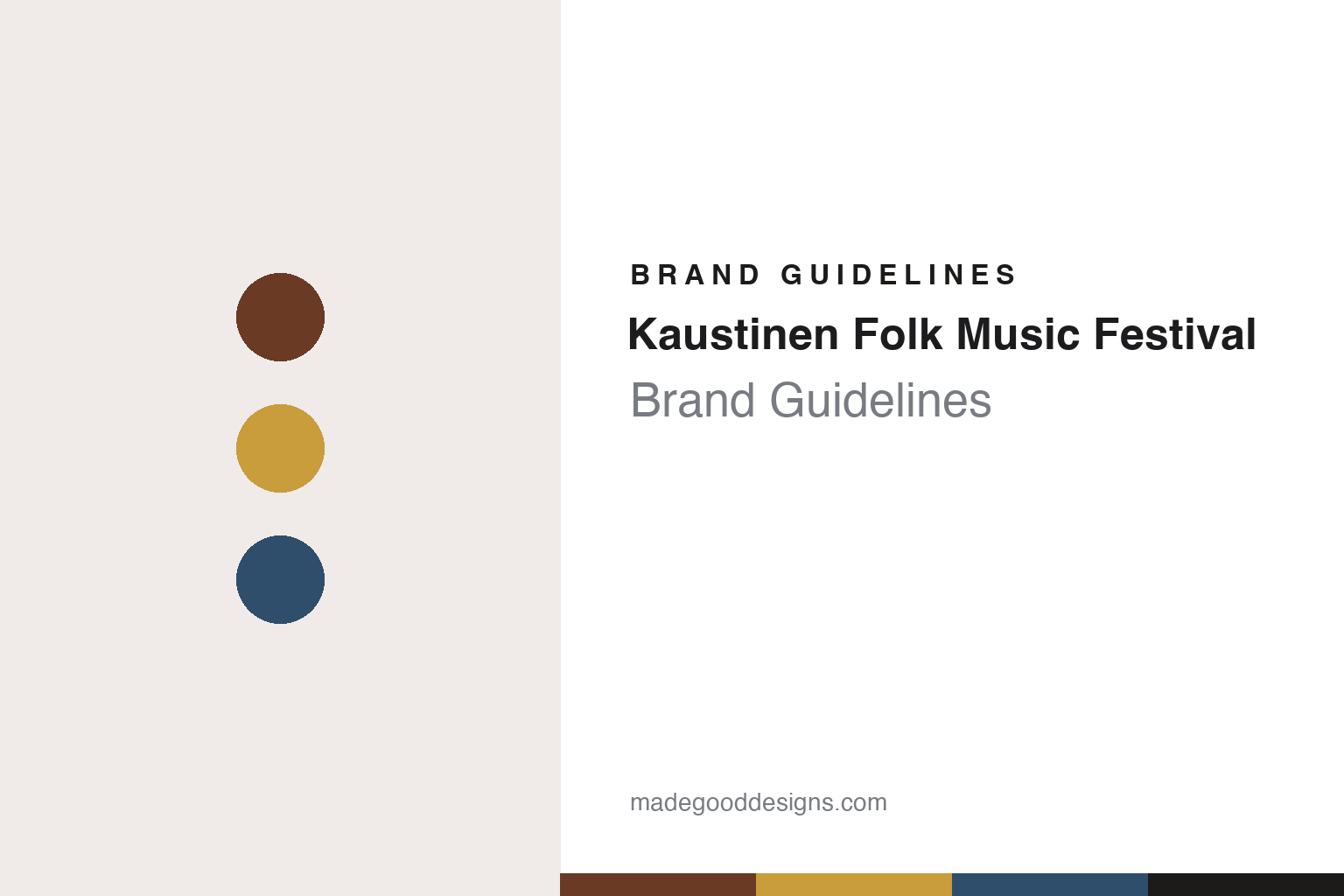
Kaustinen Folk Music Festival Brand Guidelines
A village fiddle tradition, a week in July and more players than residents.
Aa
Two constants: a fiddle brown, rye gold and lake blue palette and a humanist serif register. Abstract homage — not a Kaustinen Folk Music Festival poster or mark; no logo, artwork or wristband is reproduced.
A fiddle village
A summer festival built on a local playing tradition.
Kaustinen Folk Music Festival, in Finnish Kaustisen kansanmusiikkijuhlat, is held each July in Kaustinen, a municipality in Central Ostrobothnia with a little over 4,000 inhabitants, according to Yle in July 2026. It was first held in 1968. English Wikipedia says the estimate for that first year was about 6,000 visitors and that more than three times as many came, and that the festival grew out of a showcase of the local fiddle-based music tradition. The festival’s own site says folk music was played in Kaustinen long before the first festival, and signs off with the line “Happiest Days of Summer since 1968.”
The festival belongs to a group of Finnish summer festivals founded in the same years. Finnish Wikipedia lists Pori Jazz (1966), the Savonlinna Opera Festival (1967), Kuhmo Chamber Music (1970) and Ruisrock (1970) as its contemporaries, and says Kaustinen is a member of Finland Festivals and of CIOFF, the international network of folklore festivals.
The fiddle sits at the centre of the town’s identity. Yle reported in July 2026 that the instrument appears on the municipal coat of arms and on the roundabout in the town centre. On 15 December 2021, Yle reported, Kaustinen fiddle playing was confirmed on UNESCO’s Representative List of the Intangible Cultural Heritage of Humanity, only the second Finnish entry after sauna culture, and the decision was celebrated with fiddle playing at the Pelimannitalo, the folk musicians’ house in Kaustinen. English Wikipedia describes the inscription as covering Kaustinen fiddle playing and related practices and expressions.
Since 1970, according to English Wikipedia, the festival has named one or more people each year as Master Folk Musician, Master Folk Singer or Master Folk Dancer, together with an Ensemble of the Year, chosen for their repertoire, their skills and their work in keeping traditions going.
Colour
An association, a week and thousands of players.
The festival is organised by Pro Kaustinen ry, an association that English Wikipedia says is formed by three Kaustinen organisations of tradition bearers. Sources give slightly different starting dates: the festival’s site says Pro Kaustinen has organised it since 2011; English Wikipedia gives 2012; and Finnish Wikipedia says programme production passed to Pro Kaustinen in 2011 and the festival as a whole in 2012. Yle named Valtteri Valo as the association’s executive director in July 2023.
The festival now runs for a week, from Monday afternoon to a final concert on Sunday, the festival says; Yle reported in 2023 that the week opened with a free Monday. Finnish Wikipedia records nine-day editions in the late 2000s, such as 7 to 15 July in 2007, the festival’s 40th year, and a week-long format from 2010. Each edition carries a theme and a featured Finnish region: in 2026 the 59th festival ran from 13 to 19 July with the theme “Perinteet käsissä,” roughly “traditions in hand,” and North Ostrobothnia as its region, Finnish Wikipedia says. Earlier editions also had a changing country theme, such as Hungary in 2005 and Mexico in 2008, a practice since dropped.
The scale is set by performers as much as by audiences. The festival says about 750 performing groups and nearly 5,000 individual performers take part each year, more than Kaustinen has residents; Yle reported 800 groups from 15 countries and more than 6,000 folk-musician performers in July 2026. Yle reported in 2023 that total attendance in 2022 was a little over 43,000, a figure that includes musicians and free events, and that the 50th festival in 2017, held over seven programme days, drew more than 55,000. Finnish Wikipedia gives 58,531 total visits for 2026, and the festival gives about 58,000. The 2020 edition was not held in Kaustinen and moved online as VirtuaaliKaustinen, Finnish Wikipedia says, and 2021 combined concerts on site with online performances.
Teaching is part of the week. Yle reported in July 2026 that almost 400 children had signed up for the Näppäri course for young players, and that the course had to be split in two. The festival also runs workshops, dance parties and jams that it says are open to anyone who wants to play, sing or dance, and a children’s tent with its own programme. Around 50 local families hosted visitors in 2023, Yle reported.
Typography
Folk festivals and their settings.
A folk festival is often remembered by where and when it happens before anything else. Some take over a park on the edge of a city in high summer, with marquees pitched on the lawns; others fill a seaside town in late August, spreading concerts, dances and workshops through its halls and streets. Some gather in a concert hall in the depths of winter, some on a hillside in a provincial park, and some on a showground or in a festival village built for the purpose. The setting and the week in the calendar do much of the work a logo does elsewhere.
Where a festival issues an annual poster or programme cover, its look is renewed each year, and the artist behind it, whether an illustrator, a printmaker or a designer, shapes how that edition is remembered. When a festival credits those artists, the run of posters becomes a visual record of the event, edition by edition, and a festival without a fixed mark can still read as one thing across many years.
Behind most of these names stands an organiser that keeps them going: a city council, a folk society, a non-profit association, a trust or a small company, supported in many cases by large teams of volunteers. Organisers can change, and formats with them, while the name stays: the Cambridge Folk Festival, for one, has kept the name it was given in 1965 through several changes of format.
The practical layer is what audiences handle on the day. Programme booklets, stage timetables, wristbands, campsite and site maps, and signs pointing between venues all carry the festival’s type and colour into daily use. This guide looks at each festival through that lens: its setting, its calendar, its organiser and the material its audience reads, set out in plain terms and with our own unofficial palettes.
Aa
A humanist serif — a village festival since 1968. (Specimen set in Alegreya, a serif STAND-IN; NOT the Kaustinen Folk Music Festival logo.)
Kaustinen Folk Music Festival
A park, a canopy and a hall cut into rock.
The festival’s ground is the village itself. Its heart, the festival says, is the Festivaalipuisto, the festival park in the middle of Kaustinen, with the main stage, several other stages and most of the food and product stalls; a pavilion and the Folk Arts Centre lie within walking distance, and the music spreads into yards and onto village roads. The festival counts more than 30 stages, and a concert series called “Kaustinen käy kylään” takes free music into shops and services around the town. One day ticket covers the whole of that day’s programme.
Finnish Wikipedia describes the main arena, formerly the Keskipohjanmaa-areena and now the KPO-areena, as a round stage under a canopy nicknamed “Villen pipo,” Ville’s cap, with seating that continues onto the grass of the surrounding slope; the canopy was built in 1988 and renewed for the festival’s 40th year in 2007. Other venues on its list include the Pelimannitalo, an old log house on the hill, and the Finnish Folk Instrument Museum. The Kansantaiteenkeskus, the Folk Arts Centre, completed in 1997 to a design by the architect Rainer Mahlamäki, houses the Kaustinen-sali, a 372-seat concert hall quarried into the bedrock, as well as the Folk Music Institute, Pro Kaustinen and the instrument museum, according to Finnish Wikipedia.
The festival’s visual history is kept partly in that institute’s archive. Its website shows a photograph of the fairground in 1970 from the archive of the Folk Music Institute, the research, archive and publishing centre founded in 1974 that, Finnish Wikipedia says, publishes the magazine Kansanmusiikki, formerly Pelimanni, together with the Finnish Folk Music Association. The annual theme and featured region give each edition its own subject while the fiddle stays constant.
For a design guide, Kaustinen Folk Music Festival shows how a festival’s identity can be carried by one instrument, one village and an annual theme that changes while the core tradition stays. Compare Tønder Festival, the Nordic folk and roots festival that began in a Danish water mill in the 1970s, and Roskilde Festival, another Nordic summer festival. For this guide we use a fiddle brown, a rye gold and a lake blue with a serif, an unofficial interpretation; no product or logo is reproduced.
Explore & save
Keep Kaustinen Folk Music Festival’s identity on hand — save it to a board in the Made Good inspiration library.
Kaustinen Folk Music Festival identity set
Pin the Kaustinen Folk Music Festival fiddle brown, rye gold and lake blue palette and the humanist serif register to your own board.
Source & notes
Frequently Asked Questions
What font can I use to match the Kaustinen Folk Music Festival look?
This guide describes Kaustinen Folk Music Festival’s type as “A humanist serif — a village festival since 1968”. Its type specimen is set in Alegreya from Google Fonts as a stand-in; Alegreya is not Kaustinen Folk Music Festival’s own lettering.
What colours are in the Kaustinen Folk Music Festival palette?
This guide’s Kaustinen Folk Music Festival palette is Fiddle brown #6A3A24, Evening ink #1D1B19, Rye gold #C99C3C, Lake blue #2F4E6B and Birch paper #F6F3EC. The tones are the guide’s own unofficial interpretation, not official Kaustinen Folk Music Festival hex codes.