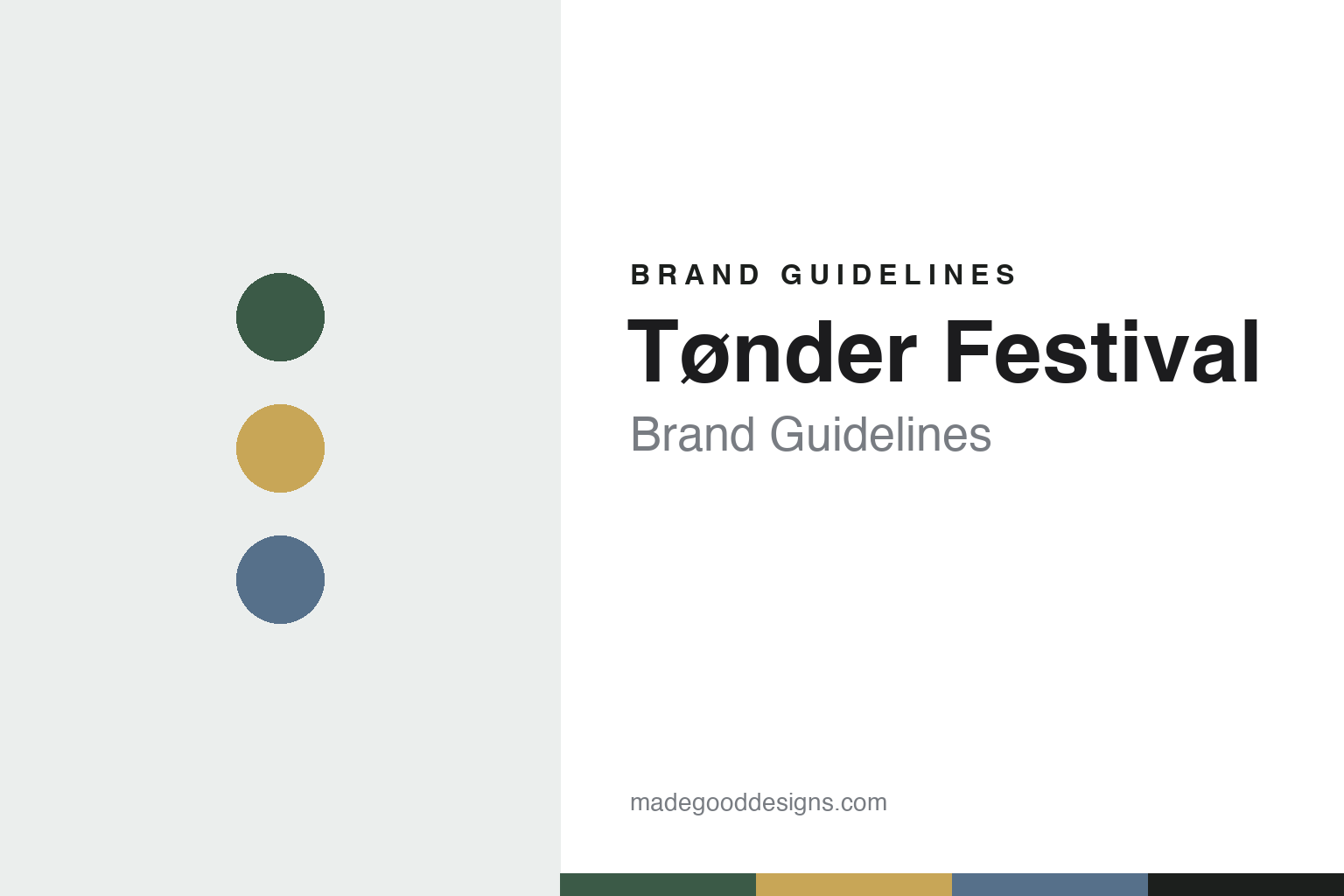
Tønder Festival Brand Guidelines
A song mill of 1974, a showground of tents and a late-August weekend in southern Jutland.
Aa
Two constants: a marsh green, reed gold and slate blue palette and a condensed sans register. Abstract homage — not a Tønder Festival poster or mark; no logo, artwork or wristband is reproduced.
The song mill
From a midsummer party in a water mill to a festival on the last weekend of August.
Tønder Festival began in Tønder, a small town in southern Jutland. The festival’s own history says it started in June 1974 as a three-day midsummer party in Bachmann’s water mill on the Vidå river in Tønder, put on by a group of young music lovers with songs and folk music. The old mill soon took the name Visemøllen, the “song mill,” and the same group staged a second three-day event that September. The first full Tønder Festival followed over three days in August 1975, with a programme that, the festival says, included the beat groups Alrune Rod and Taurus, the band later renamed TV-2.
The music magazine FolkWorld, looking back from the festival’s 25th edition in 1999, described that first year from another angle: in 1975, it wrote, the town’s three music clubs, for jazz, folk and beat, organised a first “Multi Music” festival on the last weekend of August, timed to coincide with the town festival. The town festival soon faded, FolkWorld noted, but the last weekend of August stayed with Tønder Festival. English Wikipedia gives 1974 as the founding year and 1975 for the first festival, and the festival’s own pages say it has existed “since 1974.”
One figure links those first events with the decades that followed. The festival credits Carsten Panduro, who was involved from the start, with building the festival and its atmosphere over four decades as its leader; in a 2009 interview with FolkWorld, Panduro said he had been booking the festival’s music since its start in 1975. In 1978, the festival’s history says, the town’s showground became the festival site, with a large tent holding 800 people, and in 1980 the Tønder Festival Fond, a foundation, was set up to give the festival a longer-term footing, together with its own secretariat, at first a corner of the tourist office. FolkWorld reported in 1999 that a second tent was bought in 1981 and that from 1995 the festival ran over four days, starting on the Thursday.
Colour
Radio, records and a town full of venues.
Through the 1980s the festival built the structures that still surround it. The festival says Danmarks Radio, now DR, had been a regular guest since 1975, and that in the autumn of 1982 DR’s television service broadcast seven programmes from the festival under the title “Toner fra Tønder.” In 1983 the festival set up Millstream Records, a specialist importer of folk and roots music that worked as a mail-order business from 1986 to 2014 and now runs a shop on the festival site during the festival. A company of supporters, Tønder Festivalens Venner, bought the former Hagge’s Hotel in the centre of town, which became home to the secretariat, the foundation, Millstream and the music venue known as Hagge’s; the festival dates that company to 1983, while FolkWorld dated the purchase to 1988.
By the late 1990s the festival had spread across the town. Its history lists the venues for 1997 as Tønder Gymnasium, the Kulturhuset, the town square, Visemøllen, the Tønderhallerne halls and Tent 1 and Tent 2 on the festival site. FolkWorld counted 33 acts and seven venues at the 25th edition in 1999, and the foundation marked that anniversary with a book, Tønder Festival – gennem 25 år 1975–1999.
A second period began in 2012. That year, the festival says, it introduced a wristband for the whole festival in place of tickets to single concerts, and made the festival site the centre of the event, with new stages and areas such as NOLA, devoted to the music of New Orleans and Louisiana, the Fanø tent and Little Dublin. In 2014, the festival’s 40th year, Maria Theessink succeeded Panduro as artistic director, a role in which the festival still lists her, together with that of press chief, in 2026. The 2020 and 2021 editions were not held; in 2021 a special concert series took place at the Schweizerhalle–Tønder Kulturhus instead.
The festival describes its programme as “handmade music”: folk, roots rock, country, blues, cajun and world music. English Wikipedia names acts from Ireland, Scotland, Canada, the United States, England and Scandinavia, in genres from Irish and Scottish folk music to Nordic folk, Americana and country. The 2009 FolkWorld interview shows how that programme was put together: Panduro said he rarely booked an act without seeing it live, and named festivals he regarded as kindred or watched for new acts, among them Celtic Connections in Glasgow and the folk festivals of Edmonton and Winnipeg. The same article describes courses held at the festival for young musicians from Ireland, Scotland, England and Denmark.
Typography
Folk festivals and their settings.
A folk festival is often remembered by where and when it happens before anything else. Some take over a park on the edge of a city in high summer, with marquees pitched on the lawns; others fill a seaside town in late August, spreading concerts, dances and workshops through its halls and streets. Some gather in a concert hall in the depths of winter, some on a hillside in a provincial park, and some on a showground or in a festival village built for the purpose. The setting and the week in the calendar do much of the work a logo does elsewhere.
Where a festival issues an annual poster or programme cover, its look is renewed each year, and the artist behind it, whether an illustrator, a printmaker or a designer, shapes how that edition is remembered. When a festival credits those artists, the run of posters becomes a visual record of the event, edition by edition, and a festival without a fixed mark can still read as one thing across many years.
Behind most of these names stands an organiser that keeps them going: a city council, a folk society, a non-profit association, a trust or a small company, supported in many cases by large teams of volunteers. Organisers can change, and formats with them, while the name stays: the Cambridge Folk Festival, for one, has kept the name it was given in 1965 through several changes of format.
The practical layer is what audiences handle on the day. Programme booklets, stage timetables, wristbands, campsite and site maps, and signs pointing between venues all carry the festival’s type and colour into daily use. This guide looks at each festival through that lens: its setting, its calendar, its organiser and the material its audience reads, set out in plain terms and with our own unofficial palettes.
Aa
A condensed sans — a festival that grew from a song mill. (Specimen set in Barlow Semi Condensed, a sans STAND-IN; NOT the Tønder Festival logo.)
Tønder Festival
A foundation, an association and fifty years of posters.
Today the festival runs from Wednesday to Saturday around the last full weekend of August. It moved to that pattern in 2024, the festival announced in March 2023, having run from Thursday to Sunday before; the 2024 edition, its 50th, ran from 21 to 24 August. The site lies close to the centre of Tønder and, by the festival’s count, has eight stages, from the large Open Air stage to the small Front Porch. English Wikipedia gives a capacity of 15,000.
The organisation has two parts. The festival says the Tønder Festival Fond owns Tønder Festival, while the association Tønder Festival Forening runs it and rents the brand from the foundation; volunteers who have worked at a festival can join the association. The festival counts more than 3,000 volunteers and helpers, including a leadership group of about 250, alongside a small permanent office. FolkWorld wrote in 2009 of a curry party for some 2,000 volunteers on the Monday after the festival.
The festival keeps its visual record in a poster archive: its website shows a poster for each year back to 1975. For the 50th edition in 2024 it commissioned a special poster from Lizzy Ross, a songwriter who had played the festival the year before and also works as a visual artist and designer; the festival said 50 numbered linocut prints of the design were sold in the Millstream shop on site. The same anniversary brought a renovation of the Mill, with its original windows back in place, and an overhaul of the Yellow House on the site, also known as Little Dublin. The festival’s own brand text leans on the marshland of southern Jutland and on the Danish word “ægte,” genuine.
For a design guide, Tønder Festival shows how a festival’s identity can rest on a water mill, a run of annual posters and a volunteer organisation that has carried the name for five decades. Compare Roskilde Festival, another Danish summer festival, and Celtic Connections, the Glasgow festival Panduro named in 2009 as a place to hear new acts. For this guide we use a marsh green, a reed gold and a slate blue with a sans, an unofficial interpretation; no product or logo is reproduced.
Explore & save
Keep Tønder Festival’s identity on hand — save it to a board in the Made Good inspiration library.
Tønder Festival identity set
Pin the Tønder Festival marsh green, reed gold and slate blue palette and the condensed sans register to your own board.
Source & notes
Frequently Asked Questions
What font can I use to match the Tønder Festival look?
This guide describes Tønder Festival’s type as “A condensed sans — a festival that grew from a song mill”. Its type specimen is set in Barlow Semi Condensed from Google Fonts as a stand-in; Barlow Semi Condensed is not Tønder Festival’s own lettering.
What colours are in the Tønder Festival palette?
This guide’s Tønder Festival palette is Marsh green #3B5A47, Evening ink #1C1F1D, Reed gold #C8A657, Slate blue #56708A and Paper #F5F2EA. The tones are the guide’s own unofficial interpretation, not official Tønder Festival hex codes.
When was Tønder Festival founded?
Tønder Festival was founded in 1974 (first full festival 1975), in Tønder, Denmark.