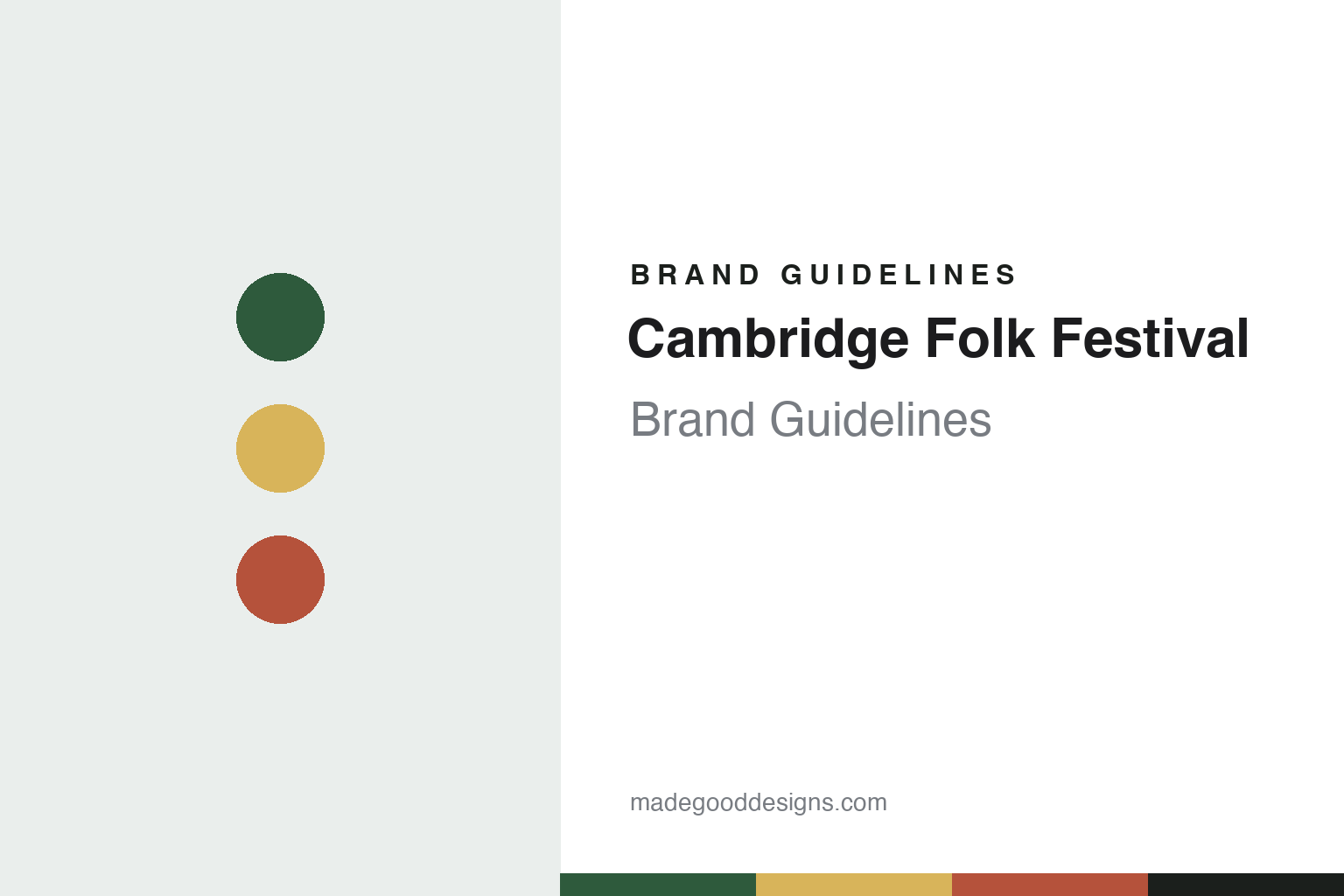
Cambridge Folk Festival Brand Guidelines
A council-run folk weekend of 1965, still pitched under marquees in the grounds of Cherry Hinton Hall.
Aa
Two constants: a parkland green, summer straw and marquee rust palette and a warm book serif register. Abstract homage — not a Cambridge Folk Festival poster or mark; no logo, artwork or wristband is reproduced.
A council festival
From a first weekend in 1965 to a fixture of the Cambridge summer.
The Cambridge Folk Festival began in 1965. BBC News, reporting in January 2025, described it as an annual four-day folk and roots music festival organised by Cambridge City Council and hosted in the grounds of Cherry Hinton Hall, and said it typically drew about 14,000 people. Cherry Hinton is one of the villages that the city of Cambridge has taken in, English Wikipedia says, and the hall’s grounds give the festival its setting: trees, open lawns and marquees, in a park the council itself has called the festival’s “spiritual home.”
English Wikipedia, drawing on the festival’s own published history, names Ken Woollard as the first director in 1965. He stayed on as festival organiser and artistic director into the early 1990s, and the role then passed to Eddie Barcan, who had worked as his assistant from 1990, according to the same article. It adds that the first festival sold 1,400 tickets and that a young Paul Simon was squeezed onto the bill as a late addition.
The question of who runs the festival has a short, neutral history of its own. English Wikipedia says the city council ran it until 2015, that a charity called Cambridge Live ran it for a short period after that, and that the council took it back in 2019. The council’s own news pages describe it as the organiser of the festival since it began in 1965, and the festival website today carries the line “organised by Cambridge City Council.”
Broadcasting carried the name well beyond the city. English Wikipedia says BBC Radio 2 broadcast the festival live until 2008, that highlights appeared on BBC Four between 2002 and 2009, and that Sky Arts showed it from 2010 to 2012. The festival marked its 50th event in 2014, the same article says.
The 2025 edition was not held, BBC News reported in January 2025. In July 2025 the council announced a new format, confirmed at a cabinet meeting on 15 July: a scaled-back two-day outdoor event at Cherry Hinton Hall with basic camping, with folk and roots events at other venues across the city either side of it. The council’s announcement of March 2026 gave the dates as Saturday 1 and Sunday 2 August 2026.
Colour
Marquees, club stages and a wide idea of folk.
English Wikipedia describes the festival as known for an eclectic mix and a wide definition of what counts as folk, and for a site where most artists play more than once across the weekend. Its account of the stages gives the plan of the grounds: Stage 1, inside a large marquee in front of the main arena; Stage 2, in a smaller marquee; a floor singers’ stage at the Coldham’s Common campsite; and the Club Tent, which five local folk clubs programmed with local artists on the festival’s behalf up to 2022, before the festival rebranded it as a third stage in 2023.
Around those stages sit smaller spaces. The same article mentions a small tent called The Hub, where young people can play together or join workshops, and a marquee in the Flower Garden whose workshops change from year to year; storytelling has been a regular fixture there, and since 2011 the band Camus has run Northumbrian smallpipes workshops in which visitors can try practice sets of pipes. Local musicians are also invited to lead informal sessions around the site, Irish sessions among them.
The festival website today describes two main stages, a street performance area with buskers and roving acts, and a Club Corner created with local folk clubs and promoters. It also runs a prize: the Christian Raphael Prize, set up in 2018 by the festival with the Raphael family for an up-and-coming folk act, which the website says brings a guaranteed slot on Stage 3 at the following festival.
The 2026 weekend kept the two-stage plan. Americana UK, reviewing the festival at Cherry Hinton Hall on 1 and 2 August 2026, described sets on Stage One and Stage Two, shade under the trees and food stalls around the site, and reported that Frank Turner headlined the main stage on the Saturday evening. The reviewer opened by asking what folk music means in 2026 and found the weekend ranged from traditional dance bands to singer-songwriters.
The city programme of 2026 added indoor and street events. The council’s announcement of March 2026 listed a family ceilidh at the Cambridge Corn Exchange on Sunday 26 July and a traditional music day along Mill Road, organised with local venues, promoters and folk clubs; the festival now calls this series “Cambridge Folk Festival Presents.” A live double album, Cool As Folk: Cambridge Folk Festival, collected recordings from the festival in 2007, English Wikipedia says.
Typography
Folk festivals and their settings.
A folk festival is often remembered by where and when it happens before anything else. Some take over a park on the edge of a city in high summer, with marquees pitched on the lawns; others fill a seaside town in late August, spreading concerts, dances and workshops through its halls and streets. Some gather in a concert hall in the depths of winter, some on a hillside in a provincial park, and some on a showground or in a festival village built for the purpose. The setting and the week in the calendar do much of the work a logo does elsewhere.
Where a festival issues an annual poster or programme cover, its look is renewed each year, and the artist behind it, whether an illustrator, a printmaker or a designer, shapes how that edition is remembered. When a festival credits those artists, the run of posters becomes a visual record of the event, edition by edition, and a festival without a fixed mark can still read as one thing across many years.
Behind most of these names stands an organiser that keeps them going: a city council, a folk society, a non-profit association, a trust or a small company, supported in many cases by large teams of volunteers. Organisers can change, and formats with them, while the name stays: the Cambridge Folk Festival, for one, has kept the name it was given in 1965 through several changes of format.
The practical layer is what audiences handle on the day. Programme booklets, stage timetables, wristbands, campsite and site maps, and signs pointing between venues all carry the festival’s type and colour into daily use. This guide looks at each festival through that lens: its setting, its calendar, its organiser and the material its audience reads, set out in plain terms and with our own unofficial palettes.
Aa
A warm book serif — read as a council notice, a stage board and a programme cover. (Specimen set in Fraunces, a serif STAND-IN; NOT the Cambridge Folk Festival logo.)
Cambridge Folk Festival
A name, a hall and a set of marquees.
The identity of the Cambridge Folk Festival is carried first by its name and its site. The name joins a city to a genre and has stayed unchanged since 1965; the place, Cherry Hinton Hall, appears beside it on almost every listing, from the BBC’s reports to the festival’s own ticket pages. The visual elements an audience meets on the day are practical ones: numbered stages in marquees, a club stage shared with local folk clubs, a campsite, a flower-garden workshop tent and a site map that ties them together.
The organiser shapes the voice. Because the festival is presented by a city council, its public statements come through council news pages, and the website closes with the council’s name; in 2026 the same name sat on a programme that reached from the Corn Exchange to Mill Road.
For a design guide, the Cambridge Folk Festival shows how a council-run event can hold one name and one park across six decades while its format changes around them. Compare Whitby Folk Week, the English folk festival on the Yorkshire coast that also began in 1965, and Green Man Festival, another British summer festival held in parkland. For this guide we use parkland green, summer straw and marquee rust with a serif, an unofficial interpretation; no product or logo is reproduced.
Explore & save
Keep Cambridge Folk Festival’s identity on hand — save it to a board in the Made Good inspiration library.
Cambridge Folk Festival identity set
Pin the Cambridge Folk Festival parkland green, summer straw and marquee rust palette and the warm book serif register to your own board.
Source & notes
Frequently Asked Questions
What font can I use to match the Cambridge Folk Festival look?
This guide describes Cambridge Folk Festival’s type as “A warm book serif — read as a council notice, a stage board and a programme cover”. Its type specimen is set in Fraunces from Google Fonts as a stand-in; Fraunces is not Cambridge Folk Festival’s own lettering.
What colours are in the Cambridge Folk Festival palette?
This guide’s Cambridge Folk Festival palette is Parkland green #2E5A3C, Evening ink #1B1F1C, Summer straw #D8B45A, Marquee rust #B5523B and Canvas #F6F3EC. The tones are the guide’s own unofficial interpretation, not official Cambridge Folk Festival hex codes.
When was Cambridge Folk Festival founded?
Cambridge Folk Festival was founded in 1965, in Cambridge, England.


