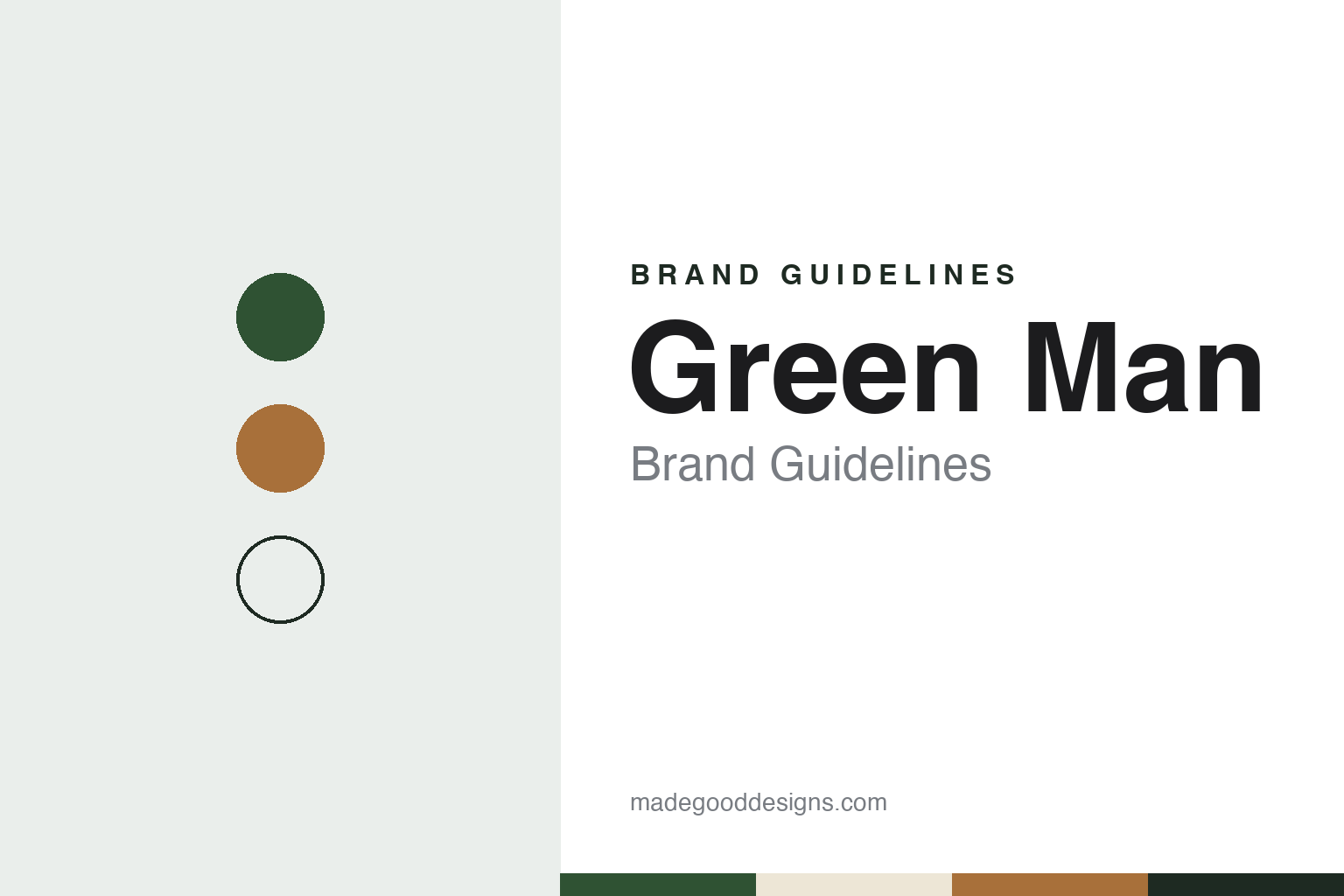
Green Man Brand Guidelines
The independent Welsh festival that grew in the hills near Crickhowell.
Aa
Two constants: a moss, bracken and cream palette and a folk-soft serif register. Abstract homage — not a Green Man asset or mark; no logo, poster or effigy is reproduced.
Craig-y-Nos
A one-day event at a castle, then a move to the hills.
Green Man began in 2003 as a small one-day event at Craig-y-Nos Castle, near Brecon in south Wales. English Wikipedia names its founders as Jo Bartlett and Danny Hagan and gives the first year’s audience as about 300 people. In 2004 the festival moved to Baskerville Hall, outside Hay-on-Wye, and ran over two days; by 2005 it had become a three-day event, with attendance put at about 1,000 in 2004 and 3,000 in 2005.
The decisive change came in the middle of that decade. English Wikipedia says Fiona Stewart joined in 2006 as joint managing director, and Euronews also dated her arrival to 2006 in August 2025; Pollstar, in an April 2019 profile, said she took over the festival in 2005. Before Green Man, Stewart had worked on The Big Chill, an English festival, Pollstar and Euronews both reported.
In 2006 the festival also moved to the site it still uses: Glanusk Park, near Crickhowell, inside the national park that Welsh speakers call Bannau Brycheiniog and that is also known in English as the Brecon Beacons. English Wikipedia says the move took the capacity to about 6,000. The founders later stepped back. Hagan resigned as a director in 2009, and in 2011 Bartlett and Hagan sold their shares to Stewart and left the company, according to English Wikipedia.
The festival then grew in stages. English Wikipedia gives a daily capacity of 15,000 in 2012 and 25,000 visitors in 2018. In 2020 the festival did not take place on site, and a digital version ran in its place, the same source says. The 2025 edition, held from 14 to 17 August, had 25,000 tickets, Euronews reported, and Huck described Green Man in September 2026 as a 25,000-capacity event.
Colour
Ownership, stages and a figure in the field.
Green Man is an independent festival, and its ownership is plain in the press. Pollstar in 2019, Euronews in 2025 and Huck in 2026 all describe Stewart as the festival’s owner, and Euronews gave her title as owner and director. Huck described her as the only woman in the UK with controlling ownership of a large music festival. Euronews reported that the festival is run by its own team rather than by a large promoter, and that Stewart does not book the line-up herself but works with a team of curators covering music, spoken word, comedy, performing arts and other strands.
That independence shapes how the festival looks on the ground. Pollstar reported in 2019 that Green Man had no headline sponsors and operated entirely in-house, including its own bars, and that independent Welsh brewers jointly supplied the beer that the bars sell. Euronews described the result in 2025 as a locally sourced Welsh beer festival held within the grounds. English Wikipedia adds that the festival’s own brewed beer, Green Man Growler, has been sold on site since 2012 and as a canned beer online since 2020.
The site is divided into named areas rather than a single arena. The festival’s website lists areas including Mountain’s Foot, Far Out, the Walled Garden and Einstein’s Garden, the last of them the science area that English Wikipedia describes, alongside tents for literature, film and comedy and areas for children and teenagers. The main stage is the Mountain Stage. Huck wrote in 2026 that its backdrop of hills and wooded slopes runs towards the peak of Table Mountain, and English Wikipedia says the winner of the annual Green Man Rising contest for a new act, launched in 2008, opens that stage on the first day.
The festival’s name has a physical form. Pollstar described a giant wooden statue of the Green Man, the figure from folklore, greeting visitors in front of the mountains, and reported in 2019 that it was burned at the end of each edition; Huck called it a giant wicker effigy.
Typography
How festivals present themselves.
A music festival’s identity is built from a few public pieces: its name, its logo, the poster that announces each year’s line-up, the wristband or ticket that gets a visitor through the gate, and the signs and stage names on site. Many festivals take their names from a place, a park or a town, and keep them for decades; Reading Festival has been tied to Richfield Avenue in Reading since 1971, and Download Festival to Donington Park since 2003. Some names have carried a sponsor for a time, as the Reading and Leeds events did when they were billed as the Carling Weekend from 1998 to 2007.
Line-up posters are the most repeated graphic of a festival year. They list the acts in tiers, with the headliners at the top, and are revised as new names are added in waves. Stage names work as a second layer of branding: festivals name stages after sponsors, broadcasters, genres or invented themes, and rename them when a site is redesigned, as Reading and Leeds did in 2026 when the Main Stage became the Grid.
Mascots and recurring characters give some festivals a mark that travels beyond the logo. Download’s dog mascot appears on tickets, stage banners, merchandise and the festival website, according to English Wikipedia. Other festivals rely on a consistent colour, a wordmark or a site landmark instead.
Ownership is part of the picture, and it is usually set out plainly on corporate pages and in the trade press. Some festivals are run by small independent teams; others belong to promoters and groups such as Festival Republic and Live Nation, whose own pages describe their founders, organisers and history. This guide sets out what dated sources say about each festival’s founding, sites and organisers, and marks clearly what rests only on the organisers’ own word.
Aa
A soft, folk-leaning serif for a festival named after a figure from folklore. (Specimen set in Fraunces, a serif STAND-IN; NOT the Green Man logo.)
Green Man
A curated bill in a Welsh park.
Green Man’s line-ups mix established acts with newer ones. Euronews named Underworld, Wet Leg and Beth Gibbons on the 2025 bill, and English Wikipedia lists Wolf Alice among the headliners of the 2026 edition, held at Glanusk Park from 20 to 23 August 2026. English Wikipedia describes the music as mostly alternative, indie, rock, folk, dance and Americana, with literature, film, comedy, science, theatre and family programmes alongside.
The festival has carried its name into smaller events. English Wikipedia records a Green Man boat party on the River Thames from 2006, renamed Green Man Ahoy! in 2016; a four-day Welsh beer and cider event at King’s Cross in London in September 2015, built around the festival’s Courtyard bar; and a one-day St David’s Day event called Hwyl at Cecil Sharp House in London. Each used the Green Man name and its Welsh food, drink and music to take the festival’s character beyond the park.
For designers, the material is the site and its names. The Welsh hills behind the Mountain Stage, the Walled Garden and the wooden figure recur in the press coverage, and the festival’s area names come from nature, science and folklore — Far Out, Einstein’s Garden, Little Folk — rather than from sponsors.
For a design guide, Green Man shows how an independent festival can build an identity from a place, a figure and a set of named areas rather than from a sponsor’s mark. Compare End of the Road, another independent British festival set in a garden, and Glastonbury Festival, a much larger festival on farmland in England. For this guide we use a hillside moss, bracken and cream with a serif, an unofficial interpretation; no product or logo is reproduced.
Explore & save
Keep Green Man’s identity on hand — save it to a board in the Made Good inspiration library.
Green Man identity set
Pin the Green Man moss, bracken and cream palette and the folk-soft serif register to your own board.
Source & notes
Frequently Asked Questions
What font can I use to match the Green Man look?
This guide describes Green Man’s type as “A soft, folk-leaning serif for a festival named after a figure from folklore”. Its type specimen is set in Fraunces from Google Fonts as a stand-in; Fraunces is not Green Man’s own lettering.
What colours are in the Green Man palette?
This guide’s Green Man palette is Hillside moss #2F5233, Valley ink #1E2A22, Fleece cream #EDE6D6, Bracken #A8703A and Mist #F6F4EE. The tones are the guide’s own unofficial interpretation, not official Green Man hex codes.
When was Green Man founded?
Green Man was founded in 2003, in Craig-y-Nos Castle, Brecon, Wales.
Who founded Green Man?
Green Man was founded by Jo Bartlett and Danny Hagan in 2003.
Who owns Green Man?
Green Man is owned and run by Fiona Stewart. This guide dates Green Man to 2003, in Craig-y-Nos Castle, Brecon, Wales.