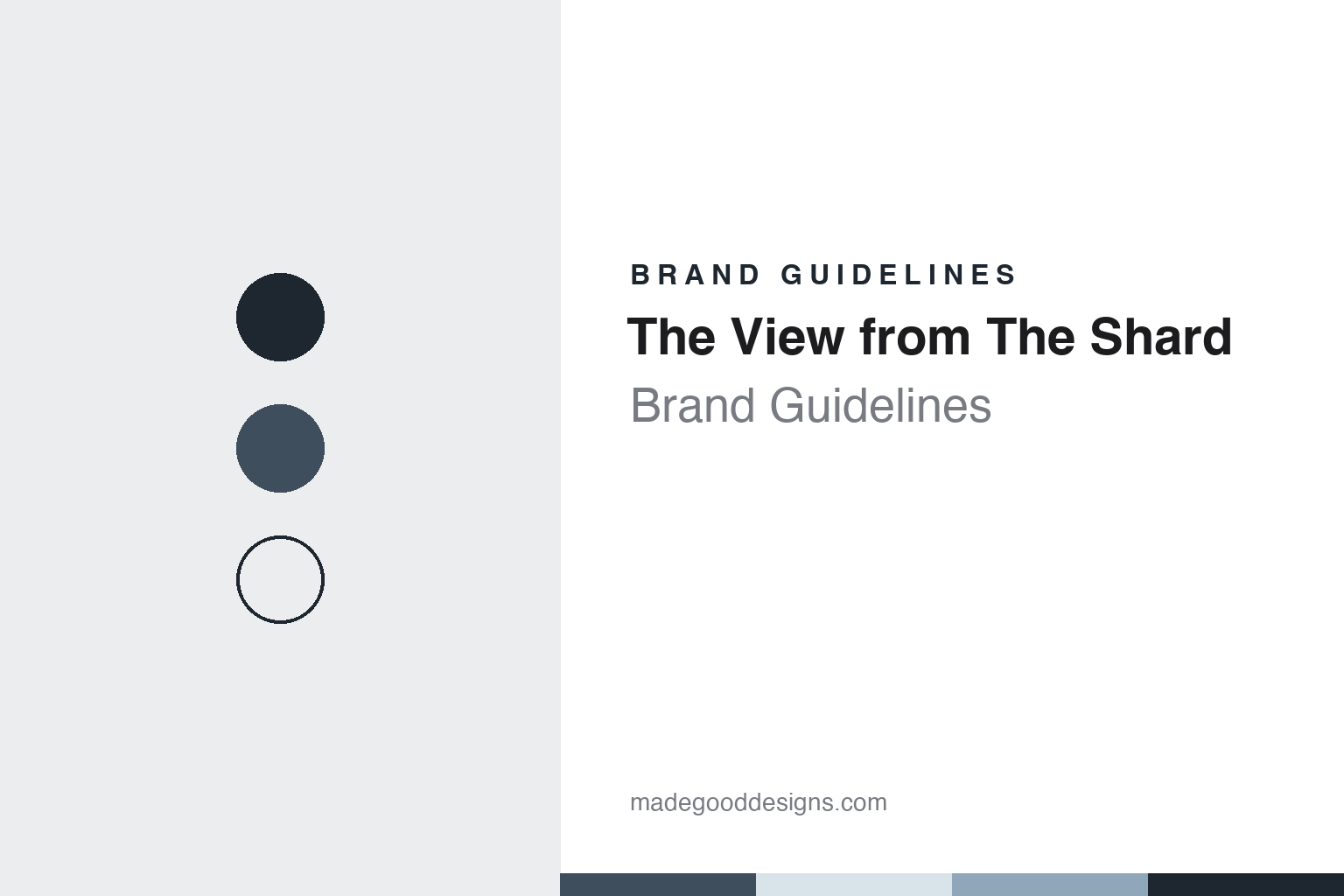
The View from The Shard Brand Guidelines
Renzo Piano’s tower at London Bridge and the gallery at its top.
Aa
Two constants: a glass grey, sky and slate palette and a geometric sans register. Abstract homage — not a The View from The Shard product or mark; no logo, ticket or photograph is reproduced.
A shard of glass
A tower at London Bridge, and a name taken from its critics.
The View from The Shard is the public observation deck at the top of The Shard, the 95-storey tower beside London Bridge station in Southwark. English Wikipedia places the attraction between the 68th and 72nd floors and gives its opening to the public as 1 February 2013; the trade site DesignCurial, previewing it on 15 January 2013, gave the same date for the official public opening.
The tower came first. English Wikipedia says that in 1998 the London property entrepreneur Irvine Sellar and his partners decided to redevelop Southwark Towers, a 1970s office block on the site, and that in spring 2000 Sellar met the Italian architect Renzo Piano in Berlin, where, by Sellar’s account, Piano sketched a spire-like sculpture rising from the Thames on the back of a menu. After a planning inquiry in April and May 2003, consent was announced on 19 November 2003. Southwark Towers was taken down in 2008 and early 2009, and construction of The Shard began in March 2009.
The name came from an objection. Wikipedia says English Heritage described the proposal as “a shard of glass through the heart of historic London,” and the phrase stuck; the building was earlier called London Bridge Tower and is also referred to as Shard London Bridge. Its operators style the name with a capital T, “The Shard,” and the attraction follows the same rule in its own name.
Piano’s design drew, Wikipedia says, on the railway lines beside the site, the London spires painted by the 18th-century Venetian artist Canaletto and the masts of sailing ships. Renzo Piano Building Workshop worked with Adamson Associates Architects; WSP was structural engineer, Arup services engineer and Mace main contractor. The steel structure was topped out on 30 March 2012, when a 66-metre spire was winched into place, and the final panes of glass took the tower to 309.6 metres. It was inaugurated on 5 July 2012, and practical completion followed in November 2012. English Wikipedia lists it as the tallest building in the United Kingdom.
Colour
A visit staged from the street to Level 72.
The attraction occupies the top of the tower’s habitable floors. English Wikipedia describes a triple-height indoor gallery on Level 69, with 360-degree views that the operator puts at up to 40 miles, and a partly open-air gallery on Level 72, the highest public level of the building at about 244 metres (800 feet). From Level 72 visitors can look up into the glass spire, which continues above them. Wikipedia’s floor plan puts the Shangri-La hotel on floors 34 to 52, residences on 53 to 65 and the spire on 73 to 95, so the View sits between the private floors and the open structure at the top.
The visit was designed as a sequence rather than a single lift ride. Previewing the attraction in January 2013, DesignCurial described a ground-floor gallery of more than 140 famous Londoners shown in playful pairings, with animated maps and video screens about the growth of London around the London Bridge crossing. Visitors rose in what it called “kaleidoscopic” lifts, fitted with video screens and mirrors to give the effect of passing up through London ceilings and roofs, including the dome of St Paul’s Cathedral, the Rubens ceiling at the Banqueting House and the glass roof of the British Museum’s Great Court, while the descent lifts used different effects.
At the change of lifts on Level 33, the same report said, guests walked through a word map of London: an image of the Thames curving across the floor, with the city mapped around it in 200 sentences written on the walls and floor, each describing a different district. Level 69 had digital telescopes offering live views as well as recorded day and night views, and Level 68 a shop for souvenirs and limited editions. Wikipedia says the lifts travel at about 7 metres per second with a change on Level 33; the operator’s own terms give a figure of up to six metres per second.
Today the operator’s website lists bars on Level 69 and Level 72, private hire of the galleries and requests for filming and photography, and says the attraction has step-free access from the booking hall on Level 1 all the way to Level 72. Its entrance is on Joiner Street, beside London Bridge station.
Typography
Observation decks, towers and wheels.
Observation decks, towers and observation wheels sell a view, but they present themselves through a building. Most carry the name the operator publishes, often a building name or an address, and their visual identity tends to borrow from the structure itself: its silhouette, its stone or steel, and the architects named in the operator’s own history pages and in the press. A deck at the top of an office tower usually shares that tower’s name; a purpose-built tower or wheel often turns its own outline into the mark.
The visitor route is where most of the design work shows. Tickets, timed-entry screens, queue signs and wayfinding lead people from a street entrance, often separate from the office lobby, through security and exhibits to the lift lobbies and up to the terraces. Many operators have rebuilt these routes in recent decades, adding museums on lower floors, new entrances and glass parapets, and they describe those renovations, with dates and design firms, on their corporate pages.
Light is the second layer. Floodlighting and LED schemes let a tower change colour for holidays and events, and several operators publish lighting calendars or run partner programmes for them. At night the lit crown often stands in for the logo, and it appears on postcards, souvenirs and social media far more often than any wordmark.
Behind the attraction there is usually a property company, a public body or an entertainment group, and these guides name them plainly, with dates for openings, renamings and changes of ownership. Souvenir graphics, from tote bags to scale models, tend to reuse the same few elements: the outline, the name and a palette drawn from the materials of the building.
Aa
A clean geometric sans for a glass tower. (Specimen set in Jost, a sans STAND-IN; NOT the logo of The View from The Shard.)
The View
A separate operator inside a tower of many uses.
The View is run separately from the rest of the tower. Its terms and conditions say the attraction and its website are operated by Shard Viewing Gallery Management Limited, based at The Shard. English Wikipedia calls it the tower’s “privately operated observation deck.”
The building’s ownership changed during construction. English Wikipedia says that in January 2008, as financial markets tightened, Sellar announced funding from a consortium of Qatari investors, including Qatar National Bank and the property developer Barwa Real Estate, which took an 80% stake and bought out the earlier partners CLS Holdings and the Halabi family trust. In 2009 the State of Qatar consolidated its ownership of the London Bridge Quarter, now called Shard Quarter, by buying the private Qatari investors’ stakes. Wikipedia gives the present split as 95% State of Qatar and 5% Sellar Property, with Sellar Property Group as developer on behalf of LBQ Ltd; DesignCurial in 2013 likewise described the tower as developed by Sellar Property in association with LBQ Ltd.
The building around the attraction is a mix of uses: offices, the restaurants Aqua Shard, Oblix and Hutong on floors 31 to 33, the Shangri-La hotel, which opened on 6 May 2014, apartments and the View itself. The attraction therefore shares its name and its silhouette with the other businesses in the tower, and its own name, The View from The Shard, describes the outlook it sells rather than the building.
For a design guide, The View from The Shard shows how an observation deck can borrow its identity from the building it sits in, with the capitalised “The” carried into the attraction’s name and the visit staged as a sequence of themed spaces. Compare the London Eye, upstream on the South Bank, and the Empire State Building, another observatory at the top of a tall tower. For this guide we use a glass grey, a pale sky blue and a Thames slate with a sans, an unofficial interpretation; no product or logo is reproduced.
Explore & save
Keep The View from The Shard’s identity on hand — save it to a board in the Made Good inspiration library.
The View from The Shard identity set
Pin the glass grey, sky and slate palette and the geometric sans register to your own board.
Source & notes
Frequently Asked Questions
What font can I use to match the The View from The Shard look?
This guide describes The View from The Shard’s type as “A clean geometric sans for a glass tower”. Its type specimen is set in Jost from Google Fonts as a stand-in; Jost is not The View from The Shard’s own lettering.
What colours are in the The View from The Shard palette?
This guide’s The View from The Shard palette is Thames slate #3E4E5C, Night glass #1E2730, Sky haze #D9E3EA, Pane grey #8FA7B8 and Paper #F6F7F8. The tones are the guide’s own unofficial interpretation, not official The View from The Shard hex codes.
When did The View from The Shard open?
The View from The Shard opened on 1 February 2013, in London, England.