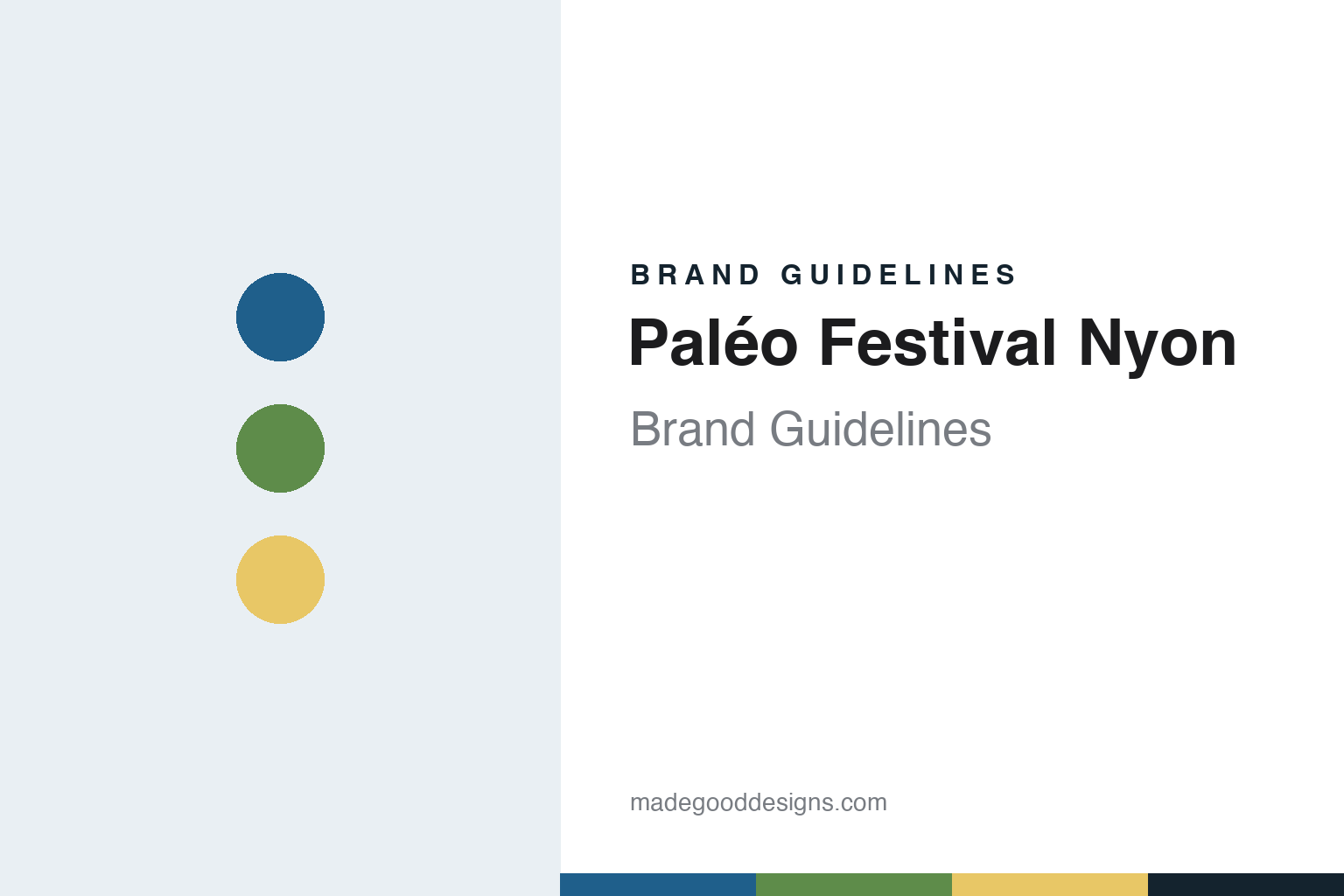
Paléo Festival Nyon Brand Guidelines
The lakeside folk club that became a six-day festival.
Aa
Two constants: a lake blue, meadow green and straw palette and a rounded sans register. Abstract homage — not a Paléo Festival Nyon product or mark; no poster, logo or stage design is reproduced.
From folk club to the Plaine de l’Asse
A folk club, a municipal hall and a lake shore.
Paléo Festival Nyon grew out of a folk club in Nyon, a town on the shore of Lake Geneva in the Swiss canton of Vaud. French Wikipedia says its founder, Daniel Rossellat, organised his first concerts at nineteen while working as a socio-cultural youth worker, and set up the Folk Club de l’Escalier with a group of friends. That club became the association Paléo Arts & Spectacles. Sources differ on the date: French Wikipedia gives 1975 for the change in its article on Rossellat and 1974 for the association’s founding in its festival article, while the festival’s own history dates the creation of the Folk Club de l’Escalier to 1976. Le Temps, in April 2015, named Jacques Monnier as a co-founder of the festival and its chief programmer.
The first festival, the First Folk Festival, was held in 1976 in Nyon’s old municipal hall, the salle communale, before an audience of 1,800, according to French Wikipedia. In 1977 the event moved outdoors to Colovray, a site on the edge of the lake, and English Wikipedia says it ran there with two stages until 1989. It was known first as the Nyon Folk Festival, then as the Paléo Folk Festival and finally as Paléo Festival Nyon, the festival says; English Wikipedia dates the first Paléo name to 1986. By the end of the 1980s, the festival’s history says, it drew 90,000 people and 1,000 helpers, and lived with a recurring threat of having to leave the site.
In 1990 Paléo moved to the Plaine de l’Asse, north of Nyon, a move French Wikipedia links to property interests at Colovray. The larger ground let the festival grow to its present scale. For the twentieth anniversary in 1995, French Wikipedia says, more than 200,000 people came, the site was enlarged to 100,000 square metres and a fourth stage, the Dôme, was added. The festival says that during the 1990s it reached the site’s capacity of 200,000 and, for the first time, had to turn people away at the gate. In 2015 Le Temps reported that the ground was rented from a farmer.
Colour
Six days, six stages and a village for the world.
Paléo runs for six days at the end of July, usually from Tuesday to Sunday. French Wikipedia describes six stages. The Grande Scène holds an audience of 35,000; Véga, an open-air stage for 20,000, also takes headliners; the Dôme is a covered tent for 3,500; the Club Tent holds 2,500 and is used for newer acts, many from the Swiss scene; Belleville, opened in 2022 for electronic music, holds up to 5,000; and La Ruche hosts circus and street-arts companies in residence. English Wikipedia adds that the last main-stage concert of each edition is preceded by a fireworks display set to music, and French Wikipedia counts about 150 food stands, some fifty bars and a free campsite with 9,000 places.
The festival began as a folk event and widened its range over time. English Wikipedia says the Village du Monde, introduced in 2003, gives part of the site to one invited region of the world each year, with its own food and with acts from that region on the Dôme stage; Africa was the first guest. Later themes listed by French Wikipedia include India in 2009, the Caribbean in 2011, the Andes in 2014 and Québec in 2019. The festival also names La Ruche and a collaboration with the HES-SO, the university of applied sciences of western Switzerland, among the additions of the years after 2000.
In 2015 the 40th edition ran for seven days, from 20 to 26 July. Le Temps reported a bill that included Joan Baez and Robert Plant, and recalled that Baez had once written to Rossellat by hand to ask to play his folk festival in Nyon.
French Wikipedia records that the 2020 edition was cancelled, and that the 2021 edition, named “45e Parallèle”, did not take place either. Paléo returned with its 45th edition from 19 to 24 July 2022, on a site whose layout had changed because a rail depot was being built at its edge, French Wikipedia says; the festival describes a completely rethought site plan from that year. The 48th edition ran from 22 to 27 July 2025.
The 49th edition opened on 21 July 2026. Keystone-SDA, in a report carried by blue News on 20 July 2026, said about 250,000 visitors were expected at the Plaine de l’Asse, with about 5,400 volunteers, more than 200 concerts and performances and around 100 artists from nearly 30 countries. The bill included Lorde, and that year’s Village du Monde was given over to the Nordic countries, laid out as a stylised Scandinavian village with fjord landscapes and fishing villages.
Typography
Design and documentation.
A music festival’s identity is built from a few public pieces: its name, its logo, the poster that announces each year’s line-up, the wristband or ticket that gets a visitor through the gate, and the signs and stage names on site. Many festivals take their names from a place, a park or a town, and keep them for decades; Reading Festival has been tied to Richfield Avenue in Reading since 1971, and Download Festival to Donington Park since 2003. Some names have carried a sponsor for a time, as the Reading and Leeds events did when they were billed as the Carling Weekend from 1998 to 2007.
Line-up posters are the most repeated graphic of a festival year. They list the acts in tiers, with the headliners at the top, and are revised as new names are added in waves. Stage names work as a second layer of branding: festivals name stages after sponsors, broadcasters, genres or invented themes, and rename them when a site is redesigned, as Reading and Leeds did in 2026 when the Main Stage became the Grid.
Mascots and recurring characters give some festivals a mark that travels beyond the logo. Download’s dog mascot appears on tickets, stage banners, merchandise and the festival website, according to English Wikipedia. Other festivals rely on a consistent colour, a wordmark or a site landmark instead.
Ownership is part of the picture, and it is usually set out plainly on corporate pages and in the trade press. Some festivals are run by small independent teams; others belong to promoters and groups such as Festival Republic and Live Nation, whose own pages describe their founders, organisers and history. This guide sets out what dated sources say about each festival’s founding, sites and organisers, and marks clearly what rests only on the organisers’ own word.
Aa
A rounded sans for a lakeside festival. (Specimen set in Nunito, a sans STAND-IN; NOT the Paléo Festival Nyon logo.)
Paléo Festival Nyon
An association, not a promoter.
Paléo is not owned by a concert promoter. It is run by Paléo Arts & Spectacles, which French Wikipedia describes as a non-profit cultural association based in Nyon. The festival says the association has about 150 active members and looks after long-term strategy through its general assembly, committee and governance council. Day-to-day running sits with the Comité d’Organisation du Festival, about 120 people, volunteers and employees, whose decisions are taken collegially, and with a permanent office of about 50 staff, the festival says. Le Temps gave the same order of figures in 2015: 50 employees for 5,000 volunteers. Rossellat was still described as the festival’s president in July 2026, and Keystone-SDA named Dany Hassenstein as its programme director. Le Temps also reported in 2015 that, through the agency Opus, the festival looks after a considerable share of the concerts held in its region.
The festival says it founded and co-finances the FCMA, a foundation for song and contemporary music in French-speaking Switzerland, and that it is a member of the Swiss Music Promoters Association and of Yourope, the European festival association. It describes a network of more than 30 sponsors and more than 100 businesses that it works with through the year.
The clearest documented design story is the Belleville stage. Keystone-SDA reported in July 2026 that the warm colour tones it had used since 2022 had been replaced by a minimalist design inspired by crystal structures, with references to the Greek goddess Iris and new LED screens; the project manager said the petals had given way to diamonds. The Village du Monde gives the site a second visual theme that changes every summer. The official website sits at yeah.paleo.ch, to which paleo.ch redirects.
For a design guide, Paléo Festival Nyon shows how a festival can build its identity from a place and a community of volunteers rather than from a promoter’s brand. Compare Montreux Jazz Festival, another festival in the canton of Vaud, and Roskilde Festival, the Danish summer festival. For this guide we use a lake blue, a meadow green and a warm straw with a rounded sans, an unofficial interpretation; no product or logo is reproduced.
Explore & save
Keep Paléo Festival Nyon’s identity on hand — save it to a board in the Made Good inspiration library.
Paléo Festival Nyon identity set
Pin the Paléo Festival Nyon lake blue, meadow green and straw palette and the rounded sans register to your own board.
Source & notes
Frequently Asked Questions
What font can I use to match the Paléo Festival Nyon look?
This guide describes Paléo Festival Nyon’s type as “A rounded sans for a lakeside festival”. Its type specimen is set in Nunito from Google Fonts as a stand-in; Nunito is not Paléo Festival Nyon’s own lettering.
What colours are in the Paléo Festival Nyon palette?
This guide’s Paléo Festival Nyon palette is Lake blue #1F5F8B, Night ink #14232E, Meadow green #5E8C4A, Straw #E8C766 and Paper #F6F3EA. The tones are the guide’s own unofficial interpretation, not official Paléo Festival Nyon hex codes.
When was Paléo Festival Nyon founded?
Paléo Festival Nyon was founded in 1976 (First Folk Festival), in Nyon, Switzerland.
Who founded Paléo Festival Nyon?
Paléo Festival Nyon was founded by Daniel Rossellat and friends in 1976 (First Folk Festival).