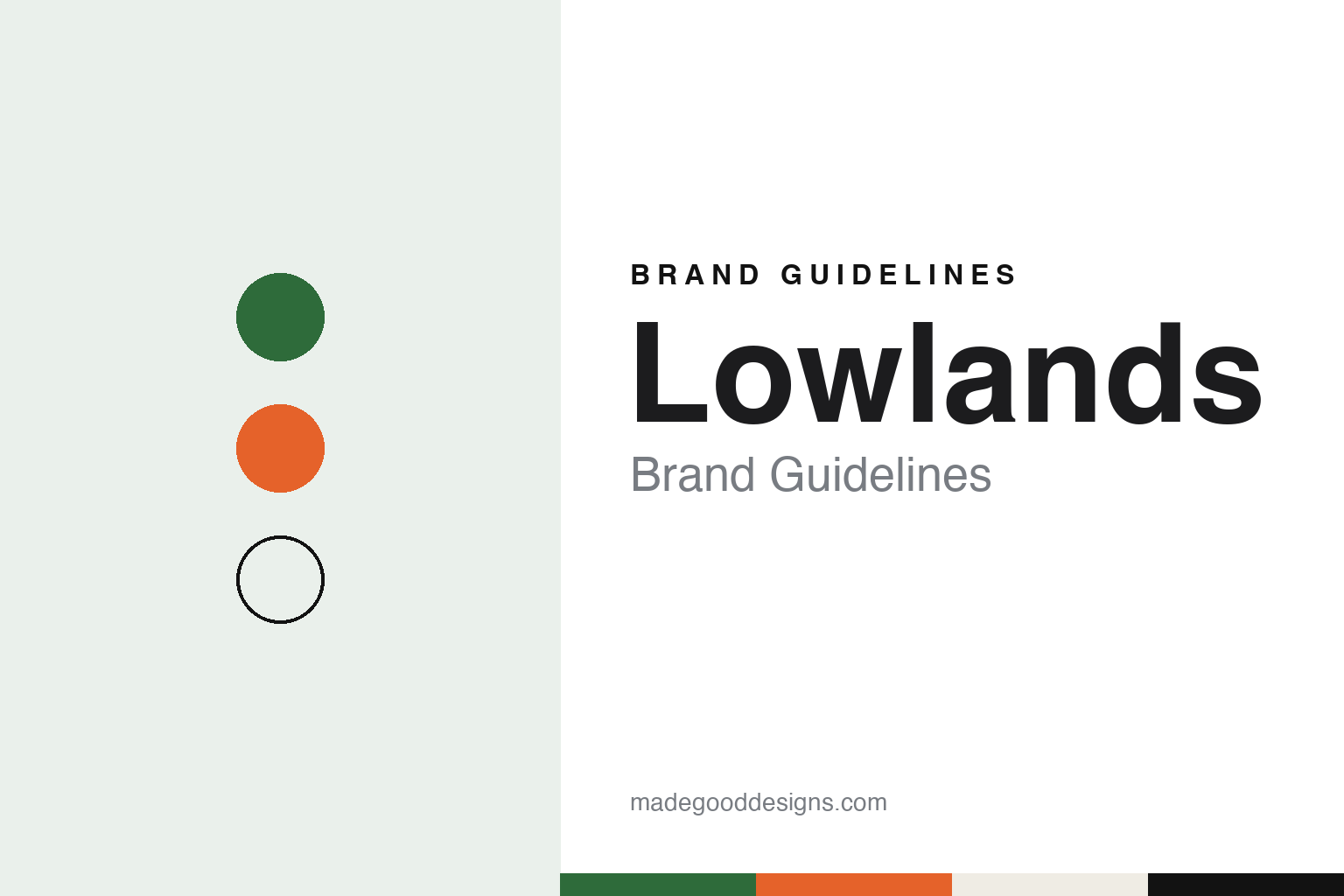
Lowlands Brand Guidelines
The Dutch festival with stages named Alpha, Bravo and Charlie.
Aa
Two constants: a polder green, signal orange and ink palette and a condensed sans register. Abstract homage — not a Lowlands product or mark; no poster, mascot, logo or pattern is reproduced.
A Campingflight to Lowlands Paradise
A 1960s happening, revived in a polder.
Lowlands takes its full name, A Campingflight to Lowlands Paradise, from a 1960s happening. Dutch Wikipedia says the Utrecht painter Bunk Bessels organised A Flight to Lowlands Paradise in November 1967 in the Margriethal of the Jaarbeurs in Utrecht: an 18-hour event with experimental theatre, dance, poets, films, body painting and liquid light slides. A second edition followed on 28 December 1968, with Pink Floyd on the bill, and reached its capacity of 18,000, according to the same source.
The present festival began in August 1993. Dutch Wikipedia describes it as a joint venture of the booking agency Mojo Concerts and the events organiser Loc7000, and says Mojo started Lowlands as a counterpart to festivals such as Pinkpop and Dynamo Open Air, with room for more alternative music. Its forerunner was Ein Abend in Wien, a two-day indoor festival at De Doelen in Rotterdam with a strong theatrical setting. English Wikipedia credits Willem Venema with reviving the concept and says the first edition, with one small and one larger stage tent, drew about 7,000 people against a target of 10,000. It also notes that Lowlands falls on the same weekend as Pukkelpop in Belgium and Reading in England, which helped it book American bands on tour. The organisers count 1993 as the first official edition.
Lowlands has been held every August since at the Walibi Holland events ground in Biddinghuizen, in the province of Flevoland. English Wikipedia records attendance rising to 12,500 in 1994, to 20,000 in 1995, when the festival sold out for the first time, to 31,000 in 1996 and to about 58,000 in 1999. In 1998, to make room, the festival built a bridge over the trunk road beside the site and moved the campsite to the other side. Eric van Eerdenburg became festival director in 2000, Dutch Wikipedia says, and under him the programme moved further into science and literature, with strands such as Lowlands University. In 2005, English Wikipedia says, the festival moved from the last to the third weekend of August.
Colour
Alpha, Bravo, Charlie.
Much of Lowlands’ identity sits in its stages. From 1994, English Wikipedia says, the tents were named after the NATO phonetic alphabet, Alpha, Bravo and Charlie at first, a system that has lasted ever since, with the exception of one stage named after the beer sponsor; Heineken has held that name since 2015, after Dommelsch and Grolsch. Most stages are large tents, the biggest roughly the size of a football pitch. Over the years the site added a theatre tent, Delta, and a comedy tent, Echo, in 1995; a medium-sized tent, India, in 1999; and in 2006 the X-ray, a corrugated-steel dome for experimental acts.
The programme is broader than music. English Wikipedia lists indoor and outdoor cinema, street theatre, cabaret, stand-up comedy, ballet, literature and comic strips alongside rock, pop, dance, hip hop and alternative music. The festival itself describes a temporary township of 65,000 people over three days, with twelve stages in three large areas, about 250 acts and performances, its own currency, a local radio station and a daily newspaper in Dutch. Its website also lists a science strand, LL Science.
The visual identity has had two long authors. Dutch Wikipedia says the graphic designer Peter te Bos, also the singer of the Amsterdam band Claw Boys Claw, worked on Lowlands from 1994 to 2016, including its website and the dressing of the site; English Wikipedia credits him with the festival’s visual style and its mascot, Rapid Razor Bob, which stayed central to the identity for more than twenty years. Since 2017 the graphic design has been in the hands of Hansje van Halem, an Amsterdam graphic and type designer whose work, English Wikipedia says, is built on geometric, repetitive and sometimes almost psychedelic patterns that play at the edge of legibility, with background and type treated as one layer. As head designer she works with the festival’s programmers and with animators, according to the same article.
Typography
Design and documentation.
A music festival’s identity is built from a few public pieces: its name, its logo, the poster that announces each year’s line-up, the wristband or ticket that gets a visitor through the gate, and the signs and stage names on site. Many festivals take their names from a place, a park or a town, and keep them for decades; Reading Festival has been tied to Richfield Avenue in Reading since 1971, and Download Festival to Donington Park since 2003. Some names have carried a sponsor for a time, as the Reading and Leeds events did when they were billed as the Carling Weekend from 1998 to 2007.
Line-up posters are the most repeated graphic of a festival year. They list the acts in tiers, with the headliners at the top, and are revised as new names are added in waves. Stage names work as a second layer of branding: festivals name stages after sponsors, broadcasters, genres or invented themes, and rename them when a site is redesigned, as Reading and Leeds did in 2026 when the Main Stage became the Grid.
Mascots and recurring characters give some festivals a mark that travels beyond the logo. Download’s dog mascot appears on tickets, stage banners, merchandise and the festival website, according to English Wikipedia. Other festivals rely on a consistent colour, a wordmark or a site landmark instead.
Ownership is part of the picture, and it is usually set out plainly on corporate pages and in the trade press. Some festivals are run by small independent teams; others belong to promoters and groups such as Festival Republic and Live Nation, whose own pages describe their founders, organisers and history. This guide sets out what dated sources say about each festival’s founding, sites and organisers, and marks clearly what rests only on the organisers’ own word.
Aa
A condensed sans for tent signs and timetables. (Specimen set in Barlow Condensed, a sans STAND-IN; NOT the Lowlands logo.)
Lowlands
A Mojo festival inside Live Nation.
Lowlands is organised by Mojo Concerts, as NOS reported in February 2026. Dutch Wikipedia says Mojo was founded in 1968 by Berry Visser, who had been booking singer-songwriters at a Delft student society; the company was run from Delft for 55 years and moved its head office to Amsterdam at the start of 2024. Mojo was taken over by SFX in 1999; SFX became part of Clear Channel Entertainment in 2001, and that group’s concert business was spun off in 2006 under the name Live Nation, the same source says. Besides Lowlands, Dutch Wikipedia lists Mojo events such as the North Sea Jazz Festival and Down The Rabbit Hole.
The festival has also changed hands at the top. In December 2024 an article by the editor of DIY, written for the ESNS conference, reported that Van Eerdenburg had decided to step down after 25 years as festival director, and that Mojo’s festival project manager Camiel le Rutte, who had worked at the Melkweg in Amsterdam for twelve years, would succeed him after shadowing him across two editions. NOS reported on 17 February 2026 that Le Rutte had taken over and, citing an interview with de Volkskrant, that he intended to book more alternative artists; it named Tyler, the Creator and Lorde among the first acts confirmed for that year.
Lowlands was not held in 2020 or 2021, Dutch Wikipedia says. It returned in 2022 with 60,000 tickets, NOS reported. The 2026 edition took place on 21, 22 and 23 August 2026 at the Walibi Holland events ground, according to the festival.
For a design guide, Lowlands shows how a festival can hold its identity through a system rather than a single logo: stage names taken from the phonetic alphabet, a long-running mascot and, since 2017, a pattern-led graphic language. Compare Reading Festival, which shares its August weekend, and Download Festival. For this guide we use a polder green, a signal orange and an ink black with a condensed sans, an unofficial interpretation; no product or logo is reproduced.
Explore & save
Keep Lowlands’s identity on hand — save it to a board in the Made Good inspiration library.
Lowlands identity set
Pin the Lowlands polder green, signal orange and ink palette and the condensed sans register to your own board.
Source & notes
Frequently Asked Questions
What font can I use to match the Lowlands look?
This guide describes Lowlands’ type as “A condensed sans for tent signs and timetables”. Its type specimen is set in Barlow Condensed from Google Fonts as a stand-in; Barlow Condensed is not Lowlands’ own lettering.
What colours are in the Lowlands palette?
This guide’s Lowlands palette is Polder green #2E6B3A, Ink black #121212, Signal orange #E5622A, Tent canvas #EFECE4 and Field grey #8A8F87. The tones are the guide’s own unofficial interpretation, not official Lowlands hex codes.
When was Lowlands founded?
Lowlands was founded in 1993 (roots in 1967), in Biddinghuizen, Netherlands.