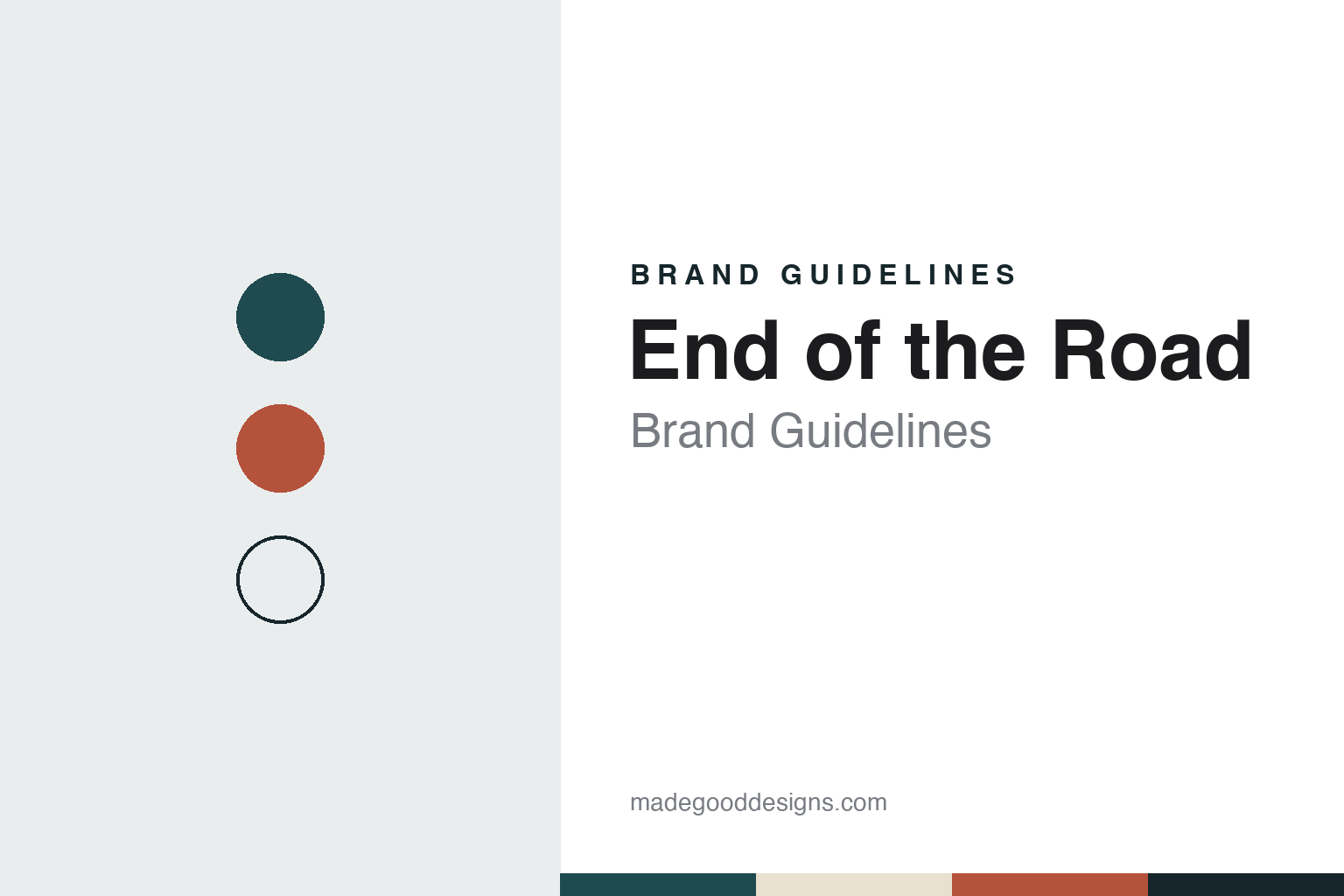
End of the Road Brand Guidelines
The independent festival in a Victorian pleasure garden on the Dorset and Wiltshire border.
Aa
Two constants: a teal, brick rose and cream palette and a plain grotesque register. Abstract homage — not an End of the Road asset or mark; no logo, poster or stage is reproduced.
Larmer Tree
A builder, a friend and a garden that said yes.
End of the Road was first held in September 2006 at the Larmer Tree Gardens, on the border of north Dorset and Wiltshire. English Wikipedia names its founders as Simon Taffe and his friend Sofia Hagberg. Taffe described the start in a first-person article in The Guardian in August 2024. He had run a building and decorating business, and he wrote that the idea came at the festival All Tomorrow’s Parties in 2001, where the line-up was curated by bands and artists.
The planning began in earnest after another small festival in 2004, Taffe wrote, when he spent two weeks calling security firms and toilet-hire companies. Stately homes and wedding venues turned the idea down; an internet search for a festival site to rent turned up only Larmer Tree, which agreed on condition that the festival obtained a licence. Taffe wrote that he contacted bands through Myspace, that the record shop Rough Trade helped with contacts, and that his friend Sofia helped make contact with artists, including at the South by Southwest festival in Texas.
The gardens themselves have a long history as a public venue. English Wikipedia says the landowner Augustus Pitt Rivers created them in 1880 as pleasure grounds for “public enlightenment and entertainment”, near Tollard Royal on the Rushmore Estate in Cranborne Chase, and that the 11-acre gardens are Grade II* listed. That Victorian setting, with its lawns, buildings and woodland, is the frame for everything the festival does.
The festival grew steadily rather than suddenly. English Wikipedia says it sold out for the first time in 2008 and has sold out in advance every year since, and gives its capacity as 15,000 in 2014. In 2016 the festival expanded to the Thursday night for the first time, the same source says, and it now runs from Thursday evening to Sunday.
Colour
Named stages in a garden.
End of the Road is independent, and its own website names the people who run it. It lists Simon Taffe as director and curator and Lauren Down as managing director, and records that co-founder Sofia Genders, née Hagberg, retired as a director in February 2015. Loud and Quiet described Taffe in 2021 as the festival’s co-founder and director. English Wikipedia says he continued to run the festival as of 2024.
The festival is built around named stages spread through the gardens. English Wikipedia lists six: the Woods Stage, the Garden Stage, the Big Top, the Folly, The Boat and the Talking Heads tent. It also describes a clearing in the woods near the Garden Stage with a piano, where unannounced sets take place, along with children’s areas, a film tent, comedy, a library in the forest and a games area. Peacocks live in the gardens, and both English Wikipedia and the organisers’ own 2020 statement, quoted by NME, mention them.
The line-up follows a pattern. Speaking to Loud and Quiet in 2021, Taffe described the festival’s remit as indie names at the top of the bill, a mix of veterans and new bands on the undercard, and plenty of room for emerging artists lower down. English Wikipedia describes the festival’s focus as independent rock and folk music. Late-night programming usually includes DJ sets, a silent disco, unannounced pop-up performances and karaoke, the same source says.
The festival’s place in the calendar is fixed too. It usually takes place over the last weekend of August or the first full weekend of September, English Wikipedia says, near the end of the British festival summer.
Typography
How festivals present themselves.
A music festival’s identity is built from a few public pieces: its name, its logo, the poster that announces each year’s line-up, the wristband or ticket that gets a visitor through the gate, and the signs and stage names on site. Many festivals take their names from a place, a park or a town, and keep them for decades; Reading Festival has been tied to Richfield Avenue in Reading since 1971, and Download Festival to Donington Park since 2003. Some names have carried a sponsor for a time, as the Reading and Leeds events did when they were billed as the Carling Weekend from 1998 to 2007.
Line-up posters are the most repeated graphic of a festival year. They list the acts in tiers, with the headliners at the top, and are revised as new names are added in waves. Stage names work as a second layer of branding: festivals name stages after sponsors, broadcasters, genres or invented themes, and rename them when a site is redesigned, as Reading and Leeds did in 2026 when the Main Stage became the Grid.
Mascots and recurring characters give some festivals a mark that travels beyond the logo. Download’s dog mascot appears on tickets, stage banners, merchandise and the festival website, according to English Wikipedia. Other festivals rely on a consistent colour, a wordmark or a site landmark instead.
Ownership is part of the picture, and it is usually set out plainly on corporate pages and in the trade press. Some festivals are run by small independent teams; others belong to promoters and groups such as Festival Republic and Live Nation, whose own pages describe their founders, organisers and history. This guide sets out what dated sources say about each festival’s founding, sites and organisers, and marks clearly what rests only on the organisers’ own word.
Aa
A plain, sturdy grotesque for a festival that keeps its stage names simple. (Specimen set in Archivo, a sans STAND-IN; NOT the End of the Road logo.)
End of the Road
A fallow year, then a return.
The festival has missed one year. On 20 May 2020 the organisers announced that the 2020 festival, due from 3 to 6 September and set to mark its fifteenth year, would not go ahead and was postponed to 2021, NME reported. Ticket holders could carry their tickets forward to the next year, and several of the booked acts, including Little Simz, moved their bookings to 2021.
The festival returned from 2 to 5 September 2021. Loud and Quiet reported that Taffe had to rebook that year’s line-up three times, and that the bill included Jonny Greenwood performing his film scores with 12 Ensemble and Kat Tinker, as well as Sleaford Mods and Arab Strap. Taffe told the magazine that the period had brought independent festival organisers closer together, naming the team at Green Man.
Since then the festival has kept to its late-summer slot at Larmer Tree. English Wikipedia gives the dates as 1 to 4 September in 2022, 31 August to 3 September in 2023, 29 August to 1 September in 2024, 28 to 31 August in 2025 and 3 to 6 September in 2026. The 2024 dates match those given at the end of Taffe’s Guardian article.
For designers, the material is the garden and its names. The stage names describe places — woods, garden, folly, boat — and the recurring details in the coverage are the lawns and woodland of a Victorian pleasure ground, the piano in the clearing and the peacocks.
For a design guide, End of the Road shows how a festival can draw an identity from a historic garden and a small set of plainly named stages. Compare Green Man, an independent festival in a Welsh park, and Glastonbury Festival, a much larger English festival. For this guide we use a peacock teal, brick rose and cream with a sans, an unofficial interpretation; no product or logo is reproduced.
Explore & save
Keep End of the Road’s identity on hand — save it to a board in the Made Good inspiration library.
End of the Road identity set
Pin the End of the Road teal, brick rose and cream palette and the plain grotesque register to your own board.
Source & notes
Frequently Asked Questions
What font can I use to match the End of the Road look?
This guide describes End of the Road’s type as “A plain, sturdy grotesque for a festival that keeps its stage names simple”. Its type specimen is set in Archivo from Google Fonts as a stand-in; Archivo is not End of the Road’s own lettering.
What colours are in the End of the Road palette?
This guide’s End of the Road palette is Peacock teal #1F4A4F, Night garden #16262B, Lawn cream #E9E1CF, Brick rose #B5523B and Linen #F7F4EC. The tones are the guide’s own unofficial interpretation, not official End of the Road hex codes.
Who founded End of the Road?
End of the Road was founded by Simon Taffe and Sofia Hagberg.