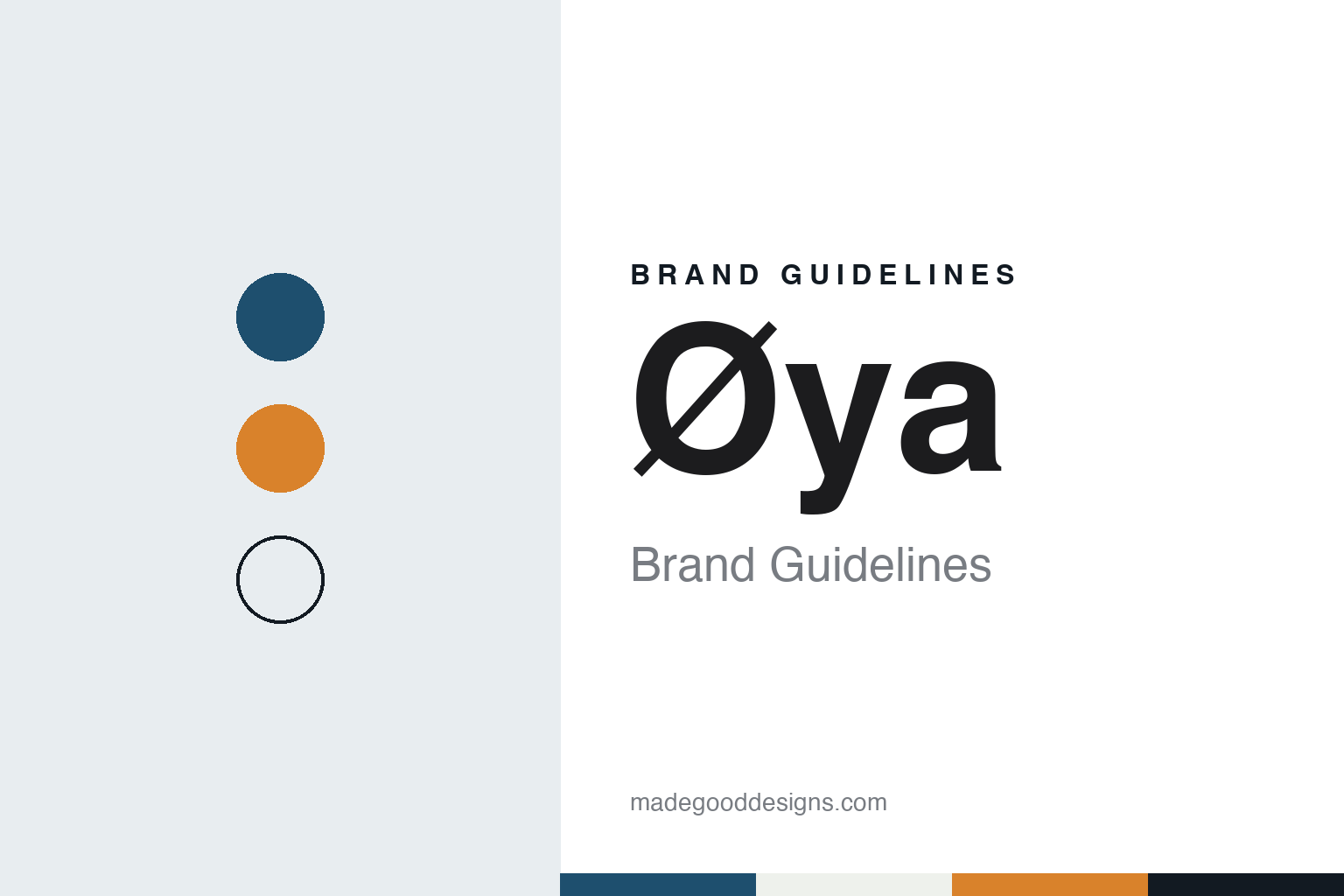
Øya Brand Guidelines
The Oslo festival named after the island where it began.
Aa
Two constants: a fjord blue, pale birch and summer orange palette and a soft serif register. Abstract homage — not an Øya mark; no logo, poster or wristband is reproduced.
From the island to the city
A club scene starts a festival outside Oslo.
Øyafestivalen, usually called simply Øya, began in 1999. Norwegian Wikipedia says it was started by people around the Oslo clubs Paragrafen, So What!, Last Train and Betong at Chateau Neuf, and that it drew about 1,000 visitors in its first year. For its first two years the festival was held on Kalvøya, an island in Bærum near Sandvika, just outside Oslo, and Norwegian Wikipedia says the name comes from there. English Wikipedia notes that it is not the same festival as the older Kalvøyafestivalen, which had also used the island.
In 2001 the festival moved into central Oslo, to Middelalderparken, the city’s medieval park. English Wikipedia says the move made it more of a central festival. By 2007 Pollstar described Øya as a 12,500-capacity outdoor festival at Middelalderparken, and reported that the organisers of a new Swedish festival, Way Out West, had picked the same August weekend and were discussing with Øya how the two might coordinate their booking.
The park set limits. In August 2013 Pollstar reported 16,000 people a day at Middelalderparken, but quoted the promoter Claes Olsen as saying that the festival could not dig into the ground or sink posts into it because of restrictions on the historic site, and that he had spent a year looking for a new home. The new site, the magazine said, was Tøyenparken, almost twice the size and about a fifteen-minute walk away. English Wikipedia adds that construction work made it impossible to keep using Middelalderparken.
Øya moved in 2014. Pollstar reported that August that the festival had sold out for thirteen years in a row and that Olsen had been eyeing Tøyenparken for a number of years. The main task, he said, had been closing a major street with a bus route for a week, so that two adjoining parks became one area, with the Munch Museum and the botanical gardens on one side and an amphitheatre park on the other. The new site was 50 per cent bigger, but the festival sold only 500 more tickets a day, Olsen said, to give the audience more space.
Colour
Club nights, a children’s festival and volunteers.
The festival runs over several days in August. Norwegian Wikipedia describes one club day followed by four days in the park, with more than 280 artists from Norway and abroad, and calls the concerts held in clubs and venues around Oslo in partnership with the festival Øyanatt. English Wikipedia likewise says the festival lasts four days in the main park area and is preceded by a club night in more or less all of Oslo’s central clubs. Children have their own event: Pollstar reported in 2014 that Øya had for three years used one of the Tøyen parks for Miniøya, the children’s festival it runs each year.
Its bills mix Norwegian and international acts. Pollstar listed Blur, The Knife and Tame Impala among the acts at the last Middelalderparken edition, in August 2013. A Dagbladet photograph caption from 2021 recalls Arcade Fire playing the stage called Amfiet, the amphitheatre, at the 2018 festival.
The festival depends on volunteers. In August 2018 News in English, an Oslo-based English-language news site, reported more than 15,000 paying ticket holders a day and nearly 3,000 volunteers who received free festival passes. Writing in BI Business Review the same month, Audun Molde of BI Norwegian Business School put the number of young volunteers working unpaid at more than 2,700, and said Øya would need to renew itself while keeping the identity that made both audiences and volunteers queue to take part.
Two summers were lost. Øya was not held in 2020, and on 7 May 2021 Dagbladet reported that it had been cancelled for a second year in a row, quoting the managing director, Tonje Kaada; ticket holders for 2020 and 2021 were offered a refund or a transfer to the next festival. English Wikipedia also records that the festival was not arranged in 2020 or 2021. Norwegian Wikipedia describes it today as an annual festival held each August in Tøyenparken.
Typography
How music festivals present themselves.
A music festival’s identity is built from a few public pieces: its name, its logo, the poster that announces each year’s line-up, the wristband or ticket that gets a visitor through the gate, and the signs and stage names on site. Many festivals take their names from a place, a park or a town, and keep them for decades; Reading Festival has been tied to Richfield Avenue in Reading since 1971, and Download Festival to Donington Park since 2003. Some names have carried a sponsor for a time, as the Reading and Leeds events did when they were billed as the Carling Weekend from 1998 to 2007.
Line-up posters are the most repeated graphic of a festival year. They list the acts in tiers, with the headliners at the top, and are revised as new names are added in waves. Stage names work as a second layer of branding: festivals name stages after sponsors, broadcasters, genres or invented themes, and rename them when a site is redesigned, as Reading and Leeds did in 2026 when the Main Stage became the Grid.
Mascots and recurring characters give some festivals a mark that travels beyond the logo. Download’s dog mascot appears on tickets, stage banners, merchandise and the festival website, according to English Wikipedia. Other festivals rely on a consistent colour, a wordmark or a site landmark instead.
Ownership is part of the picture, and it is usually set out plainly on corporate pages and in the trade press. Some festivals are run by small independent teams; others belong to promoters and groups such as Festival Republic and Live Nation, whose own pages describe their founders, organisers and history. This guide sets out what dated sources say about each festival’s founding, sites and organisers, and marks clearly what rests only on the organisers’ own word.
Aa
A soft serif for a park festival named after an island. (Specimen set in Fraunces, a serif STAND-IN; NOT the Øya logo.)
Øya
From five owners to a festival group.
For almost two decades Øya was owned by the people who ran it. Molde wrote in BI Business Review in August 2018 that it had in practice been run for some twenty years by the same group of friends, with five private individuals as owners. That changed as the 2018 festival opened. News in English reported on 9 August 2018 that the US fund Providence Equity Partners had bought Øyafestivalen through its Superstruct Entertainment group, for an undisclosed amount. It quoted Claes Olsen, an owner, founder and booking chief, as saying that he and his four partners had a management agreement that “gives us full control over operations,” and reported that Olsen and the co-founder Linn Lunder said the festival would remain a Norwegian company, run by the same management and with the same profile. The founders, the site added, had taken stakes in Superstruct.
Ownership moved again in 2024. CMU reported on 24 June 2024 that the investment firm KKR had acquired Superstruct from Providence for an undisclosed sum, and Music Week said Superstruct had been established by Providence in 2017, listing Sziget and Sónar among its festivals. Norwegian Wikipedia likewise records the 2018 sale to Superstruct and the 2024 sale of Superstruct to KKR.
Øya’s identity rests as much on its places as on any mark. Its name keeps the island where it began, and its history runs through three sites: Kalvøya, the medieval park and Tøyenparken, where, as Olsen described it in 2014, a closed street joins two parks into one festival ground.
For a design guide, Øya shows how a festival can keep a name taken from a place it left long ago. Compare Way Out West, the Gothenburg festival that launched on Øya’s weekend in 2007, and Sziget, another festival in the Superstruct group. For this guide we use a fjord blue, a pale birch and a summer orange with a serif, an unofficial interpretation; no product or logo is reproduced.
Explore & save
Keep Øya’s identity on hand — save it to a board in the Made Good inspiration library.
Øya identity set
Pin the Øya fjord blue, pale birch and summer orange palette and the soft serif register to your own board.
Source & notes
Frequently Asked Questions
What font can I use to match the Øya look?
This guide describes Øya’s type as “A soft serif for a park festival named after an island”. Its type specimen is set in Fraunces from Google Fonts as a stand-in; Fraunces is not Øya’s own lettering.
What colours are in the Øya palette?
This guide’s Øya palette is Fjord blue #1E4F6E, Ink #121A22, Pale birch #EEF1EC, Summer orange #D9822B and Paper #F9F8F4. The tones are the guide’s own unofficial interpretation, not official Øya hex codes.
When was Øya founded?
Øya was founded in 1999, in Kalvøya, Bærum, near Oslo.
Who founded Øya?
Øya was founded by People around the Oslo clubs Paragrafen, So What!, Last Train and Betong in 1999.
Who owns Øya?
Øya today: Øyafestivalen, Oslo; part of Superstruct Entertainment since 2018.