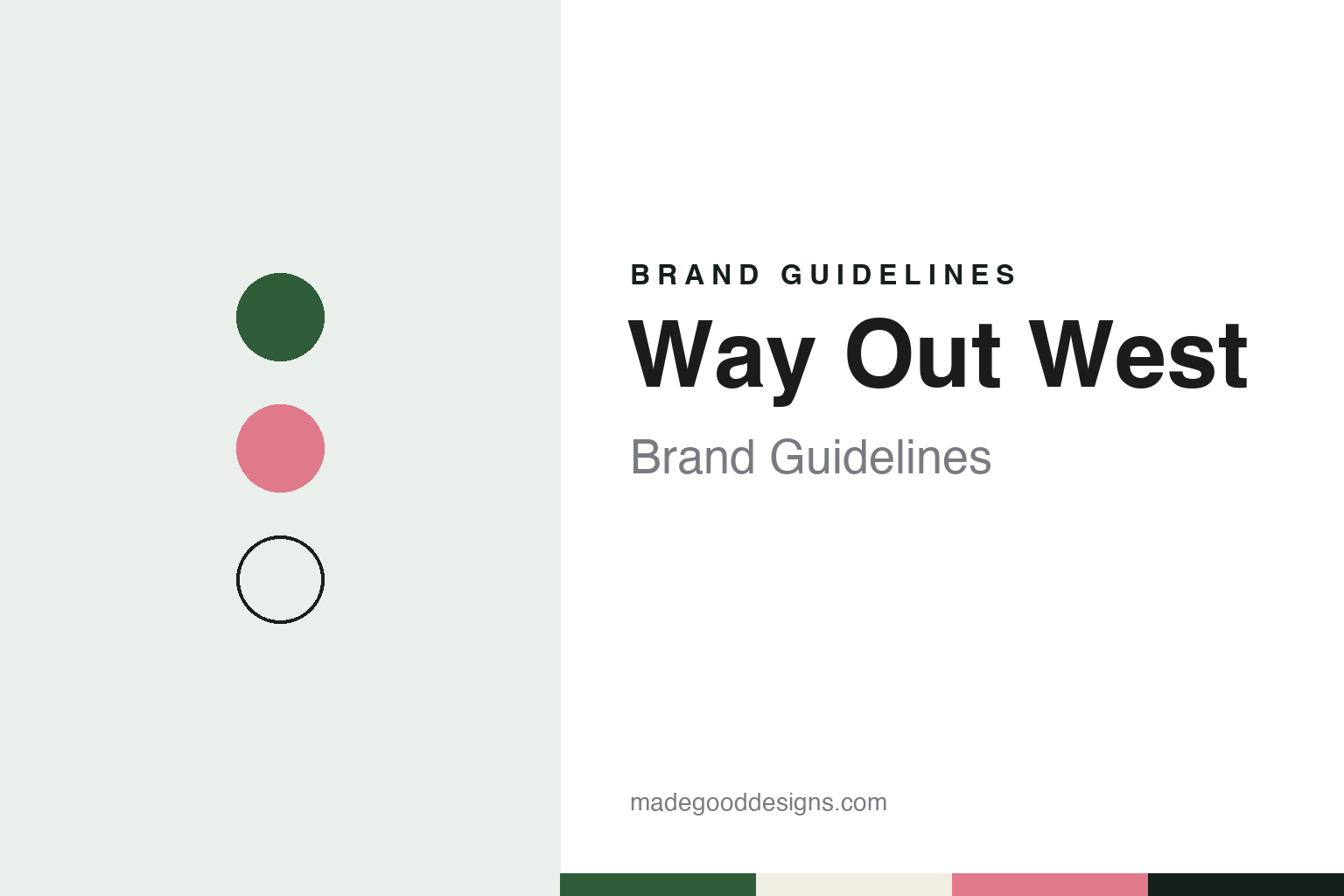
Way Out West Brand Guidelines
The Gothenburg park festival Luger launched in 2007.
Aa
Two constants: a park green, birch white and flamingo pink palette and a grotesque sans register. Abstract homage — not a Way Out West mark; no logo, poster or wristband is reproduced.
A festival in the city
A promoter sees room for an urban festival.
Way Out West was started in 2007 by Luger, a Swedish booking agency and concert promoter, in Slottsskogen, a large park in central Gothenburg. Pollstar reported in February 2007 that Luger’s Ola Broquist saw a gap beside Sweden’s big rural outdoor festivals, such as Hultsfred and Arvika: an event for a slightly older audience who no longer wanted to travel far and camp. The site, the magazine wrote, was in the city centre, no more than a fifteen-minute tram ride from the outskirts, and the idea was that visitors would see music by day and go on to Gothenburg’s nightclubs afterwards.
Broquist described the new event to Pollstar as a bigger step on from Accelerator, a touring festival Luger already ran in venues of up to 3,000 capacity in Stockholm, Gothenburg and Malmö, and said it would present the same style of bands. Swedish Wikipedia names Broquist, Patrick Fredriksson, Joel Borg and Niklas Lundell among the festival’s founders, and Pollstar reported in 2018 that Fredriksson had founded Way Out West together with Broquist.
The first edition was held on 10 and 11 August 2007. Luger had planned for a maximum of 10,000 people a day, Pollstar reported that month, but those tickets were gone weeks ahead, so 6,000 more were printed and they sold as well. The bill included The Hives and Primal Scream. A year later Pollstar put the second edition at about 22,000 people a day, and in August 2010 it reported that the festival had sold out for the fourth year in succession, with 25,000 a day in the park.
Luger itself is older than the festival. Pollstar reported in June 2008 that it had been formed with Backbeat Bolaget, a cultural organisation in Sandviken, that its founders Ola Broquist, Patrick Fredriksson and Morgan Johansson owned the whole company by 1997, and that the Swedish promoter EMA Telstar bought 49 per cent of it in 1998. Swedish Wikipedia dates Luger’s formation to 1991 and says it has been based in Stockholm since 1998.
Colour
Clubs, three days in the park and a meat-free menu.
The festival is built around a city rather than a campsite. From the start, the concerts in Slottsskogen ran alongside late-night shows in club venues around Gothenburg, now billed as Stay Out West. In 2010 Luger’s press officer Joel Borg told Pollstar that “the club concept is a crucial part of Way Out West and strengthens the urban feel of the festival,” and the magazine noted that the festival ran alongside Gothenburg’s annual cultural festival. Swedish Wikipedia lists early club stages such as Pustervik, Trädgår’n and Sticky Fingers, and later venues including Annedalskyrkan, a church, and Världskulturmuseet, the city’s museum of world culture.
The format grew in 2012. Beats Per Minute, reviewing the edition of 9 to 11 August, reported that Way Out West had expanded into a full three-day festival, and Swedish Wikipedia says it was the first edition with three evenings of concerts in the park. Billboard reported a sold-out crowd of 27,000 that year, with Kraftwerk among the headliners, and wrote that the park had hosted the festival since it began.
The same year brought the decision the festival has kept ever since. On the eve of the 2012 edition, Way Out West announced that all food served to staff, artists and visitors would be vegetarian, Channel 4 News reported in August 2014, quoting Luger’s Fredrik Holmstedt as saying that providing meat for so many people was the single biggest contribution to the festival’s carbon footprint. The Swedish public broadcaster SVT reported in August 2012 that the rule had applied to the menus in Slottsskogen, while some club venues in town still served meat; Broquist told SVT that the organisers had run out of time to extend it further. The festival says it has been completely meat free and largely dairy free since 2012.
Film is part of the programme too. Swedish Wikipedia says films have been shown at Way Out West since 2011, in cinemas around Gothenburg, and that in 2024 a cinema tent, Cinema Slottsskogen, was added inside the festival area. It also says the festival was cancelled in both 2020 and 2021 and returned to the park in 2022.
Typography
How music festivals present themselves.
A music festival’s identity is built from a few public pieces: its name, its logo, the poster that announces each year’s line-up, the wristband or ticket that gets a visitor through the gate, and the signs and stage names on site. Many festivals take their names from a place, a park or a town, and keep them for decades; Reading Festival has been tied to Richfield Avenue in Reading since 1971, and Download Festival to Donington Park since 2003. Some names have carried a sponsor for a time, as the Reading and Leeds events did when they were billed as the Carling Weekend from 1998 to 2007.
Line-up posters are the most repeated graphic of a festival year. They list the acts in tiers, with the headliners at the top, and are revised as new names are added in waves. Stage names work as a second layer of branding: festivals name stages after sponsors, broadcasters, genres or invented themes, and rename them when a site is redesigned, as Reading and Leeds did in 2026 when the Main Stage became the Grid.
Mascots and recurring characters give some festivals a mark that travels beyond the logo. Download’s dog mascot appears on tickets, stage banners, merchandise and the festival website, according to English Wikipedia. Other festivals rely on a consistent colour, a wordmark or a site landmark instead.
Ownership is part of the picture, and it is usually set out plainly on corporate pages and in the trade press. Some festivals are run by small independent teams; others belong to promoters and groups such as Festival Republic and Live Nation, whose own pages describe their founders, organisers and history. This guide sets out what dated sources say about each festival’s founding, sites and organisers, and marks clearly what rests only on the organisers’ own word.
Aa
A grotesque sans for a city-park festival. (Specimen set in Archivo, a sans STAND-IN; NOT the Way Out West logo.)
Way Out West
A Luger festival inside Live Nation.
Way Out West belongs, through Luger, to Live Nation. Pollstar reported on 17 June 2008 that Live Nation had bought the remaining 51 per cent of Luger, that the terms were not disclosed, and that Luger would stay in its Stockholm offices and continue to operate as a separate company. Swedish Wikipedia describes Luger as owned since 2008 by Live Nation Sweden and lists Way Out West among the festivals it arranges, alongside Åre Sessions and Lollapalooza Stockholm. The festival’s own website carries Luger’s privacy notice.
The city has been part of the arrangement. When Luger moved its Stockholm festival Where The Action Is to Gothenburg in 2011, Pollstar reported, Broquist said: “We’ve worked closely with the city of Gothenburg for many years with Way Out West.” The magazine added that the two festivals would use the same park with layouts arranged so that they did not share the same ground.
The festival presents its site through named stages and areas. Its food pages, read in November 2026, name Azalea and Flamingo as the two main stages and place food areas at Gläntan, by the entrance, at Lilla Dammen and at Höjden, a stage Swedish Wikipedia says was introduced in 2016. Its home page describes five stages running from early in the day to late evening, with the festival carrying on at night in venues across central Gothenburg, and a separate film strand.
For a design guide, Way Out West shows how a festival can take its identity from a city park and its clubs rather than a field and a campsite. Compare Øya, the Oslo festival that shared Way Out West’s August weekend in 2007, and Roskilde Festival, another Scandinavian summer festival. For this guide we use a park green, a birch white and a flamingo pink with a sans, an unofficial interpretation; no product or logo is reproduced.
Explore & save
Keep Way Out West’s identity on hand — save it to a board in the Made Good inspiration library.
Way Out West identity set
Pin the Way Out West park green, birch white and flamingo pink palette and the grotesque sans register to your own board.
Source & notes
Frequently Asked Questions
What font can I use to match the Way Out West look?
This guide describes Way Out West’s type as “A grotesque sans for a city-park festival”. Its type specimen is set in Archivo from Google Fonts as a stand-in; Archivo is not Way Out West’s own lettering.
What colours are in the Way Out West palette?
This guide’s Way Out West palette is Park green #2F5D3A, Ink #16201A, Birch white #F1EEE4, Flamingo pink #E07A8B and Paper #FAF8F3. The tones are the guide’s own unofficial interpretation, not official Way Out West hex codes.
When was Way Out West founded?
Way Out West was founded in August 2007, in Gothenburg, Sweden.
Who founded Way Out West?
Way Out West was founded in August 2007 by Luger, with Ola Broquist and Patrick Fredriksson.
Who owns Way Out West?
Way Out West today: Organised by Luger, owned by Live Nation since 2008.