Bernina Express Brand Guidelines
The Rhaetian Railway train from Chur to Tirano.
Aa
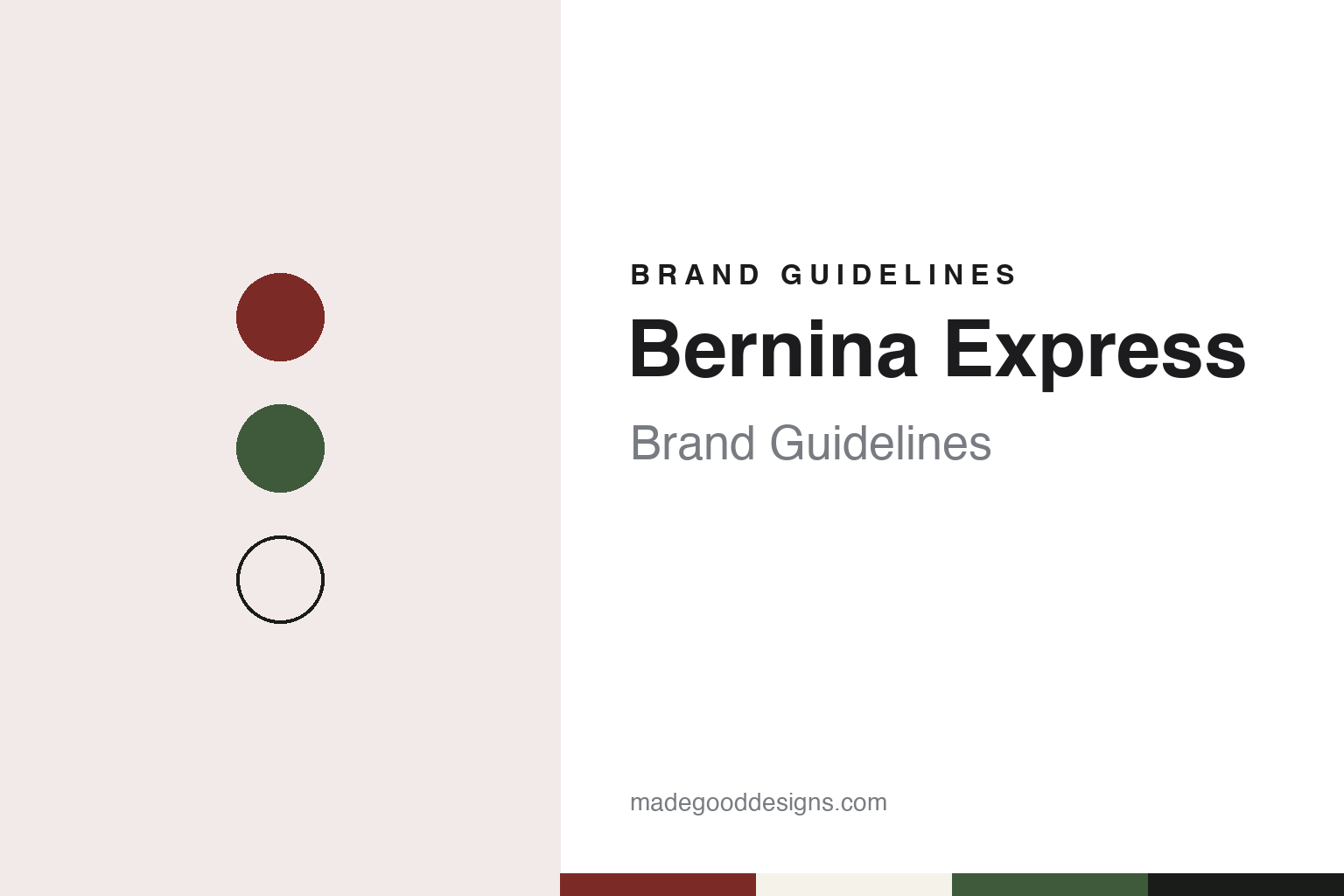
Two constants: a Bernina Express red, larch green and granite palette and an Alpine serif register. Abstract homage — not a Bernina Express product or mark; no train, logo or livery is reproduced.
Over the Bernina Pass
From Graubünden to the Valtellina.
The Bernina Express is the panoramic train of the Rhaetian Railway (RhB), the narrow-gauge network of the Swiss canton of Graubünden. It runs from Chur, and from St. Moritz, over the Bernina Pass to Tirano in Italy. RhB gives the journey as about four hours from Chur and about two hours and a quarter from St. Moritz, over 196 bridges and through 55 tunnels, past the Landwasser Viaduct, the Palü Glacier and the Brusio circular viaduct. Its own timeline dates the inauguration of the Bernina Express to 1973.
It is not the same subject as Bernina, the Swiss sewing-machine maker: the train takes its name from the pass and the Piz Bernina massif, which swissinfo.ch gave in 2010 as the highest peak in the Graubünden Alps at 4,049 metres.
The operator is older than the train by almost a century. RhB says the Schmalspurbahn Landquart–Davos AG was founded in February 1888, backed by the Dutchman Willem Jan Holsboer, and that its first train reached Klosters on 29 September 1889. The company took the name Rhaetian Railway on 12 February 1895, and in 1897 the canton acquired all its shares, so that, RhB says, the railway has since belonged to the canton of Graubünden. Its network today runs to 385 kilometres.
Colour
Two lines, one heritage listing.
The train runs over two historic lines. The Albula Line, from Thusis to St. Moritz, was completed in 1903, and the Bernina Line, from St. Moritz to Tirano, in 1910, swissinfo.ch reported in May 2010. The Bernina Line was built from 1906 to 1910 by a separate company; the paper dated its opening celebrations to 5 July 1910, the first time St. Moritz and Tirano were linked by rail, and noted that power for its trains came from the Campocologno hydroelectric plant. A rail link over the pass had first been proposed twelve years before that opening, the paper wrote, and by August 1910 almost 92,000 travellers had used it. RhB records that it merged with the Berninabahn company in 1943, a takeover it describes as completed in 1944 with effect from January 1943.
The Bernina section is the one that gives the train its character. In a second piece the same month, swissinfo.ch described the red train climbing from Tirano, at 429 metres, without rack-and-pinion assistance to the 2,253-metre Bernina Pass, with gradients its driver put at seven per cent in places, on one of the few lines that run on direct current. Leaving Tirano, the paper wrote, the train crosses the Piazza del Santuario della Madonna among pedestrians and bicycles, more like a tram than a mainline train. At the Bernina Hospice it crosses the language boundary between Italian to the south and the German and Romansh of the Engadine.
The Brusio circular viaduct, a nine-arch spiral that lets the train gain height in a short distance, became the symbol of the Bernina railway, swissinfo.ch wrote in 2010; a copy has stood in Costa Rica since 2000, built by a Swiss expatriate to link his hotel to a restaurant.
On 7 July 2008, at its meeting in Quebec City, UNESCO’s World Heritage Committee inscribed the two lines as the Rhaetian Railway in the Albula/Bernina Landscapes, swissinfo.ch reported the next day, giving their combined length as 122 kilometres and counting 144 bridges, including the Brusio viaduct, and 42 tunnels and galleries on the Bernina section alone. The listing nearly left the Bernina out: in 2004 RhB had put forward only the Albula Line, and a committee from the Valposchiavo valley campaigned until the company changed its mind, the paper reported in 2010. RhB’s deputy director told it that more than one million passengers used the Bernina line in 2009.
Typography
Design and documentation.
Luxury, sleeper and scenic trains sell a journey rather than a seat, and their identities are built to match. A train’s name is often its strongest asset: some revive the names of older services, others are named after a route, a region or a landscape. Operators publish these names with crests, monograms and lettering that echo railway signwriting, and many give a train its own livery, so that the colour of the carriages becomes part of the brand. The Venice Simplon-Orient-Express, for example, runs in a blue-and-gold livery, National Geographic Traveller reported in 2018.
Inside, the identity moves into materials. Carriage interiors carry marquetry, glass, upholstery and fittings, and on trains that use restored rolling stock the pages on history and individual carriages, with their build years and builders, become a large part of what the operator publishes. Newer interiors are often credited to named designers, studios and craft workshops.
The printed and digital pieces around a journey do much of the remaining work. Menus, cabin cards, tickets, luggage labels and welcome letters repeat the same names and lettering; route maps and timetables show where a train runs, how many nights a journey takes and which stations it stops at; and dress codes, music and dining arrangements are described as part of the experience.
Behind the names sit owners and operators that change over time: state railways, regional railway companies, private operators and international hotel groups. This guide states those owners and operators plainly, with dates, and attributes descriptions of carriages, suites and routes to the operator or to a named, dated source. It does not cover fares, and it makes no record claims.
Aa
An Alpine serif — the red train under the glaciers. (Specimen set in Fraunces, a serif STAND-IN; NOT the Bernina Express logo.)
Bernina Express
The red train under the glaciers.
The colour is part of the name in common speech. swissinfo.ch called it “the little red train” in 2010, and RhB says it repainted its trains in a new red livery when it adopted a new corporate image for its centenary in 1989. The Bernina Express runs in that red with large-windowed panoramic cars in first and second class, which RhB describes as modern carriages with food and drinks served at the seats.
RhB markets the Bernina Express as a product family rather than a single train. Its pages list the panoramic train itself, a Bernina Express Bus between Tirano and Lugano, a Bernina Express Pullman Class offer, an on-board information app for passengers’ phones and Wi-Fi on board, alongside vouchers and a fan shop it shares with the Glacier Express. The UNESCO name appears across the same pages, beside route maps of the climb from the Engadine to Tirano.
The journey itself carries the brand from north to south. swissinfo.ch described a route that passes from glaciers to chestnut trees and palms within about two hours on the Bernina section, crossing three language regions and a national border, from the Engadine forests down through the Valposchiavo, one of the four Italian-speaking valleys of Graubünden. The same trains share track and owner with the eastern half of the Glacier Express, which RhB has run jointly with the Matterhorn Gotthard Bahn since 1930.
For a design guide, the Bernina Express shows how an operator can brand a route by its landmarks: a pass, a circular viaduct and a heritage listing, all on a red train. Compare the Rhaetian Railway, the company that runs it, and the Glacier Express, the other panoramic train on its network. For this guide we use a pass red, a larch green and a granite grey with a serif, an unofficial interpretation; no product or logo is reproduced.
Explore & save
Keep Bernina Express’s identity on hand — save it to a board in the Made Good inspiration library.
Bernina Express identity set
Pin the Bernina Express red, larch green and granite palette and the Alpine serif register to your own board.
Source & notes
Frequently Asked Questions
What font can I use to match the Bernina Express look?
This guide describes Bernina Express’s type as “An Alpine serif — the red train under the glaciers”. Its type specimen is set in Fraunces from Google Fonts as a stand-in; Fraunces is not Bernina Express’s own lettering.
What colours are in the Bernina Express palette?
This guide’s Bernina Express palette is Pass red #7C2A25, Ink #1A1C1A, Larch green #3E5A3B, Granite #62666A and Paper #F8F6F0. The tones are the guide’s own unofficial interpretation, not official Bernina Express hex codes.